
Raising Next Generation Workers

???????????????????????????????????????????????????????????????????

Our house was invaded last evening! My son, Jarod, turned sixteen this weekend, so a gaggle of his marching band cronies arrived for his party. There was uproarious laughter, scrumptious food, and spontaneous singing. Of course, this momentous event triggers additional milestones. In the next few days, he will go test for his driver’s permit. (Watch out. Consider yourself warned—go buy a helmet!) I am thrilled that in a couple weeks he will begin his first real, paying, part-time job at a local business. Yes, in case you cannot sense it, here is one “proud papa.” (Deep down, I’m even more thrilled that I might actually keep a little more cash in my pocket.)

In our previous post, I introduced the issue: How can parents ready a next generation of workers? How can we know with confidence that our kids are growing up truly ready to engage in a lifetime of God-honoring endeavors in all they do?

We are joined again by Dr. Christian Overman, the Director of Worldview Matters. http://www.biblicalworldview.com.

John: “Christian, in our first round, you shared the importance of a biblical worldview—gaining an accurate view of God, one’s life purpose, pursuits in the world—including one’s personal perspective on work. So I’m wondering, what seem to be the biggest present-day roadblocks to a healthy, God-pleasing worldview being cultivated in the next generation? Where do you see these blocks showing up and why?”

Christian: “The biggest challenge, as I see it, is that kids today live in a secularized society, and parents do little to counter this. Kids hear and see messages throughout the day that never make reference to God, or His Word. Not in math class at school, not in TV programs at home, and not in public shopping malls. This has the effect of convincing kids that ‘God things’ are ‘Sunday things,’ and reinforces the ‘Sacred-Secular Divide’ which keeps Christians thinking that some times are ‘God times’ such as times of personal devotion, church services, or saying grace at dinner, and everything else is ‘something other.’ But in reality, the biblical worldview makes no provision for ‘something other.’ The earth and all it contains is God’s. Jesus is Lord of all. Therefore, washing dishes is a ‘God time,’ mowing the lawn is a ‘God time,’ and doing homework is a ‘God time.’

John: “Wow! Perhaps I should try that as a motivator for getting my kids to actually DO their homework. Ha! Seriously though, it strikes me that getting over that barrier, this ‘great divide,’ is a humongous key to reshaping our framework and helping a next generation realize that they truly can be doing all for the glory of God (1 Cor. 10:31).

So one more question. Please share what you deem the ‘basic essentials’ parents need to emphasize for raising kids who are ready to work for God’s glory. What do you believe a parent needs to most cultivate in order to get a kid ready for a life of God-pleasing work?”

Christian: “Parents can emphasize that any kind of work that does not violate God’s will is work worth doing, has great value, and qualifies as ‘God’s work,’ whether it is done for pay or not. We don’t find meaning in our work. We bring meaning to our work. Parents can teach their kids to bring meaning to their daily work by doing it ‘heartily as unto the Lord.’ Work, at its best, is a practical way of loving God and loving people. The sooner kids view it this way, the better. We were created to work. That’s what God had in mind for us when He said, ‘Let us make man, and let them rule…over all the earth.’ This earth-ruling role requires all sorts of work, from farming to building airplanes. It is all a sacred task. We don’t have to be a pastor or a missionary to do ‘the work of God’ in the earth. Helping kids to ‘get’ this concept helps us all.”

John: “Those are profound essentials we need to make sure we are passing along if we want to effectively prepare the next generation for leading, creating, managing, and otherwise working on God’s earth. Great big thanks, Christian, for sharing with us in these posts!”

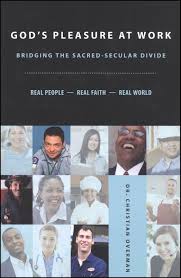
Want to know more? Intrigued to take this further with your kids and your own workplace perspectives? Grab empowering ideas from Christian’s book God’s Pleasure At Work: Bridging the Sacred-Secular Divide.

Order a copy at http://biblicalworldview.com/bookstore.html
God's Pleasure at Work


Raising Kids, Ready to Work!

worldviewmatters

Grimy gum on sticky tile floors. Scrape it off. Stacks of boxes in the stock room. Tear ‘em down. Sloshy, overflowing trash bags from the lunch counter-café. Haul those bad boys to the dumpster. Along the way, try my best to not break the slimy bags, spilling dead French fries and greasy liquids—thus making more work for myself. (I managed such an epic fail numerous times.)

These were my wondrous tasks at my first paycheck-producing job as a sixteen year-old. I was hired to work as an after-school stock boy by a grumbly Woolworth store manager named Mr. Akers. He never cracked a smile and refused to shake hands due to his Howie Mandel style aversion to germs. Honestly, to my youthful ego, this seemed like a less-than-ideal job. However, I felt confident, ready for the challenge, and eager to succeed in the workforce.

What’s it take these days to raise kids to be ready to engage in a lifetime of meaningful work? I recently had the privilege of doing a special interview with researcher, author, and a leading expert in perspective cultivation, Dr. Christian Overman. Enjoy gleaning from his rich insights!

Christian Overman

John: “The thick thread, Christian, of your research and writing addresses worldview. Why does a kid’s worldview matter? What’s the big deal? Why is it important for parents to pay attention to their children’s worldview?”

Christian: “A worldview is what a person believes to be true about God, about spiritual things, about how everything came into existence, about what makes humans unique, about what is right and wrong, and about what gives people purpose and meaning in living. Children who believe that no God exists, and therefore there is no Personal Being ‘above all’ who knows everything done in secret, will have less of a moral dilemma with stealing—if they think they can get away with it—and be more likely to cheat on a test at school. That’s just the tip of the iceberg. It is critically important to pay attention to a child’s worldview, because it is their worldview that will shape their personal values, and their values will shape their behavior.”

John: “That makes solid sense. Worldview shapes values, and then such values lead to long-term workplace behaviors. Also, a firm grasp of what gives us purpose and meaning obviously can have a huge impact on our attitude and actions in our daily work. OK, so if worldview is that important, how should parents do their work of deliberately forming kids’ all-important beliefs and values? What would you say are the top three or four best practices parents can/should utilize in order to be more intentional about shaping their kids’ worldview?”

Christian: “On the top of my list, #1 is building into children a view of the Bible as the fully-true and inspired Word of God. An acceptance of the unquestionable authority of Scripture is critical. Of course, the Bible isn’t always easy to understand. For that reason, I recommend #2: having regular conversations about Scripture at opportune times, particularly as it relates to the real-life experiences in the child’s life. Along with this goes #3, which I’ll call the “best practice” of all: parental modeling. Kids need to see their parents living out their own respect for God and His Word, especially in the “little things” of everyday life.”

John: “Big thanks, Christian. Most of us as parents don’t just naturally engage in such intentional conversations and modeling with our kids. You’ve shared empowering tips! We’ll continue this interview in next week’s post. Great thanks!”

Want to glean more from Dr. Overman? For greater detail and further insight on intentional cultivation of a God-honoring worldview in your own life and your kids’ perspectives, I highly recommend Christian’s book, God’s Pleasure at Work: Bridging the Sacred-Secular Divide.

God's Pleasure at Work

To learn more and order your own copy, visit: http://biblicalworldview.com/bookstore.html

Watch for Part 2 of this interview in our next blog-post!

Blessings in all your endeavors this week!

Baseball, Business and Best Practices

????????????????????????????????????????????????????????????????????????????????

I was throwing in the backyard with my eight-year-old one evening this spring, and I had a flash of insight. I’m playing the best baseball of my life. I’m on fire! OK, perhaps “on fire” is a slight exaggeration, but I realized that I’m seriously playing my strongest ball ever. And this is ironic, considering I am in my mid-40s. To what should I attribute this sudden surge in skill? What gives?

One word sums it up, plain and simple: Practice.

This is now my third season helping coach Josiah’s spring-summer team. Our record is 7 and 2. We are having fun, winning games, and deliberately putting in the serious practice time on the fundamentals. The team’s head coach, Chris, drills us in two-hour practices on Saturday mornings. We all groan, but deep down, we are discovering it is actually good for us. Even when it’s not an official practice, Jos’ and I are often throwing in the backyard, plus reviewing more complex skills. I suppose it should not surprise me that my own sense of advancement is increasing.

Here is a poignant reminder that we can sense similar advancements in our faith-at-work progress as we engage in implementation of intentional, deliberate best practices. For serious standout excellence, consistent repetition is key. Malcolm Gladwell champions this principle in his hallmark book Outliers: The Story of Success (Little, Brown and Company 2008). The concept rings true in musical performance, public speaking, sports, painting, programing, and virtually every pursuit of human flourishing. So of course, the impact of practice applies in big ways for business. Passionate commitment to regular, repetitious practice will hone leaders and their workplaces, bringing God greater glory. The Apostle Paul urges us, “Whatever you do, do your work heartily, as for the Lord . . .” (Colossians 3:23).

Michael Baer insists: “It matters how we operate our business. We are called to operate it with excellence, to use the best practices to create a great company . . . there is no Christian excuse for sloppy business habits.”[1] Such operational practices must involve thoughtful planning, an establishment of values, vision, and goals, the comprehensive design of strategic plans, and the intentional assembly of the business team.

What will you do personally this summer to pursue intentional, God-honoring practices at work? Consider revisiting your business’s core values and asking, “How are we actually acting on these?” Lead your team in a review of your primary tasks and query, “How can we serve our clients with even greater effectiveness?” Perhaps you should block out an hour alone, just to practice some fresh dreaming—pursue some God-like creativity!

James Davison Hunter winsomely declares, “In short, fidelity to the highest practices of vocation before God is consecrated and in itself transformational in its effects.”

So how are you, your team, and entire workplace being transformed through best practices? With some fresh commitment and intentionality, you can find yourself saying, I’m playing the best business of my life. I’m on fire—to the glory of God!


[1]Baer, Michael R. Business as Mission: The Power of Business in the Kingdom of God. Seattle, WA: YWAM Publishing, 2006, page 21.

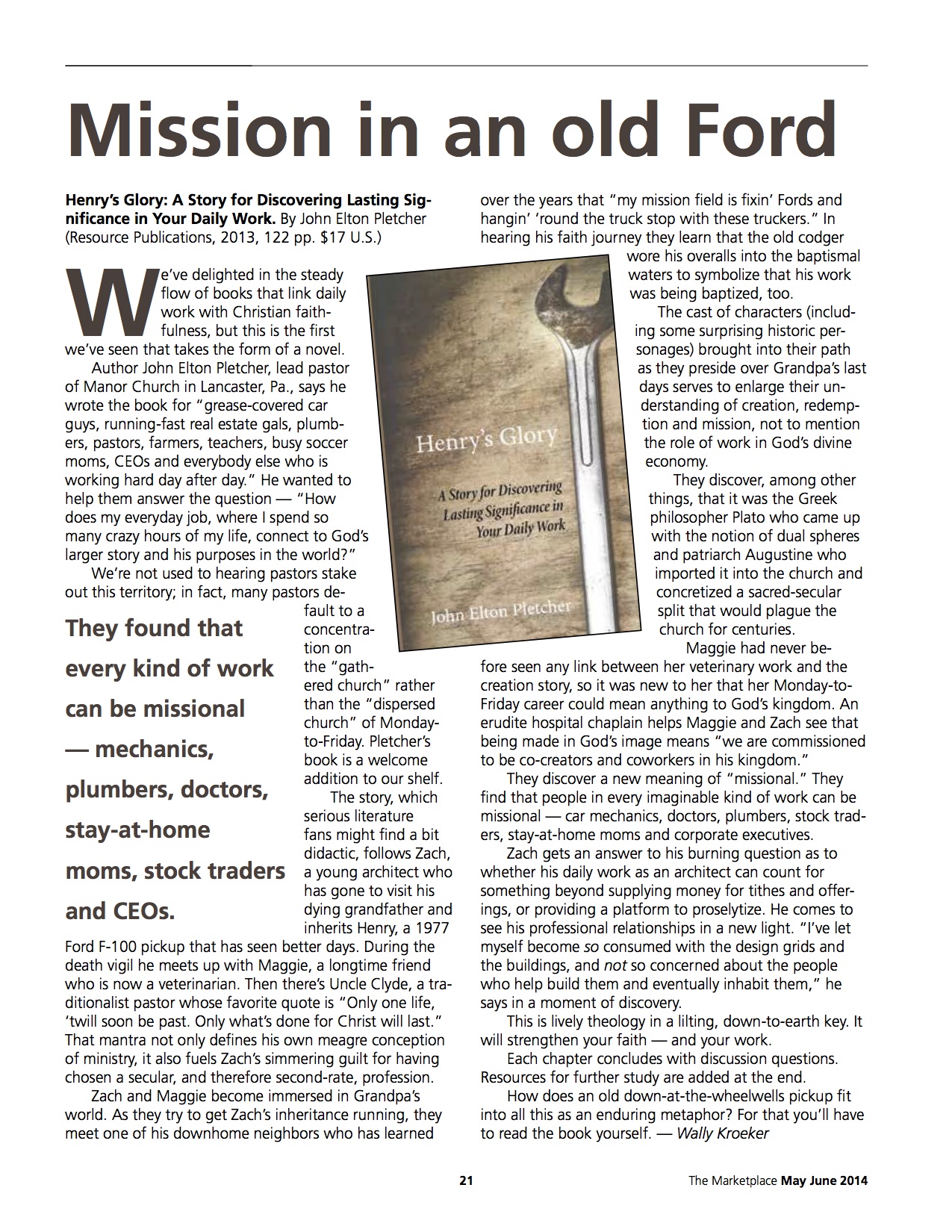
Mission in an old Ford

MKP May June 2014 21 lr copy 2

I’m jazzed, psyched, thrilled, and otherwise quite ecstatic!!

Have I perhaps understated my emotion? Henry’s Glory is reviewed in the current issue of The Marketplace magazine. In case you wondered, it’s a pretty big deal for a rookie author like me to have his book reviewed by an actual magazine—so I’m deeply honored and I’m shouting great big praise to God!

Here are two excerpts from Wally Kroeker’s review, and his full comments can be viewed at http://www.meda.org/the-marketplace-magazine. Click on the mag cover and access page 21. And of course, feel free to share this with friends.

Kroeker says:

“We’re not used to hearing pastors stake out this territory; in fact, many pastors default to a concentration on the ‘gathered church’ rather than the ‘dispersed church’ of Monday-to-Friday. Pletcher’s book is a welcome addition to our shelf.”

“This is a lively theology in a lilting, down-to-earth key. It will strengthen your faith—and your work.”

Thanks for checking out the review, for helping spread the word about Henry—and for joining me in thanks to God for such a positive review!

Blessings, joy, and fruitfulness in all your work this week!


Hard-Working Moms—There’s Hope!

???????????????????????????????????????????????????????????????????????????????

Fall of second grade, I proudly submitted a carefully crafted biography of my mom, composed on classic, dotted-line paper. This was a special writing project, to be displayed in our hallway for parent-teacher night. I waxed eloquent, reporting with the utmost, seven-year-old precision: “My mother does not work. She is a housewife.” Little did I know how clueless my statement was or how ridiculously male chauvinistic. Mom had to have felt like it was hopeless—all that time, her amazing nurture, and energetic hard work—what a waste. I must have seemed like a hopeless case.

Mom-hood reveals ever-deepening layers of hopelessness. After all, moms’ work is never done. School projects. Taxiing kids. Financial pressure. It all builds up and pushes down on a mother’s soul. Mom is expected to be the Chief Operating Officer of the family corporation. Along with endless tasks, moms are deeply concerned about their kids’ feelings and also each unique developmental stage. God wired moms with emotional and developmental radar, in great contrast to dads. Most guys are only slightly aware that there might be some small humans, under four feet tall, living in the house. Mix in all of a mom’s concern over her kids’ choices, friends, and future plans. Any cocktail of these ingredients yields high anxiety. Mom’s work can feel hopeless.

So what’s a mom to do? Where can moms find fresh doses of new hope in the midst of all they juggle at work? I’ll propose that several hope-filled insights emerge from a couple of women, undeniably two of the greatest moms in all of history.

BEST MOMS, EVER!

Luke’s Gospel records how Mary encountered the angel. She said “YES” to God’s plans, even though they were immensely challenging (Luke 2:38). It’s not everyday a young woman is told she will become pregnant by the Holy Spirit. There would be gossip and accusations. “Who can believe such a claim? It’s scandalous.” She was to become MOM to the Son of God! And she said, “I am your servant; May it be. . . .”

It seems that a YES to God is the essence of deep trust—genuine dependence—and the very core of faith for all of us. Will moms step boldly into what God wants? Will you listen and be receptive to God’s words, his instructions? Will you process life’s difficult assignments, hard tests, and rascally scenarios through God’s truth and his powerful presence?

Years ago, there was a mom named Susanna. She had a gaggle of ten kids with her husband, Sam. Sadly, their house caught fire and all but burned to the ground—not once, but twice. Her husband was devoted, both to God and to Susanna. However, Sam also had a very judgmental side, often expressing strong critique toward her and the children. He was also precarious with money, which made life extremely difficult for the family. Susanna constantly sought to cultivate Jesus’ values and heart, in all daily actions with her children. One of their girls, Hetty, a very bright but equally strong-willed young woman, kicked up her heals. She recklessly leaped into a brief fling with a young lawyer and got pregnant outside marriage. This caused great disgrace to the very proper and religious family. Dad disowned her, but Susanna persevered with motherly love for her wayward daughter, Hetty.

A Mom’s Integrated Prayer

This is actually a very old account, so you might benefit by hearing one of Susanna’s prayers. Each phrase reveals just how integrated she was about her daily work and how much she desired to incorporate Jesus’ heart into her own heart as well as her children.

“Help me, Lord, to remember that religion is not to be confined to the church, or closet, nor exercised only in prayer and meditation, but that everywhere I am in Thy presence. So may my every word and action have a moral content . . . May all the happenings of my life prove useful and beneficial to me. May all things instruct me and afford me an opportunity of exercising some virtue and daily learning and growing toward Thy likeness. . . . Amen.” (quoted in Richard J. Foster’s, Streams of Living Water, 237)

Susanna’s son, Jacky, became one of the foremost leaders, thinkers, and provocative communicators of his era. John, as he was widely known outside the family, left a massive footprint on the culture of his day. And Susanna’s son, Charles, is responsible for crafting amazing songs, many of which are still sung in churches today. The family name is Wesley. Their profound legacy in Christian thought and practice resulted from Susanna’s passionate aim to form Christ’s heart in all of her children.

Both Mary and Susanna’s examples point out this vital truth: Mom’s best hope is found in connecting her own heart—and her kids’ hearts—with Christ’s heart!

There was a fantastic outcome for Mary’s work, even after comically losing Jesus in Jerusalem for three days. (How do you lose the Son of God?) Luke 2:51-52 notes the holistic development. Jesus grew in wisdom, in physical height, and in favor with both God and other humans. When moms access Jesus’ heart and choose to say YES, then kids grow strong and experience whole-person development—mentally, physically, spiritually, and socially.

Don’t miss it, moms. Your kids can grow up to make HUGE impact, to touch lives and become big workers in God’s kingdom business. You might say, “My kid will never be a Wesley. And he or she certainly won’t be Jesus.” OK, but you can raise kids who grow up to work hard daily, build the next bright future, fight disease, solve hunger crises, create noble cultural endeavors, plant churches, and in a myriad of other ways, share Christ with a world in desperate need of Jesus’ grace.

Moms, we thank you. Realize it or not, your work is full of hope!


Resurrection @ Work—the Surprising Significance

?????????????????????????????????????????????????????????????????????????????

I bet you wonder. Whether you wait tables each day, help patients at the hospital, fix cars, or juggle kids plus your in-home office—whatever you do—I bet you wonder. Does anything I do in my daily work have lasting, eternal significance? The answer to this question is surprisingly, inextricably linked to Jesus’ bodily resurrection.

People readily anticipate that Michelangelo’s marvelous Sistine ceiling might last into Christ’s final kingdom. I was first introduced to the concept of future redemption for creative works in my fine arts course in college. I shrugged. I am no Michelangelo. In recent years, more scholars have posited that redemption’s reach might not be exclusively for the artists. What if your own daily work could have lasting significance, even a literal lasting, based on Creation’s “groaning for glory” and the cosmic redemption foretold in God’s grand story (Romans 8)?

Revelation 21-22 paints amazing frescoes of the eternal kingdom. Sin, death, pain, disease, tears, and all that perpetuated the curse are wiped away so all things become new. The thorns and thistles, germs and disease, ravages of war and violence, less-than-stellar work outcomes, what was done for selfish, greedy, and idolatrous reasons instead of aiming to bring him glory—all of it will be wiped clean, making way for the transformed, new creation. The prophetic prequel in Isaiah 65:17-25 also speaks of very tangible, ongoing work. Houses will be built; vineyards will flourish; financial portfolios will show great gains. There will be very earthy, ordinary stuff in this new, eternal kingdom.

Resurrection’s Long-term Significance for Your Work

You’re probably still wondering: Really? And what in the world does this have to do with the Resurrection? Consider this: Jesus’ resurrection presents a foretaste, a sneak peek at what is yet to come. After Christ was raised, he had a glorified body—a fully redeemed physical body. Scenes from Luke’s account note that it was still very tangible. His followers recognized him; he ate broiled fish; he showed scars; he could be touched; he worked to teach and enlighten, producing changed insight in others; he built a fire and cooked breakfast on the beach (John 21)—all very typical, earthy expressions. In 1 Corinthians 15, Paul argues that Christ is the first in the lineup of resurrection and redemption, and we will someday follow in that same train of redemptive resurrection. Our bodies will be raised up and redeemed.

So, a number of heavy-hitter scholars have said, “If we will have glorified bodies, AND if all of Creation will be redeemed as Paul declares in Romans 8 (after so long groaning for glory), doesn’t it make sense this must include certain outcomes of our work?” Perhaps this is why Paul concludes 1 Corinthians 15 with this passionate injunction: “Always work enthusiastically for the Lord, for you know that nothing you do for the Lord is ever useless.” (Explore further insights in Darrell Cosden’s, The Heavenly Good of Earthly Work, Paternoster Press, 2006.)

So What If?

People have postulated that musical scores such as Handel’s Messiah, hymns like Amazing Grace, and some colossal architecture that stands the test of time—like the Winchester Cathedral—might pass through the cleansing fire (2 Peter 3) and thus hold redeemed significance, to the glory of God.

But WHAT IF the house you constructed with solid craftsmanship, or the real estate deal you worked with amazing care and energy—to serve both God and that family that needed to move into a safer home—what if the tangible results of those labors might also last, to be marvelously redeemed? Or what about the financial planning Dale has helped our family do for the past twenty years? Or what if the life-skills counsel you supplied for that troubled teen finally came to beautiful fruition in her life, OR what if . . .

Some of you are saying, “Wow, that’s out there. I don’t know, Pletch.” OK, I invite you to simply contemplate and dare to ask, what if Creation’s redemption might truly reach that far? Remember that God’s kingdom work is humongous, and I can’t help but imagine that he has some amazing surprises in store for us. New heavens and earth, complete with the Garden-City, appear to have dimensions that already exceed our normal comprehension of distance and capacity (Revelation 21-22). What if the eventual kingdom is actually more down-to-earth than our all-too-common, Star Wars-like fantasies, where everyone is dressed in white, zooming around in heavenly outer space? What if it includes more lasting, physical work outcomes than we have ever imagined?

Perhaps as we contemplate, we can gain perspective by reflecting and joining Moses’ heart cry:

Let your work be shown to your servants, and your glorious power to their children. Let the favor of the Lord our God be upon us, and establish the work of our hands upon us; yes, establish the work of our hands!

Psalm 90:16-17 (ESV)

Lenten Work

??????????????????????????????????????????????????????????????????????????????????????????????????????????????????????

“I’m giving up chocolate!”

“No coffee for me for the next forty days!” (I’m shaking at the very thought of such asceticism, and so are my coworkers who fear the agony of being around me when I lack sufficient caffeine. Bring me the bed of nails or hot coals to walk on before you mess with my java.)

 “This year, I’m keeping my wine and chocolate, but giving up all social media. Goodbye, Facebook friends! See you after Easter.”

“No thick, juicy steaks on my plate for six weeks.”

With the start of Lent this year, I have heard such predictable declarations of devotion and also a number of unique, extra-creative statements of intentionality. I must confess that my own spiritual heritage did not include practicing Lent or Ash Wednesday. My religious tutelage also held no celebration of Fasnacht Day. Now, I must shout “Yea!” for the donuts’ great holiday. I have come to highly revere the sweet holiness of this fine tradition, especially when accompanied by a latte. Seriously, in recent years, my own appreciation for the potential benefits of Lenten observance has increased as I have witnessed people’s personal denial of self-consumption. I have seen meaningful, challenging levels of personal progress through such deliberate actions.

This year though, I cannot help but wonder, “What might it look like to dig several feet deeper, to apply Lenten disciplines in the workplace?”

Instead of giving up something that represents primarily a sensory, consumer appetite, what if my zone of self-denial dared to include a core choice of the soul? How about contemplating what might be one or more of my deep-down personal ruts, a deficiency in my character relating with my coworkers, or even some often overlooked, warped, or misguided workplace values?

What about giving up water-cooler gossip and competitive character assassination?

Could I dare to begin each of the next forty days by prayerfully laying down my arrogance?

How might your productivity increase if you gave up your patterns of procrastination, to passionately attack your to-do list—especially your most dreaded tasks—even daring to do the worst first?

What healthier habits might take root in your heart if you laid aside the workplace lust you’ve flirted with way too frequently in recent months?

Might I sense a deeper connectedness with Christ, with family, and friends, if I choose to give up workaholic tendencies, to practice the sacred rhythms of Sabbath?

R. Paul Stevens and Alvin Ung supply a convicting list of nine workplace struggles, dubbing them “deadly work sins.” Pride. Greed. Lust. Gluttony. Anger. Sloth. Envy. Restlessness. Boredom. Their powerfully persuasive call to surrender these vices takes the conversation beyond the predictable “stop that” or “cut it out!” Ung and Stevens winsomely analyze the fresh fruit of the Spirit as life-giving antidotes. Joy. Goodness. Love. Self-control. Gentleness. Faithfulness. Kindness. Patience. Peace.[1]

One of my friends reminded me yesterday that as we enter Lent, a truly Christ-focused approach should be something vibrantly different than gloomy, grey, boring, and dismal—an outlook consumed with only short-term self-denial. Instead, Lent actually comes to us like the beautiful harbinger of springtime—potentially leading us toward brighter outcomes—resulting in a more Spirit-led life. Who knows? Perhaps such enriched Lenten practices in the workplace might stretch beyond forty days, changing us at the core of who we are, transforming how we work, and even multiplying our Christ-like impact on others.

Let’s dare to embrace Lent in our workplaces this year, in a fashion that addresses those much-needed places in our souls. I sense that will be far more wonderful, life giving, and joy-producing than my giving up coffee—both for me as well as all my coworkers.


[1]R. Paul Stevens and Alvin Ung. Taking Your Soul to Work: Overcoming the Nine Deadly Sins of the Workplace. (Eerdmans, 2010).