
Gratitude Pie @ Work

??????????????????????????????????????????????????????????????????????????????????????????????????????????????????

Just say “thanksgiving.” What’s your knee-jerk picture? Perhaps you envision a turkey or maybe family gathered around the table. For me, it’s PIE! Several of my most precious holiday memories include Grandma’s oh-so-creative concoctions. She would work relentlessly for two days prior to the great feast, hand-rolling crusts and baking a scrumptious assortment of pies. Classic pumpkin, deep-dish apple, dark chocolate pudding, and the delectable pecan. The lineup was placed atop the garage chest freezer, remaining nicely chilled in the crisp November air.

Two legendary family members had a special way of expressing their gratitude for Grandma’s hard work in the kitchen. Following our family’s indulgent dining on the grand bird and sundry side dishes ‘round the oak table, Uncle Bob and Uncle Buzz would each pick a pie from the garage freezer top. Yes, each of them, a WHOLE pie. With great care, they would lavishly layer their selection with whipped topping. Once the white fluff was complete, my uncles would give Grandma a grateful kiss, exit the kitchen, and promptly plunk down in a living room recliner. With fork and whole pie in hand, Uncle Buzz and Uncle Bob would watch football and devour an entire pie. To this day, I have no clue how they stuffed it in. For a young boy like me, this was indeed an impressive scene to behold. Gram would chuckle and beam from ear to ear with her own grateful grin. She reveled in their gratitude. With amazement, I aspired to such capacity in consumption. Alas, to this day, I am lucky if I can down two pieces of pie across Thanksgiving Day. My uncles still hold the family record!

How might our daily work evoke greater gratitude? Chesterton said, “When it comes to life the critical thing is whether you take things for granted or take them with gratitude.”

Psalm 145:10-11 declares: All of your works will thank you, Lord, and your faithful followers will praise you. They will speak of the glory of your kingdom; they will give examples of your power.

I am struck by this reality. Both God’s works—what he has created and what he is accomplishing—and his faithful people are capable of expressing praise and thanks. Both the outcomes of God’s intentional efforts as well as the people who serve him—BOTH have the capacity to bring him gratitude and make him famous. In fact, such spotlighting of God’s impressive kingdom work has distinct missional results. Psalm 145:12 says, “So that all people may know of your mighty acts . . .” And verse 21 echoes similar motivation behind such thanks and praise: May everyone on earth bless his holy name forever and ever.” More people in more places recognize and experience his glorious kingdom through such gratitude!

?????????????????????????????????????????????????????????????????????????????????????????????????????????????????????????????????????

I put out the challenge to our gathering of friends this past Sunday to “come ready to share next Sunday” where they see God at work in their workplaces, their families, their neighborhoods, and across all of their lives. We’re planning for open microphones in our Sunday services so people can share a feast of thanks together! As I am preparing my own heart, I’ve come up with my starter list, where I see God at work. These include: My amazing family, Nancy and our boys, as well as my incredible mother! I am also grateful to God for a tremendous church family, Manor Church, and the privilege I have to serve with a fabulous team of leaders. I am oh-so grateful for God’s provision of “daily bread”—the stuff of physical food, creative clothing, running vehicles, and a fine roof over our heads. I’m also grateful for some serious “whipped cream” in my life that added to the pie this year. Over the top stuff has included extra-gracious opportunities like Henry’s Glory being published and read by people. What a joy to see how God is working to change my life and others’ lives. I give him great praise!

How about giving thanks for the way Christ works through the tough stuff? Along with you, I’ve had my share of disappointments, heartaches, and stresses this year. Eugene Peterson says, “God works patiently and deeply, but often in hidden ways in the mess of our humanity and history.” In that light, we must certainly thank him for the messy stuff as well. Even there, Christ is working!

How about you? What’s your “gratitude pie” taste like?



Workplace Sex Trysts: A Strategy for Standing Strong

?????????????????????????????????????????

Diet Coke, circa mid-90’s, flaunted one very steamy TV ad. An office full of women suddenly begin whispering to each other, “It’s 11:30.” As the commercial commences, they scurry to the office windows to ogle. A male construction worker on ground level removes his sweat-soaked shirt and begins lusciously drinking a Diet Coke. Apparently, this has become a daily workplace ritual for these women. Though lusting should never be a laughing matter, the commercial’s format draws a chuckle twenty years later. The gawking women wear big-framed 80’s eye-wear and oh-so-poofy hair; the bare-chested eye candy is sporting a far-from-chiseled four-pack. And in retrospect, what real man sips Diet Coke anyway?

Workplace temptation runs rampant. Place people together for extended blocks of time, working close on endeavors of big consequence, and the affection temperature is bound to rise. Glances are exchanged and soon feelings are shared; flirtation seems innocent, but sparks begin to fly. Then all too quickly, something hotter kindles. So how can we develop a strategy for sexual integrity in our workplaces, a wholesomeness that matches Christ’s heart for business leaders and workers in every profession?

The young biblical hunk, Joseph, stands as a stunning example in overcoming workplace temptation. Genesis 39 records the racy scene. Promoted to second in command over a large estate in Egypt, Joseph soon caught the wandering eye of the owner’s wife. Mrs. Potiphar repeatedly made her temptress moves, “day after day,” the story records. Joseph repeatedly resisted, finally stating emphatically that such indulgence would be a serious violation of his relationship with God (Gen. 39:9). This young man’s conviction and stance, so far away from his father Jacob’s oversight, was astounding. Finally, Joseph employed the best strategy ever. In a moment of brilliant insight, he did the most courageous thing. He ran away! (explore more on such a strategy in 1 Corinthians 6:17-20) His reward? He was quickly framed by the scorned, pouting, plotting temptress. (I know, shocker!) And he was promptly tossed in the deep, dank confines of prison. (See the rest of the story in Genesis 40 through 50.) Tom Nelson elaborates: “When it comes to sexual temptation in the workplace, we don’t have to go out of our way to look for it; it often finds us. Joseph’s wise response to sexual temptation in the workplace is a model for us to emulate. Joseph didn’t cozy up to sexual temptation, he fled from it.”[1]

?????????????????????????????????????????????????????????????????????????????????????????????????????????

What’s the big deal? Our core struggle with lust is that we imagine how people can be used for our self-serving interests instead of genuinely loved. God’s style of selfless love aims at practically caring for others’ best interests, not using or abusing them. How do we develop a strategy, to stand strong against workplace temptation, or as in Joseph’s case, to decisively run away? In Taking Your Soul to Work, R. Paul Stevens and Alvin Ung urge these five strategy steps:

(1) Know that your heart’s desires are for God. Hunger and passion for God put all lesser desires into perspective. (2) Reduce exposure to erotic stimulation in your choice of movies, novels, and Internet sites. Put a plan in place that will help you avoid temptation on business trips. (3) Pray for a colleague, a customer, or a supervisor whom you find attractive. Choose God’s perspective on the person instead of treating her/him as “just a body” to be visually consumed. (4) Seek accountability partners. (5) Identify the early beginnings of lustful thoughts. Heightened vigilance in advance allows you to be more responsive to the Spirit’s guidance.[2]

Instead of being trapped in daily rituals of workplace lust and other sexual sins, we can stand strong. We can run away, stay pure, and truly honor Christ. We can honor others with more wholesome love at work.

[1]Tom Nelson. Work Matters: Connecting Sunday Worship to Monday Work. (Wheaton: Crossway, 2011), 173.

[2]R. Paul Stevens and Alvin Ung. Taking Your Soul to Work: Overcoming the Nine Deadly Sins of the Workplace. (Grand Rapids: Wm. B. Eerdmans Publishing, 2010), 26-31.

4 Reasons You Can Whistle @ Work

?????????????????????????????????????????????????????????????????????????????

I could not help but chuckle. My morning walk on the golf course cart path was proving to be gorgeous. Leaves revealed a hint of fallish tint. The mid-September sky was bright, and the air was crisp. Amid the rustling treetops, birds were chirping, but I was suddenly struck by another high tone, piercing the soundscape. Overtop the birdsong and gentle hum of a green machine at work, there danced a stunning, pronounced melody. The tune was distinct, recognizably classic in cadence, echoing off the arcade of trees and turf. I scanned in all directions, eventually to discover that the beautiful whistling was coming from the lips of the hard-working grounds keeper. It was a stunning, spot-on-pitch performance—and he was oblivious to having an audience. ‘Top of his lungs, he kept whistling, and I laughed aloud.

Immediately struck with amazement and query, I thought, “It’s very early morning; his work is tedious, mundane, for sure. It’s repetitive and ridiculously thankless for that matter.” Confession: I’ve never gone back to the clubhouse after a round of golf to deliberately compliment, tip, or otherwise praise the grounds crew. But here’s this early morning laborer, whistling as he works, with volume level at Max 10.

So what gives? ‘Something special in his 5 a.m. java? How can the rest of us find healthier joy in our daily work, whatever we do? Based on God’s view of work, I’ll suggest four reasons we can whistle in our work this week.

YOUR WORK TODAY MAKES GOD SMILE.

God originally made us in his image—his very likeness as creative coworkers—and he called us to work. In Genesis 2:15, we discover that a great big part of this imago Dei and our original call was for humans to work the garden. The Hebrew word for work carries the ideas of labor, service, and worship. Originally, this was all good, all positive. Yes, Genesis 3 records the curse in response to the Fall, but work was originally a part of God’s very good plans for humans. In response to the Curse’s ugly consequences, God’s story unfolds redemptive plans to renew all of creation, including work and its creative outcome (Rom. 8).[1] When we work, God smiles.

YOUR WORK TODAY IS THE OVERFLOW OF GRACE.

Our everyday work is part of our living out God’s saving grace. He planned for it! Ephesians 2:8-10 reminds us that we are saved by grace through faith; it’s not of our own good works. Yet, we discover with verse 10 that the overflow of God’s creativity, his remaking us, is that we now ACTIVELY live out creative good works. Faith is indeed about DOING something. He planned in advance for us to accomplish good works.

WHATEVER IT IS—YOUR WORK CAN SERVE CHRIST AND MAKE HIM FAMOUS!

For your own deeper inspiration and recalibration of perspective, explore these verses. Soak up fresh motivation for the soul of your work. See 1 Cor. 10:31 and Colossians 3:23-24.

YOUR WORK MATCHES JESUS’ HEART, ACTIONS, AND MISSION.

Jesus’ own example and his kingdom teachings are full of business and workplace implications. Mark 6:3 tells us that Jesus was a tekton, one who works with his hands. We often forget that Jesus was a carpenter and/or sculptor many more years than he was the traveling rabbi and miracle-worker. As a result, Jesus knew business and marketplace workers. Perhaps this sheds some light on why the majority of his parables are infused with business context and kingdom principles related to everyday work scenarios. Tom Nelson reminds us:

“Working with his hands day in and day out in a carpentry shop was not below Jesus. Jesus did not see his carpentry work as mundane or meaningless, for it was the work his Father had called him to do. I have a good hunch that Jesus was a top-notch carpenter and did top-notch work . . . I am sure there were many things that made the Father well pleased, but one important aspect of Jesus’ well-pleasing life that we must not overlook was his well-pleasing work as a carpenter.”[2]

So, as the golf course greens keeper continued whistling, I found myself grinning and saying, “Sign me up! I want what he’s having!” God’s smile, great big grace, his glory, and Jesus’ own work—four reasons you can rejoice with God in your work today. Let’s get whistling!

??????????????????????????????????????????????????????????????????????????????????????????????????????


[1]Darrell Cosden, The Heavenly Good of Earthly Work. (United Kingdom: Paternoster Press, 2006), 86-91.

[2]Tom Nelson, Work Matters: Connecting Sunday Worship to Monday Work. (Wheaton: Crossway, 2011), 90.

Work’s Agony and Ecstasy—Remembering Robin Williams

??????????????????????????????????????????????????????????????????????????????????????????

“Nano nano.” As a fourth grader, I tried to spread my fingers just like Mork from Ork in order to bid adieu to friends at school. (my right hand, no problem; left hand, I still can’t do it.)

We are awash in a sea of emotions at the stunning news of Williams’ suicide. Like so many funny men, the work of his early years was hysterical and at points raucously crude—symptomatic no doubt of youthful immaturity. As his body of work grew, so did his sophistication, choosiness of roles, and thoughtfulness of his characters. Still always treating us to jovial faces and good-like-medicine laughter, his work became more and more purposeful. Complexity of characters and message are profound in Patch Adams and Dead Poets Society. “O Captain, my Captain!” “Carpe diem! Seize the day, boys.”

So we longingly ask, what goes wrong? How does such a hilarious guy of stardom fall so far emotionally that he chooses to exit? The forensics and toxicology are still being completed. It is well documented that he battled both depression and addiction. Friends have been interviewed, and they confirm that he was struggling, albeit with a seemingly strong support system enfolding him.

None of us, especially those of us with deeply religio-spiritual backgrounds, should rush to hand out diagnoses and snap judgments. Let’s not forget, it was not long ago that Rick Warren’s family faced the tragic loss of their son. Let’s not forget, so many of our extended families have experienced first-hand the ravages of mental illness and suicide—including my own cousin just a few years back.

What can we say? Because God designed us for integrated living, we must resist the urge to compartmentalize, thinking that our mental-emotional health is incidental, a sidebar. If you are struggling with depression and addiction, reach out for hope and help, both to Christ through spiritual mentors and to health professionals—please do it NOW!

What else can we say? Because God wants us to work as his coworkers, in his image (Genesis 1:26-28), we need to balance life better. Work hard, yes, but resist defining our own identities solely on our work success. Here’s where our faith, a deeper trust, has to intersect with our creative good works, pre-ordained by our Maker (Saint Paul, Ephesians 2:8-10). Will we trust him? Don’t let your own identity become so wrapped up with your work outcomes that you descend into the abyss, especially in those seasons when your work is not producing a remarkably fruitful crop. You are so much more than the sum total of your portfolio!

I recently read Irving Stone’s classic biographical novel of Michelangelo.[1] We readily applaud the sculptor-painter’s amazing achievements, but we often fail to recognize the deep agony, work frustration, and overall despondency he faced with each artistic endeavor.

What hope can we find in our own dark moments, when work is less than stellar, when life seems to rot, and we hear those voices from the shadows? Let’s be real real. Most of us are moved by Robin’s tragic story because the psychological tremors hit too close to home, echoing into the depth of our own souls, homes, and workplaces. We all have our own moments and voices that whisper diabolical thoughts in the face of our agony.

Courageously recall, there is indeed an unseen battle. Some will accuse me of over-simplifying, but we dare not miss the essential power of prayer in putting on God’s protective armor (Saint Paul, Ephesians 6:10-20). The biblical leader of workers, master wall builder, Nehemiah, handled his own opposition from critics, the taunting voices, would-be distractions, and impending despair. He replied, “I am doing a great work, so I cannot come down . . .” And then he passionately prayed, “Strengthen my hands.” (Nehemiah 6)

C. Neal Johnson, calling for vigilance in spiritual warfare related to our work-a-day business, asserts:

“There is also a form of prayer called inner healing prayer (IHP). It is an approach to prayer in which an individual can identify and resolve deep-seated emotional issues that have plagued his or her attempts at healthy living . . . Both research data and anecdotal testimonies evidence significant long-term, deep, inner healing as a result . . . Training in how to conduct IHP is highly recommended in order to be effective and to avoid unscriptural activities.”[2]

Let us pray fervently for the Williams’ family and close friends, for peace and strength, hope and comfort. Let us pray for one another, for deep healing in our daily work’s agony and ecstasy.

And by all means, Carpe diem. With Christ’s strength and for his glory, let us make our lives extraordinary!

????????????????????????????????????????????????????????????????????????????????????????

[1]Irving Stone, The Agony and the Ecstasy: A Biographical Novel of Michelangelo. (Doubleday and Company, 1961).

[2]C. Neal Johnson, Business As Mission: A Comprehensive Guide to Theory and Practice. (IVP, 2009), 450-51.

Weed-Pulling @ Work

???????????????????????????????????????????????????????????????????????????????????????????????????????????????????

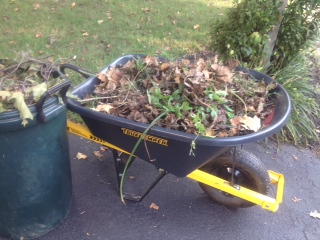
Mid-summer flowerbeds can be monstrously frightening. A few weeks back, dark mulch was rich and thick. Edges were crisp, and all was clean. That was late May. A mere six weeks later, ugly invaders have crept in. Early-fallen leaves, scorched by summer sun. Twisted twigs, dropped by thunderous episodes of the night. Scariest of all, prickly weeds, stray vines, and rogue tree-upstarts have taken over. What was previously pristine now appears dastardly devilish. However, last Friday morning, I overcame those foolish fears (including my sluggard tendencies). I mustered enough courage to machete my way into the sprawling plots to take on the insidious, wicked weeds. And I was triumphant! Now, the enemies have been vanquished; the beds have been beautified once again. Eden is restored (at least for this week).

I am struck with the primal necessity of tackling weeds. We were originally assigned the good work of the garden (Genesis 2:15), but such garden-work—all work for that matter—was cursed following the humans’ attempted coup d’état (Genesis 3). Thorns and thistles now spring up, yes literally—yet we dare not miss the metaphor such enemy invaders supply. The weeds and “sweat of the brow” take over what had previously been an uber-productive, marvelously creative, unencumbered workplace. All garden work—every workplace endeavor—is now a place characterized by more difficult, challenging, and even too often treacherous toil.

But greater news springs up! Because Christ’s redemption is far-reaching and will eventually transform Creation altogether (Romans 8:18-25), there is this important kingdom-work of weed-pulling. God’s grand story reveals the already-not-yet nature of Christ’s kingdom.[1] With Christ’s first coming and the inauguration of his kingdom, sin’s curse is indeed broken—AND then, there’s more to come! In all such interplay, we live with longing anticipation of all Christ will eventually fulfill, AND for now we work/serve by grace to impact all the God-glorifying, kingdom-advancement we can (Ephesians 2:10). In the here and now, we boldly work to pull weeds and make room for more creative, glorious beauty to spring up.

Wheel barrow of weeds

With such realization, there are numerous areas of daily work that might be labeled “pulling weeds.” Andy Crouch insists that “creation begins with cultivation—taking care of the good things that culture has already handed on to us.” Crouch asserts, “Cultivating also requires weeding—sorting out what does and does not belong, what will bear fruit and what will choke it out.”[2]

Allow me to suggest a poignant, mid-summer discipline for cultivating the soul and action of your daily work. Ask yourself two questions and make two answer lists.

First, what do I need to weed out of my own life and leadership habits, in order to make room for the greater work of God in me and through me? (Don’t skip this painful but highly important, personal cultivation step.) What needs yanked from your life to make room for fresh growth?

Second, what can and should be weeded from our workplace, business, or organization to make room for greater creativity and productivity? Two corollary, sub-questions: What should we stop doing in order to do the main thing of our mission more effectively? And what hard decision or proposed changes have we been putting off, but NOW is the time!?

Brilliant life-strategist Henry Cloud calls this pulling the tooth.[3] Too many of us put up with a nagging toothache for too long. Henry winsomely implores us to take action, now rather than later. Make the dentist appointment. Sit in the chair and get it pulled. Makes perfect sense for your mouth, so why not in your life and leadership at work?

Muster the courage to take action on attitudes, habits, negative people, and unfruitful team practices that really need to go. Pull the weeds, make room, and experience the joy of greater growth in your own life and your workplace this summer!

Mid-summer flower bed1


[1]Ben Witherington III supplies engaging discussion of such in his thoughtful work, Imminent Domain: The Story of the Kingdom of God and Its Celebration.

[2]Andy Crouch, Culture Making: Recovering Our Creative Calling. (IVP, 2008), 74-75.

[3]Henry Cloud, 9 Things You Simply Must Do to Succeed in Love and Life. (Integrity Publishers, Nashville), 43-67.

Raising Next Generation Workers

???????????????????????????????????????????????????????????????????

Our house was invaded last evening! My son, Jarod, turned sixteen this weekend, so a gaggle of his marching band cronies arrived for his party. There was uproarious laughter, scrumptious food, and spontaneous singing. Of course, this momentous event triggers additional milestones. In the next few days, he will go test for his driver’s permit. (Watch out. Consider yourself warned—go buy a helmet!) I am thrilled that in a couple weeks he will begin his first real, paying, part-time job at a local business. Yes, in case you cannot sense it, here is one “proud papa.” (Deep down, I’m even more thrilled that I might actually keep a little more cash in my pocket.)

In our previous post, I introduced the issue: How can parents ready a next generation of workers? How can we know with confidence that our kids are growing up truly ready to engage in a lifetime of God-honoring endeavors in all they do?

We are joined again by Dr. Christian Overman, the Director of Worldview Matters. http://www.biblicalworldview.com.

John: “Christian, in our first round, you shared the importance of a biblical worldview—gaining an accurate view of God, one’s life purpose, pursuits in the world—including one’s personal perspective on work. So I’m wondering, what seem to be the biggest present-day roadblocks to a healthy, God-pleasing worldview being cultivated in the next generation? Where do you see these blocks showing up and why?”

Christian: “The biggest challenge, as I see it, is that kids today live in a secularized society, and parents do little to counter this. Kids hear and see messages throughout the day that never make reference to God, or His Word. Not in math class at school, not in TV programs at home, and not in public shopping malls. This has the effect of convincing kids that ‘God things’ are ‘Sunday things,’ and reinforces the ‘Sacred-Secular Divide’ which keeps Christians thinking that some times are ‘God times’ such as times of personal devotion, church services, or saying grace at dinner, and everything else is ‘something other.’ But in reality, the biblical worldview makes no provision for ‘something other.’ The earth and all it contains is God’s. Jesus is Lord of all. Therefore, washing dishes is a ‘God time,’ mowing the lawn is a ‘God time,’ and doing homework is a ‘God time.’

John: “Wow! Perhaps I should try that as a motivator for getting my kids to actually DO their homework. Ha! Seriously though, it strikes me that getting over that barrier, this ‘great divide,’ is a humongous key to reshaping our framework and helping a next generation realize that they truly can be doing all for the glory of God (1 Cor. 10:31).

So one more question. Please share what you deem the ‘basic essentials’ parents need to emphasize for raising kids who are ready to work for God’s glory. What do you believe a parent needs to most cultivate in order to get a kid ready for a life of God-pleasing work?”

Christian: “Parents can emphasize that any kind of work that does not violate God’s will is work worth doing, has great value, and qualifies as ‘God’s work,’ whether it is done for pay or not. We don’t find meaning in our work. We bring meaning to our work. Parents can teach their kids to bring meaning to their daily work by doing it ‘heartily as unto the Lord.’ Work, at its best, is a practical way of loving God and loving people. The sooner kids view it this way, the better. We were created to work. That’s what God had in mind for us when He said, ‘Let us make man, and let them rule…over all the earth.’ This earth-ruling role requires all sorts of work, from farming to building airplanes. It is all a sacred task. We don’t have to be a pastor or a missionary to do ‘the work of God’ in the earth. Helping kids to ‘get’ this concept helps us all.”

John: “Those are profound essentials we need to make sure we are passing along if we want to effectively prepare the next generation for leading, creating, managing, and otherwise working on God’s earth. Great big thanks, Christian, for sharing with us in these posts!”

Want to know more? Intrigued to take this further with your kids and your own workplace perspectives? Grab empowering ideas from Christian’s book God’s Pleasure At Work: Bridging the Sacred-Secular Divide.

Order a copy at http://biblicalworldview.com/bookstore.html

God's Pleasure at Work


Raising Kids, Ready to Work!

worldviewmatters

Grimy gum on sticky tile floors. Scrape it off. Stacks of boxes in the stock room. Tear ‘em down. Sloshy, overflowing trash bags from the lunch counter-café. Haul those bad boys to the dumpster. Along the way, try my best to not break the slimy bags, spilling dead French fries and greasy liquids—thus making more work for myself. (I managed such an epic fail numerous times.)

These were my wondrous tasks at my first paycheck-producing job as a sixteen year-old. I was hired to work as an after-school stock boy by a grumbly Woolworth store manager named Mr. Akers. He never cracked a smile and refused to shake hands due to his Howie Mandel style aversion to germs. Honestly, to my youthful ego, this seemed like a less-than-ideal job. However, I felt confident, ready for the challenge, and eager to succeed in the workforce.

What’s it take these days to raise kids to be ready to engage in a lifetime of meaningful work? I recently had the privilege of doing a special interview with researcher, author, and a leading expert in perspective cultivation, Dr. Christian Overman. Enjoy gleaning from his rich insights!

Christian Overman

John: “The thick thread, Christian, of your research and writing addresses worldview. Why does a kid’s worldview matter? What’s the big deal? Why is it important for parents to pay attention to their children’s worldview?”

Christian: “A worldview is what a person believes to be true about God, about spiritual things, about how everything came into existence, about what makes humans unique, about what is right and wrong, and about what gives people purpose and meaning in living. Children who believe that no God exists, and therefore there is no Personal Being ‘above all’ who knows everything done in secret, will have less of a moral dilemma with stealing—if they think they can get away with it—and be more likely to cheat on a test at school. That’s just the tip of the iceberg. It is critically important to pay attention to a child’s worldview, because it is their worldview that will shape their personal values, and their values will shape their behavior.”

John: “That makes solid sense. Worldview shapes values, and then such values lead to long-term workplace behaviors. Also, a firm grasp of what gives us purpose and meaning obviously can have a huge impact on our attitude and actions in our daily work. OK, so if worldview is that important, how should parents do their work of deliberately forming kids’ all-important beliefs and values? What would you say are the top three or four best practices parents can/should utilize in order to be more intentional about shaping their kids’ worldview?”

Christian: “On the top of my list, #1 is building into children a view of the Bible as the fully-true and inspired Word of God. An acceptance of the unquestionable authority of Scripture is critical. Of course, the Bible isn’t always easy to understand. For that reason, I recommend #2: having regular conversations about Scripture at opportune times, particularly as it relates to the real-life experiences in the child’s life. Along with this goes #3, which I’ll call the “best practice” of all: parental modeling. Kids need to see their parents living out their own respect for God and His Word, especially in the “little things” of everyday life.”

John: “Big thanks, Christian. Most of us as parents don’t just naturally engage in such intentional conversations and modeling with our kids. You’ve shared empowering tips! We’ll continue this interview in next week’s post. Great thanks!”

Want to glean more from Dr. Overman? For greater detail and further insight on intentional cultivation of a God-honoring worldview in your own life and your kids’ perspectives, I highly recommend Christian’s book, God’s Pleasure at Work: Bridging the Sacred-Secular Divide.

God's Pleasure at Work

To learn more and order your own copy, visit: http://biblicalworldview.com/bookstore.html

Watch for Part 2 of this interview in our next blog-post!

Blessings in all your endeavors this week!

Baseball, Business and Best Practices

????????????????????????????????????????????????????????????????????????????????

I was throwing in the backyard with my eight-year-old one evening this spring, and I had a flash of insight. I’m playing the best baseball of my life. I’m on fire! OK, perhaps “on fire” is a slight exaggeration, but I realized that I’m seriously playing my strongest ball ever. And this is ironic, considering I am in my mid-40s. To what should I attribute this sudden surge in skill? What gives?

One word sums it up, plain and simple: Practice.

This is now my third season helping coach Josiah’s spring-summer team. Our record is 7 and 2. We are having fun, winning games, and deliberately putting in the serious practice time on the fundamentals. The team’s head coach, Chris, drills us in two-hour practices on Saturday mornings. We all groan, but deep down, we are discovering it is actually good for us. Even when it’s not an official practice, Jos’ and I are often throwing in the backyard, plus reviewing more complex skills. I suppose it should not surprise me that my own sense of advancement is increasing.

Here is a poignant reminder that we can sense similar advancements in our faith-at-work progress as we engage in implementation of intentional, deliberate best practices. For serious standout excellence, consistent repetition is key. Malcolm Gladwell champions this principle in his hallmark book Outliers: The Story of Success (Little, Brown and Company 2008). The concept rings true in musical performance, public speaking, sports, painting, programing, and virtually every pursuit of human flourishing. So of course, the impact of practice applies in big ways for business. Passionate commitment to regular, repetitious practice will hone leaders and their workplaces, bringing God greater glory. The Apostle Paul urges us, “Whatever you do, do your work heartily, as for the Lord . . .” (Colossians 3:23).

Michael Baer insists: “It matters how we operate our business. We are called to operate it with excellence, to use the best practices to create a great company . . . there is no Christian excuse for sloppy business habits.”[1] Such operational practices must involve thoughtful planning, an establishment of values, vision, and goals, the comprehensive design of strategic plans, and the intentional assembly of the business team.

What will you do personally this summer to pursue intentional, God-honoring practices at work? Consider revisiting your business’s core values and asking, “How are we actually acting on these?” Lead your team in a review of your primary tasks and query, “How can we serve our clients with even greater effectiveness?” Perhaps you should block out an hour alone, just to practice some fresh dreaming—pursue some God-like creativity!

James Davison Hunter winsomely declares, “In short, fidelity to the highest practices of vocation before God is consecrated and in itself transformational in its effects.”

So how are you, your team, and entire workplace being transformed through best practices? With some fresh commitment and intentionality, you can find yourself saying, I’m playing the best business of my life. I’m on fire—to the glory of God!


[1]Baer, Michael R. Business as Mission: The Power of Business in the Kingdom of God. Seattle, WA: YWAM Publishing, 2006, page 21.

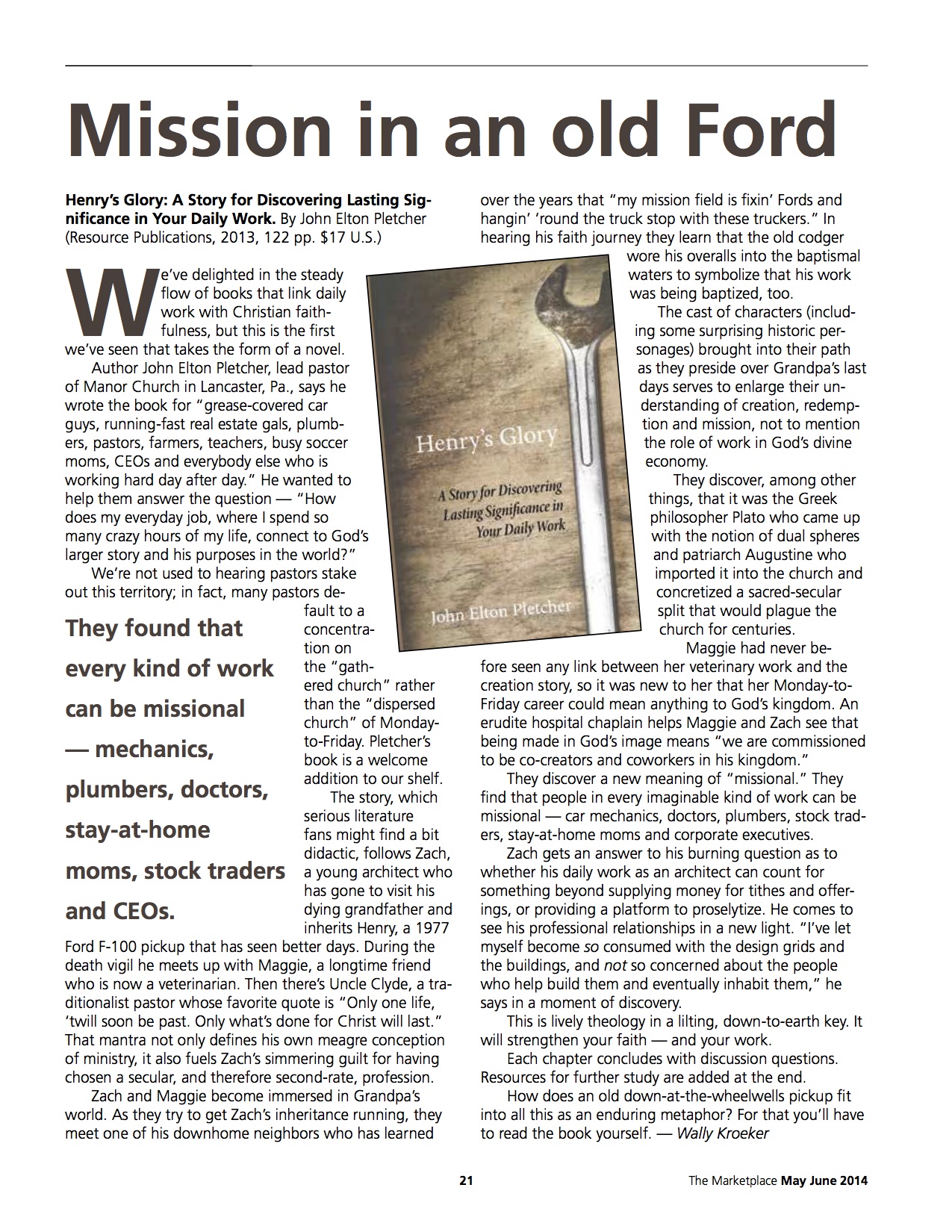
Mission in an old Ford

MKP May June 2014 21 lr copy 2

I’m jazzed, psyched, thrilled, and otherwise quite ecstatic!!

Have I perhaps understated my emotion? Henry’s Glory is reviewed in the current issue of The Marketplace magazine. In case you wondered, it’s a pretty big deal for a rookie author like me to have his book reviewed by an actual magazine—so I’m deeply honored and I’m shouting great big praise to God!

Here are two excerpts from Wally Kroeker’s review, and his full comments can be viewed at http://www.meda.org/the-marketplace-magazine. Click on the mag cover and access page 21. And of course, feel free to share this with friends.

Kroeker says:

“We’re not used to hearing pastors stake out this territory; in fact, many pastors default to a concentration on the ‘gathered church’ rather than the ‘dispersed church’ of Monday-to-Friday. Pletcher’s book is a welcome addition to our shelf.”

“This is a lively theology in a lilting, down-to-earth key. It will strengthen your faith—and your work.”

Thanks for checking out the review, for helping spread the word about Henry—and for joining me in thanks to God for such a positive review!

Blessings, joy, and fruitfulness in all your work this week!


Hard-Working Moms—There’s Hope!

???????????????????????????????????????????????????????????????????????????????

Fall of second grade, I proudly submitted a carefully crafted biography of my mom, composed on classic, dotted-line paper. This was a special writing project, to be displayed in our hallway for parent-teacher night. I waxed eloquent, reporting with the utmost, seven-year-old precision: “My mother does not work. She is a housewife.” Little did I know how clueless my statement was or how ridiculously male chauvinistic. Mom had to have felt like it was hopeless—all that time, her amazing nurture, and energetic hard work—what a waste. I must have seemed like a hopeless case.

Mom-hood reveals ever-deepening layers of hopelessness. After all, moms’ work is never done. School projects. Taxiing kids. Financial pressure. It all builds up and pushes down on a mother’s soul. Mom is expected to be the Chief Operating Officer of the family corporation. Along with endless tasks, moms are deeply concerned about their kids’ feelings and also each unique developmental stage. God wired moms with emotional and developmental radar, in great contrast to dads. Most guys are only slightly aware that there might be some small humans, under four feet tall, living in the house. Mix in all of a mom’s concern over her kids’ choices, friends, and future plans. Any cocktail of these ingredients yields high anxiety. Mom’s work can feel hopeless.

So what’s a mom to do? Where can moms find fresh doses of new hope in the midst of all they juggle at work? I’ll propose that several hope-filled insights emerge from a couple of women, undeniably two of the greatest moms in all of history.

BEST MOMS, EVER!

Luke’s Gospel records how Mary encountered the angel. She said “YES” to God’s plans, even though they were immensely challenging (Luke 2:38). It’s not everyday a young woman is told she will become pregnant by the Holy Spirit. There would be gossip and accusations. “Who can believe such a claim? It’s scandalous.” She was to become MOM to the Son of God! And she said, “I am your servant; May it be. . . .”

It seems that a YES to God is the essence of deep trust—genuine dependence—and the very core of faith for all of us. Will moms step boldly into what God wants? Will you listen and be receptive to God’s words, his instructions? Will you process life’s difficult assignments, hard tests, and rascally scenarios through God’s truth and his powerful presence?

Years ago, there was a mom named Susanna. She had a gaggle of ten kids with her husband, Sam. Sadly, their house caught fire and all but burned to the ground—not once, but twice. Her husband was devoted, both to God and to Susanna. However, Sam also had a very judgmental side, often expressing strong critique toward her and the children. He was also precarious with money, which made life extremely difficult for the family. Susanna constantly sought to cultivate Jesus’ values and heart, in all daily actions with her children. One of their girls, Hetty, a very bright but equally strong-willed young woman, kicked up her heals. She recklessly leaped into a brief fling with a young lawyer and got pregnant outside marriage. This caused great disgrace to the very proper and religious family. Dad disowned her, but Susanna persevered with motherly love for her wayward daughter, Hetty.

A Mom’s Integrated Prayer

This is actually a very old account, so you might benefit by hearing one of Susanna’s prayers. Each phrase reveals just how integrated she was about her daily work and how much she desired to incorporate Jesus’ heart into her own heart as well as her children.

“Help me, Lord, to remember that religion is not to be confined to the church, or closet, nor exercised only in prayer and meditation, but that everywhere I am in Thy presence. So may my every word and action have a moral content . . . May all the happenings of my life prove useful and beneficial to me. May all things instruct me and afford me an opportunity of exercising some virtue and daily learning and growing toward Thy likeness. . . . Amen.” (quoted in Richard J. Foster’s, Streams of Living Water, 237)

Susanna’s son, Jacky, became one of the foremost leaders, thinkers, and provocative communicators of his era. John, as he was widely known outside the family, left a massive footprint on the culture of his day. And Susanna’s son, Charles, is responsible for crafting amazing songs, many of which are still sung in churches today. The family name is Wesley. Their profound legacy in Christian thought and practice resulted from Susanna’s passionate aim to form Christ’s heart in all of her children.

Both Mary and Susanna’s examples point out this vital truth: Mom’s best hope is found in connecting her own heart—and her kids’ hearts—with Christ’s heart!

There was a fantastic outcome for Mary’s work, even after comically losing Jesus in Jerusalem for three days. (How do you lose the Son of God?) Luke 2:51-52 notes the holistic development. Jesus grew in wisdom, in physical height, and in favor with both God and other humans. When moms access Jesus’ heart and choose to say YES, then kids grow strong and experience whole-person development—mentally, physically, spiritually, and socially.

Don’t miss it, moms. Your kids can grow up to make HUGE impact, to touch lives and become big workers in God’s kingdom business. You might say, “My kid will never be a Wesley. And he or she certainly won’t be Jesus.” OK, but you can raise kids who grow up to work hard daily, build the next bright future, fight disease, solve hunger crises, create noble cultural endeavors, plant churches, and in a myriad of other ways, share Christ with a world in desperate need of Jesus’ grace.

Moms, we thank you. Realize it or not, your work is full of hope!