
Joy @ Work—even the P.O.

Post Office—Rustic


Non-stop, the press reports that the US Postal Service has fallen on hard times, so it really wasn’t a stretch for my expectations to be low. I stood waiting at a local Post Office, a tiny, drafty storefront with just one customer station. I’m amazed they keep such Podunk places open; but then ironically, I still appreciate such convenience. The clerk was working to help the lone customer in front of me, but she was plodding, slow as molasses in January. I was annoyed by the worker’s sluggish pace and oh-so-obvious gift of gab. Certainly, she could move faster and cut with all the superfluous chatter. Some of us have places to go and tasks to accomplish today. Her every move seemed SO slow, and yet accompanied by joy-filled gibberish about everything—from the freezing temp’s to her mild jealousy over a coworker’s trip to Florida. All the while, she was ridiculously focused on serving this woman’s every postal need. Finally, when it appeared all was finished and it would be my turn, I heard, “Oh, now, do you need any stamps? The rate hike happens next week.” “Why, yes, I do,” replied the patron. “Thanks so much!” While maintaining a cool exterior, I grit my teeth. I was about to lose it in exasperation. When will it be MY turn?!

Upon further review, three simple, but powerfully important perspectives are present in this little scene.

First, my methodical clerk believed she was to serve the person right in front of her. I can’t help but recognize, intrinsically woven into this clerk’s work purpose is serving others, aiming to add real value. (And why did I find this so irritating? —a sure sign of my own rank selfishness. Despicable ME!)

Second, she placed cultivating relationships first, over the robotic, just get-‘er-done approach that runs rampant. In retrospect, kudos to post office lady for talking it up and putting a passionate priority on the person right in front of you! Kudos to the USPS for encouraging such relational focus in your team members!

Third, my uber-conversationalist clerk has obviously learned to enjoy her work while serving others. Can this really be? Is this actually legal? Dennis Bakke has written a rich resource, extolling the practice of joy at work.[1] Many of us were taught, our upbringing implied, or perhaps we mistakenly inferred, that work was a wicked result of the curse of sin, a rascally consequence of the biblical Fall (Genesis 3). In reality, work was part of God’s wonderful, original framework. He personally accomplished amazingly good work with the Creation in Genesis 1. Humans were created “in his image” (Gen. 1:26-27). Since we first encounter God as the ultimate worker, we must conclude he planned for us to be productive, creative workers as well. Genesis 1 makes it clear that at the wrap-up of each day, he found great joy, as he repeatedly labeled his work “good” and “very good.” He assigned the humans to “work” the Garden (Gen. 2:15). Certainly, the consequences delineated in Genesis 3 include work becoming more sweaty and arduous. However, in light of God’s original intentions, we dare not conclude that God intended our perspective on work to be perpetually horrific, a kill-joy outlook. Consider this: a part of Christ’s redemption includes our attitude in our work. Just last week, Pope Francis tweeted: “If we live the faith in our daily life, then our work too becomes a chance to spread the joy of being a Christian.”[2] There’s a wave of fresh realization—our perspective can become more like my exemplary postal worker.

Finally, it was my turn at the P.0. My package was quickly stamped. I paid. She smiled and talked. “I’ve worked for the Post office for 37 years. I really enjoy my job!” I grinned and replied, “It’s obvious; you exude joy! Thanks so much.” She beamed a big smile, and so did I. I was extra-glad that a few moments before, I didn’t go postal.


[1]Dennis Bakke, Joy at Work: A Revolutionary Approach to Fun on the Job, (PVG, 2010).

[2]@Pontifex, Jan 21

 

Your No-Fear Year

No Fear Year image

“I’m afraid my new bright idea will never catch on. What if we fail? What if sales stay flat-lined for five straight months? I’m scared we won’t be able to handle the pressure.” A host of fears can haunt even the best of your business psyche. Perhaps 2013 found you gripped with workplace paranoia. Fortunately, the New Year holds opportunity for fresh courage in your business endeavors—and every new life challenge in 2014!

I recently had the privilege of interviewing Donna Alexander. She opened an amazing business in 2012. Pies Galore and More supplies phenomenal baked goods to residents in Lancaster County, Pennsylvania—but what Donna has created is so much more than delectable pastries. She’s launched a wonderfully inviting atmosphere that serves as a connecting point in the community.

Donna has demonstrated tremendous courage in the opening two years. I was curious how she is conquering her business fears, so I tossed some big questions her way.

Pletch: What did you most fear about starting your new business?

Donna: Fear of failure—would the business really work or would I be completely embarrassed and lose a lot of money trying? And just to be clear, my fear-conquering is still very much a daily work in progress! I suppose we never reach a point (in this life) of having completely won over fear.

Pletch: SO true! That’s great authenticity. I’m wondering. Did you have a spot where you almost did not “pull the trigger” or you considered backing out of the start-up?

Donna: Once we got going with the process, I didn’t really think about backing out. But I did say “no” to the idea a couple of times when it was it was first presented to me. I didn’t think I was ready for it; the expense and risks seemed too scary. God kept bringing it back to me, and once I started taking a few steps, the doors started “flying open.” I truly believe now that this is where God wanted me to be, even if I didn’t want to embrace it at first.

Pletch: What helped motivate you to take the risk, step out, and go for it?

Donna: The encouragement of friends! There were a couple of people who kept letting me know how much they believed in me and the idea. They believed in me more than I did myself, because I tend to be overly self-critical. Second, Christian music has been very encouraging, specifically from WJTL radio. At times it seemed like God was putting together special playlists for me, reminding me of His never-ending presence and His faithfulness. I decided I should give the business a try or I might regret it later.

Pletch: Yea, it’s fun to choose to let our fear of regret trump our other fears. So one final question: How has your faith in God sustained you and resourced your leadership and the life of your business?

Donna: This has been and continues to be a huge faith journey. I struggle almost daily with my fears and being tempted to despair. It’s easy to wish that the road would be less challenging. Going in, I thought if I could just get through the first year—well, we’re in year two now and it’s still very demanding physically (the amount of hours worked) and financially. But God has continually been there reminding me that I am not alone and that this was His idea, so it should be for His glory. The capstone of the building I’m leasing states that it is to be used “for the glory of God,” and that is what we are striving to do, with His help. I continue believing that He wants to work through me and through this business to touch other people, and that means I have to keep “pushing back the dark” (a line from a song by Josh Wilson playing on the radio right now).

Obviously, Pies Galore and More is indeed so much more. Donna is seeking to vibrantly live out her faith through her workplace endeavors everyday—all for God’s glory!

What risks will you take this year? How about saying “NO” to those shaking knees and instead, say a big “YES” to taking that bold step forward? Trust God deeper. He is with you. Take more risks, and walk boldly into your no-fear year!

Busyness and a Missio Christmas

Christmas Cards

It was in my mailbox again this year—a marvelously mysterious Christmas card from a remarkable businessperson. “But why?” I wonder every year.

Most of us feel the strenuous stress, the tug and the tension of these days. This year is no different. You have extra product to push out the door, additional tasks to conquer, reconnections to make with long-term clients, and hopefully a pleasant handful of new relationships to foster. You also have a wish list a mile long, still to conquer, plus the wrapping, maybe a batch of baking, school concerts, the extra-special church services (queue the child-shepherds, clad in bathrobes), as well as the parties to attend (and possibly one or two to host!), and—well, you know, on and on, ad infinitum. As of this morning, there are just nine days ‘til Christmas—so sorry to scare you.

I am still shaking my head over the card. “Where does she find the time to send it?”

We all have a lot to cram into the upcoming hours, and this thought arrests my psyche this morning. If I do not make the time, in all the busyness of my business, I might miss the fuller significance, the blessed connections, and the real joy. I’m struck again: What was the origin, the purpose—the deeper significance, the real business of Christmas?

A dusty Latin phrase sums it up. Missio dei. The mission of God.[1] The babe of Christmas came and lived in light of his Father’s busy business. Whereas God certainly knows how to pause, to rest and reflect, he also seems very at-home with busyness. We first meet God in his story as an uber-creative, hard-working character (AKA, Creator, see Genesis, chapters 1-2). Across God’s story, he is constantly, intentionally planning and tangibly working out his redemptive plans. He’s busy. When he was a middle school kid, Jesus’ parents lost him in Jerusalem. (Yes, I know, how do you lose Jesus? A deep question to ask Mary and Joe, someday.) They finally found him, several days later, talking it up with the leaders in the Temple. Jesus’ response at his parents’ what were you thinking? is profound with intentionality. He replied, “Didn’t you know I would be busy with my Father’s business?” (my paraphrase; but see Luke 2:49, NKJV) When confronted about his Sabbath work, Jesus said, “My Father is always working, and so am I.” (John 5:17 NLT) Years later, one of Jesus’ followers, an early leader in the movement, Saint John, penned these words. “The Father has sent his Son to be the Savior of the world.” (1 John 4:14 NIV) These words capture the Father’s intentional planning, the busyness of his business, and the full push of the missio dei.

Our mystery card comes from Renae, a phenomenal realtor in Marion, Iowa. She sold our first house for us in 1999, when we were trying to move back to the east coast for a new endeavor. I chuckle now. Renae made a grand windfall of a few hundred dollars on the deal, and she treated us like we were million dollar clients. Every year, we receive the hand-written, personalized Christmas card, and I shake my head in amazement. Call it smart real estate business (you never know whom I might refer her way). Yes, AND we should call it smart mission. She has not forgotten that God’s business places precious, life-changing connections with people right at the forefront!

So, I am compelled to slow down, breathe deep, and remember the WHY behind all of the busyness. I am struck with fresh gratitude for people with whom I can connect, the energy for creativity to produce, and the joyous opportunities to join God in his mission this season and into the New Year.

I pray you make the time to pause and remember the why of this season—and have a very missio Christmas!


[1]C. Neal Johnson, Business As Mission: A Comprehensive Guide to Theory and Practice (Downers Grove: IVP Academic, 2009), 28 and 49.

Christmas and the Blessing Business

Scrooge for Blessing Business Blog

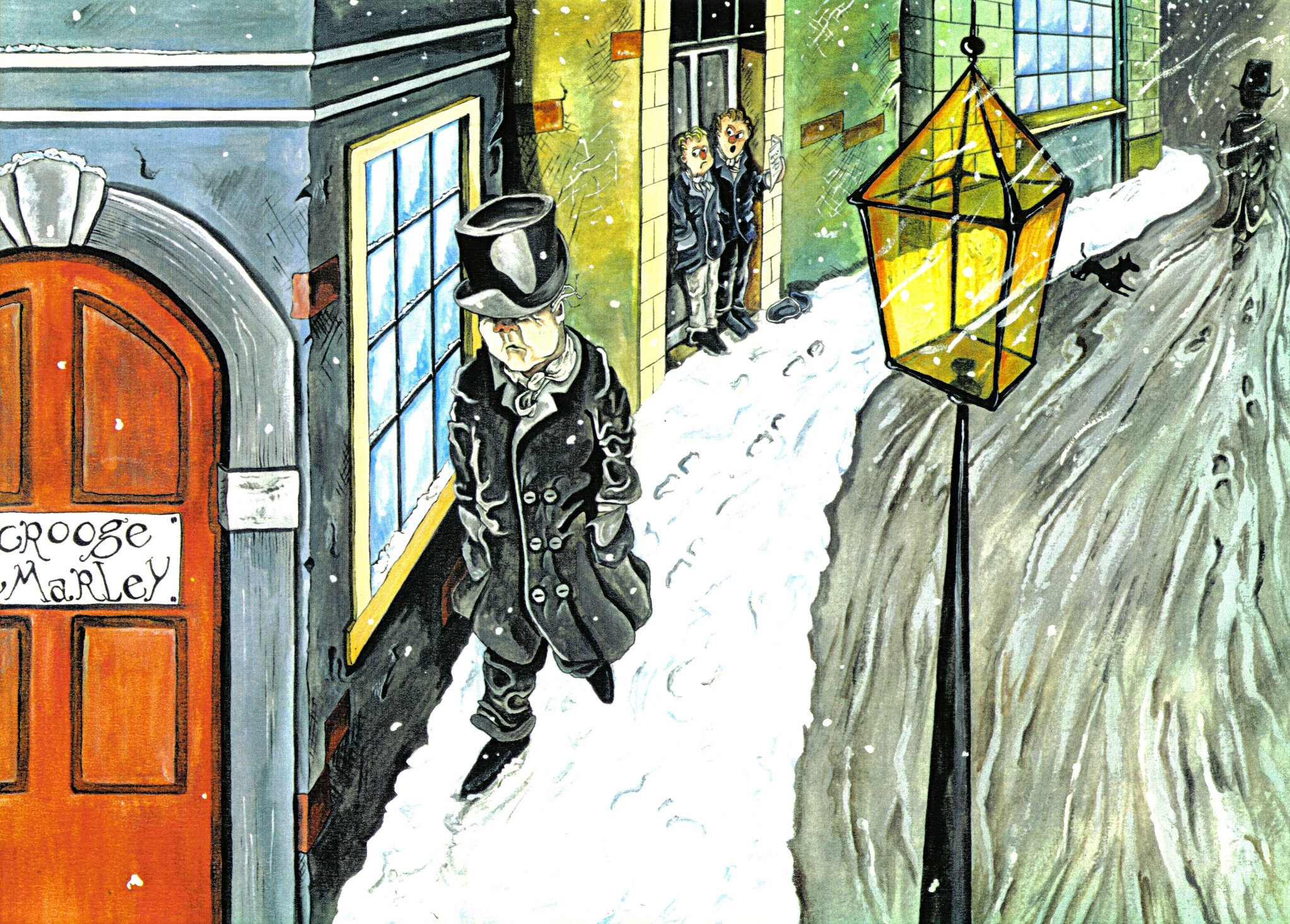
‘Tis the season. Both the big screen and local stages portray the classic tale, A Christmas Carol. At a pivotal point in the plot, Tiny Tim share his now-famous line, “God bless us, every one!” Such sentiment served as the antithesis of Scrooge’s own humbug. Original readers of Dickens’ tale were moved by the frail yet endearing boy’s optimistic plea, and future audiences have continued to be stirred. In my own family, any characters that dare to be grumpy during December are mocked with a sarcastic “humbug!” They quickly get the message. “Straighten up thy attitude!”

Consider how Dickens’ choice of words might motivate us as leaders in our workplaces and evoke a current-day response. How often we just breeze past the word bless, relegating it for consoling nearby sneezers or impressively accompanying churchy comments. I am afraid we give it little deeper consideration for everyday application. Meaning for this rich Hebrew word bless is explained by one scholar like this: “An enduing with power for success, prosperity, and longevity. . . . a blessing that confers abundant and effective living upon something or someone.”[1] Here’s a synthesis of this definition, perhaps a bit more memorable way to express what it means to bless:

We bless when “we give more deeply so others can live more fully”—so someone or a group of people can thrive—truly flourish.

In his winsome book on business and faith integration, Jeff Van Duzer describes one of the primary aims of business —intentionally contributing to what he dubs human flourishing.[2] With such bigger perspective, leaders who are seeking to integrate their faith in holistic ways deliberately correlate their own everyday work with the potential for profound flourishing, helping greater life emerge for their employees, coworkers, clients, and other business contacts. As Scrooge discovered just in time for Christmas morning, the bottom line in business becomes even bigger than the thrill of “a lot of buying and selling.” Through intentionally giving of our time, training, coaching, money, encouraging words, a listening ear, creative leadership, and overall energy, we intentionally engage in the business of blessing!

On the Saturday afternoon before Christmas, when I was ten years old, Dad and I walked downhill to the intersection at the bottom of our road, to visit the local barber. For a brief era, we lived in this dismally depressed coalmine town—Monongah, WV. Though our own family’s finances were stunningly meager, Mom insisted both her boys look good for Christmas Sunday services. We found the barber in jovial spirits, quite talkative regarding his own anticipation of the coming week’s festivities. Dad went first for his cut, followed by my turn in the chair, which included a classic boost-up on the vinyl-covered board to raise my height. As he worked his scissors and clippers, he buzzed me with kind questions about my hopes and anticipations for Christmas week. Once my ears were lowered, Dad surrendered cash to the barber, $3 per head. Though I do not recall doing any whining or grumbling, in hindsight, I realize the joy-filled barber must have sniffed out our family’s economic condition. He placed Dad’s $6 in his register till. Then he wisped out a crisp ten-dollar bill, folded it twice and shook my hand, pressing the amazing gift into my palm. He grinned and said, “Please buy your mom and grandma something special.” He had listened, sensed, and then he blessed. (‘stunning to realize, based on inflation approximations, this was something like handing a kid a fifty today) I have never forgotten that moment of generosity.

How will your workplace be a blessing business this season? I hope we can all join Ebenezer, Tiny Tim, and the benevolent barber of my childhood. May we not only speak the blessing, but also schedule the extra moments, slow down to listen, share words of hope, risk some extra capital, and more strategically invest in people. With hearts and souls determined to help others flourish, let’s truly work with God.

“God bless us, every one!”


[1]Harris, Theological Wordbook, 132.

[2] Van Duzer, Why Business Matters  (and What Still Needs to Be Fixed), IVP, 2010.

Marvin’s Market’s Marvelous Thanksgiving

thanksgiving turkey

You can feel it. There’s an extra-early push of retailers’ holiday marketing this year. Everyone is working for higher numbers. And why not—it’s smart business! ‘Seems stores everywhere are scrambling to declare an extension of Black Friday, stretching your can’t-miss deals to include the entire month. One of my favorite radio stations just launched their Christmas music, and it’s only mid-November. Now, I love Jingle Bells with the best of ‘em, but I find myself rolling my eyes and uttering a sarcastic pleeeez under my breath, as I change the station. Could we at least get to Thanksgiving week?

As the pulse of purchasing, the trappings of tinsel, and the wanna-be sensational sales season all crank up, it could be tempting for all of us to go crazy over the almighty push of the product. In fact, during this year—when everyone is longing for a further surge in economic recovery—it would be easier than ever to believe the only bottom line is the number of units sold and how deep the stacks of greenbacks grow.

I find myself asking, as we push into the season of big sales and the hopes that Santa’s sleigh will be overflowing: Does service-oriented, responsive business still matter? And if so, what difference might it really make?

Mom and I sat at Panera together one evening in October, indulging in scrumptious salads and delectable sandwiches. Amid the warm chatter, our conversation morphed into reminiscing about Thanksgivings of yesteryear. One tale she shared from her childhood serves as a poignant reminder of the power—yea, even the all-out necessity—of responsive, service-oriented business.

In step with many classic homes of the 1950s, Mom’s family typically procured their turkey for the big feast from the local grocer. Marvin’s Market was known throughout the region of Lebanon, Ohio for supplying fresh, quality meats at fair prices—and with exceptional service. So naturally, the Thanksgiving of 1956 would be no exception. There was simply no question where Everett Hall’s family would purchase the bird for their Thanksgiving Day spread.

On his way home from work on Thanksgiving Eve, Everett, Mom’s dad (and my granddad), would pick up the immense turkey, weighing in at nearly twenty pounds. It was fresh—never frozen—and carefully wrapped in crisp, white butcher paper. By this point in the day, my grandmother, Mom’s mom, would be working feverishly with Aunt Grace and other relatives, baking pies, chopping bread, and mixing the seasonings for stuffing.

It was my mother’s dubious task (at the ripe old age of seven) to meticulously pull any tiny, black pinfeathers that might still be remaining in the turkey’s body. On this particular Thanksgiving Eve, immediately after dinner and dishwashing, Grandma landed Tom Turkey in the middle of their big oval, oak kitchen table. Gram began to pull back the white paper as Mom huddled close to begin her pinfeather-pulling task.

To their horror and disgust, as the paper was pulled back, they were quickly greeted by a repulsive odor emanating from the great bird. Grandma and Mom grabbed for their noses and called for Grandpa. Everett came quickly, and with one whiff of the carcass, he declared their bird to be spoiled and not fit for consumption—not even for the canines of the house. It was a tremendously foul smell, indeed!

By now it was nearly 8 p.m. Grandpa promptly picked up the phone and dialed Marvin. He placed the call to his home phone. Within three rings, Marvin answered. Grandpa kindly explained. “So sorry to bother you, Marvin, but we’ve got a glitch in our feast. It seems that somehow, a bad bird landed on our table. You won’t believe the horrific smell.”

‘Just fifteen minutes, and Marvin himself was rapping on their front door and delivering a fresh, twenty-five pound gobbler. It would be the biggest feast the Hall house had ever experienced. Marvin apologized profusely for the mishap, and just as quickly as he came, he whisked away the stinking tom. In the moments that followed Marvin’s departure, Grandma and Mom made a stunning discovery. They quickly concluded that Marvin had brought them his own family’s turkey. Removing the classic paper, they discovered this bird was already meticulously cleaned. Not a single black pinfeather could be found.

Even in 1956, while such behavior was more expected and deemed noble, this was still astonishingly impressive business—especially after-hours on the eve of a holiday. Indeed, it spoke a passionate focus for serving people.

While we like to say we value a personalized people-focus, we must collectively confess, such attitudes and actions are rare in our day. So, I’m wondering: Are our teams primed and ready, in this holiday season 2013, not only to deliver a stack of product, sell a bunch, and make a bunch, but to also deliver exceptional service, to truly serve others in ways that bless and add real value?

Author Ken Eldred, in his insightful book The Integrated Life, draws from Jesus’ greatest command, loving God and loving neighbor (Matthew 22:37-39). Eldred concludes that the real goal of business is to serve others to the glory of God, and he cites J.C. Penney, founder of the successful retail chain, who espoused this overarching objective in business. In an early store ad, Penney critiqued the dichotomized thinking so prevalent in business, with this clarification:

The assumption was that business is secular, and service is religious. I have never been able to accept that line of arbitrary demarcation . . . . Is not service part and parcel of business? It seems to me so; business is therefore as much religious as it is secular. If we follow the admonition to love God, and our neighbors as ourselves, it will lead us to understand that, first of all, success is a matter of the spirit.[1]

Thus, Penney’s foundational goal in business was serving others to the glory of God. I wonder what could happen, in our collective spirit and the bigger bottom line, if we would dare to broaden our thinking.

Consider a quick handful of ideas as we roll full-steam into the season:

First, check your own attitude as a leader. “Is my heart focusing on truly serving others? Am I daily cultivating a people-focused mindset?”

Second, take the time to gather your team(s) and talk about the importance of going above and beyond this season. Perhaps reading them this dusty old tale from my mom’s childhood would help orient them to a renewed service mindset. Let them discuss what they believe was Marvin’s motivation as well as what the outcomes would have been had he not demonstrated such service for the Hall family.

Third, raise the bar. Challenge your teams, at every level, to intentionally plan for slowing down, talking and sharing with customers, and finding ways to actually care and serve their clients and contacts each day and each week. Such intentionality will be an important cure for the all-too-often crushing, rushing push of the frantic season!

Mom and I chuckled as she wrapped up her recounting of Marvin’s most marvelous moment for the Hall family’s Thanksgiving. We shook our heads together with big smiles. Mom reflected, “Do you realize that Marvin’s one act of service, such personalized customer-concern was so powerful, we are still talking about it over five decades later?”

Who will be reminiscing about your team’s exceptional care and service in 2063?


[1]Eldred, The Integrated Life, 43-44.