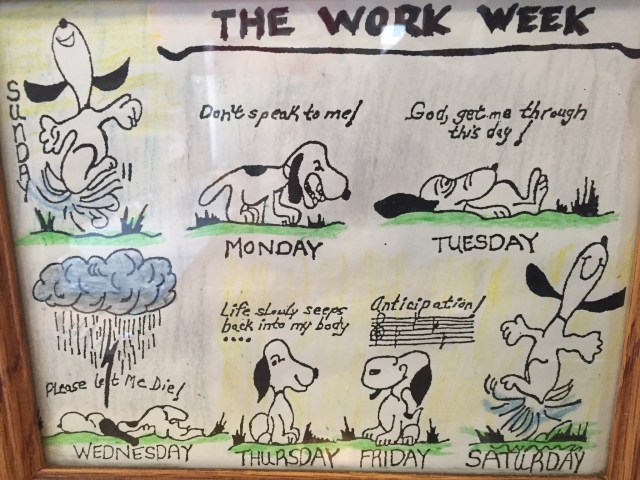
How Do You REALLY Feel About Your Workweek?

Workweekcartoon

The cartoon hangs in one of my favorite pizza shops. As I pay for my pizza or hoagies, I can’t help but chuckle. Each week, we ride a wild roller coaster of emotions related to our workplaces. And honestly, who among us doesn’t live for the weekend?

But WHAT IF that could be different? Consider these possibilities:

  • What if you gained a renewed attitude and learned to bring meaning to your tasks and appointments, instead of striving to find meaning in your daily work?[1]
  • What if this renewed outlook, bringing meaning to your work, could be found in the wondrous reality that we each reflect God’s image? After all, we are God’s co-creators and coworkers, vital leaders and culture makers in the rhythm of our daily tasks (Genesis 1:27-31). (I too quickly forget this, making everything seem way too mundane!)
  • What if we could discover fresh passion, deeply entrusting the work of our hands to God’s blessings and favor, doing our very best for his glory, and ultimately trusting him for productive outcomes (Psalm 90:16-17 & John 15:4-5)?
  • What if your work-time outlook was infused with the fresh realization that you are daily serving Christ in whatever you do? As a result, you can work at it heartily (Colossians 3:23-24).
  • What if you discover a renewed joy in your calling and gifting? In his winsome book, Loving Monday, John D. Beckett asserts:

“We can be called to the arts, to athletics, to government service or to business. If it is God’s call, it is a legitimate and high calling. In other words, you can be an ‘ordained’ plumber! People called to business have many opportunities for service unavailable to those who are specifically focused on ministry vocations.”[2]

What if we were to uncover the start of renewed passion and childlike joy? We might just start loving the opportunities we encounter every Monday through Friday!

For further exploration of how you can better navigate your own emotions about your workweek, check out my new book, co-authored with my mother, Holly Hall-Pletcher. EmotiConversations: Working through Our Deepest Places. It’s available at wipfandstock.com, amazon.com, and other favorite booksellers.

Print

[1]Bonnie Wurzbacher, as quoted by Christian Overman in God’s Pleasure at Work: Bridging the Sacred-Secular Divide, p. 16.

[2]John D. Beckett. Loving Monday: Succeeding in Business Without Selling Your Soul, p. 96.

How Can Earthquakes and “Zombies” Motivate Our Daily Work?

resurrectionlight

It’s a plaguing question that haunts us all.

Does my daily work actually have any lasting, eternal value? (Let’s keep it real. We all ask this from time to time.)

And let me complicate the issue with one further annoying question: Might the Easter season hold clues or help us in any way answer this question of our daily work’s meaning and motivation?

First, let’s be clear. We are including the everyday, down-to-earth stuff like landscaping, making cereal, spreading manure, and running repetitive, tedious lab tests. Yes, the messy, sometimes bloody, dirty stuff. Most of us are quick to assign some greater, lasting value to arenas like teaching children, caring for patients, preaching sermons, creating works of art, or leading a not-for-profit. But what about changing diapers, changing oil at the garage, changing hair color in the salon, or changing light bulbs in a warehouse? ‘Just want to be clear. The question is pertinent for every task, especially and including this often mind-numbing, mundane stuff.

Next, it’s important to grasp work’s original ideal. Work was originally portrayed in God’s grand story as very earthy, dirty, creative, tactile, and marvelously full of worship. Genesis 1 presents God as the original earth-worker. The first man was formed from the dust of the ground (Gen 2:7). The LORD called and commissioned humans to “rule and reign” in his image (Gen 1:26-28). In Genesis 2:15, he assigned Adam “to work” and “take care” of the garden. This same word for work, when surveyed across the broader scope of Scripture, conveys rich ideas of working in various fields, serving in a full mix of arenas, and even worshiping.

Thus, work and work’s outcomes were blessed and beautiful. However, humanity’s rebellion and the resulting curse sent everything topsy-turvy, horrifically including human work (Gen 3:17-19). Here is at least part of why we now find work tedious, exhausting and sweaty, extra-conflicted by relational stress, and all-too-often perplexing. Yes, we readily encounter daily work as unfulfilling.

SO, what in the world does Easter have to do with our quest for greater motivation and meaning? Tucked in Matthew’s account are two potentially puzzling, curious events. Matthew 27:51b-53 recounts

“The earth shook, rocks split apart, and tombs opened. The bodies of many godly men and women who had died were raised from the dead. They left the cemetery after Jesus’ resurrection, went into the holy city of Jerusalem, and appeared to many people.”

earthquake-cracks?????????????????????????????????????????????????????????????????????????????

Why do earthquakes and zombie-like people appear as Jesus is dying? Consider this. Jesus’ gruesome, glorious death evokes an immediate response for the previously cursed creation. Earth quakes. Rocks split. Tombs break open as dusty bodies with brittle bones rejoin (compare Ezekiel 37). New spirit enters long-dead heroes of the Hebrew faith. Eventually, once Christ is raised, these holy “walking dead” come into the holy city, Jerusalem, and appear to many people. This had to feel stunningly apocalyptic.

If your head is spinning with curiosity, ponder the potentially divine reason. God was seriously showing off, displaying a preview, early signs of what is yet to come. Dodson and Watson explain: “Tied to the bodily resurrection is also the idea that the world will be renewed and restored to its state of wholeness as a garden paradise . . . it involves the renewal of what has been destroyed—cities, the land, and all of creation (Isaiah 60; Ezekiel 36) . . . The end of the world would bring about a resurrected creation.”[1] What breaks open at Christ’s death and resurrection is like a movie preview supplying glimpses into scenes that will fully flood the screen at the culmination of history in Christ’s final victory (1 Corinthians 15).

Darrell Cosden posits: “That this salvation of the natural world includes our work follows logically. Work, which has further shaped nature, is now just as much a part of nature as what God made originally . . . we must conclude from this biblical material that our work experiences salvation along with us.”[2] Thus, Cosden links such consummation of Christ’s resurrection, our human resurrections, and the subsequent redemption of Creation (Romans 8) with eventual redemption of our work and work’s outcomes.

As present-day workers, we can find far-reaching hope! Even our most mundane, treacherous tasks—like plowing endless expanses of field, making the umpteenth sales call, or engaging in one more boring board meeting—might actually hold eternal value. When done to serve the Lord Christ, for the good of others, such rough and tumble, everyday, earthy jobs can actually bring him great glory and end up emerging as work that’s included in the shocking, death-defying, restored New Creation at Christ’s triumphant return. No wonder the Apostle Paul closed 1 Corinthians 15 by saying: “So, my dear brothers and sisters, be strong and immovable. Always work enthusiastically for the Lord, for you know that nothing you do for the Lord is ever useless.”

With such earthshaking potential for holy renewal, let’s get motivated in today’s work—with greater enthusiasm—and all for his glory!

[1]Jonathan K. Dodson and Brad Watson. Raised? Finding Jesus by Doubting the Resurrection. Grand Rapids: Zondervan, 2014, p. 24.

[2]Darrell Cosden, The Heavenly Good of Earthly Work. UK: Paternoster, 2006, p. 71.

Your Must-Do Work in the Snowstorm

blizzard

Wintry weather pounded our classic two-story, antique-Iowan home during January 1998. Nancy and I did not yet have kids, but we had a houseful of “kids” that weekend. Our church regularly hosted worship team interns, all late-teen and early-twenty-something students. This crew of courageous collegians regularly traveled two hours from Ankeny to serve on weekends. Typical accommodations involved guys bunking at our place, and the girls staying at another leader’s house nearby.

In typical fashion, the car full of friends made their trek on Saturday morning. By Saturday afternoon, a surprise snowstorm was brewing. By evening, Old Man Winter was blasting our vintage house with all-out-blizzard gusto. Sunday church was cancelled as wind and whiteouts piled on a foot of fresh powder. The “kids”—including a gaggle of other local young adults from our church—ALL piled into our place for the long weekend.

Our house was abuzz for three days. We watched movies (Harrison Ford’s high-energy, action flick Air Force One had just come out. “GET OFF MY PLANE!”). We gobbled homemade pizza, toppings-piled-high nachos, and thick pans of lasagna. We laughed. We teased (two of our interns were in their early stages of flirtation and dating). Feeling some compulsion to add a dash of productivity, we held a worship arts planning meeting (well, sort of). We philosophized. We fought and made up. (After all, who doesn’t squabble after being cooped up that long with that many friends?) We sang outrageously goofy songs, made breakfast together both Sunday and Monday mornings, and otherwise created some of the most marvelous memories.

Eighteen years later, there is a snowpocalypse forecast for a large swath of the US east coast. Pictures of empty bread aisles and abandoned milk coolers are posted across social media. While I cannot recreate that one-of-a-kind, blizzard ’98 experience, I can envision a handful of must-dos we can each carry into the forthcoming labor of these snowy days.

First, there will be surprises. So, let’s roll with joy. Looking back, it would have been easy to tell those young adults a polite “no, you can’t stay,” or even “GET OFF MY PLANE.” I do recall that Nanc’ and I had already experienced a jam-packed week. No doubt it would have felt good to have our own space and breathing room. But we have never regretted those three hilarious days, and we are so glad we rolled with the opportunity.

Second, work will emerge, accompanied by opportunities to lovingly serve others. While we thoroughly enjoyed the cabin full of friends, it was some serious labor to host and navigate that flight. During this year’s blustering storm, will you find neighbors to assist with shoveling or nearby friends to serendipitously invite for a meal? While making bread, stacking wood, or washing dishes—tasks that certainly seem mundane—we must choose Christ’s joy and servant-hearts.

Finally, make the most of the space, the sweet grace of extra time. With that crew of young adults, we made delicious food, played hysterical practical jokes, planned for upcoming Sunday services, and unearthed a treasure trove of marvelous memories. Whatever you do during this storm, you must make something. If you have a woodworking shop, use the time to build that table or refinish an antique chair that’s been gathering dust. If you’re married, home alone, just the two of you, make the most of your time together. Wink-wink. (Need I really encourage this? All studies show there will be a significant spike in hospitals’ maternity traffic approximately nine months from this weekend.) So, why not make something? You get the idea.

Perhaps such gracious time carved out by snowstorms might, after all, be more like what God intends for our normal Sabbath rhythms (Genesis 2:1-3). I too often forget that intentional holy disruptions are commanded and encouraged, integral to practicing our workplace theology. We are too typically too busy. Snowstorms and accompanying Sabbath are indeed for our good. When Jesus and his disciples walked through the fields and plucked grain on the Sabbath, the Pharisees’ critique and Christ’s summative teaching proved unique and mildly puzzling (Mark 2:23-28). At least one of Christ’s intentions was to help us embrace the empowering tension of Sabbath. Yes, it’s commanded. Yes, we’re to be spontaneous. Yes, it’s God-like. And yes, it’s VERY good for us.

Every one of those characters who camped at our house for snowzilla ’98 is now all grown up, working hard, and serving strong in God’s kingdom. Nanc’ and I would never dream of taking credit for such marvelous adults—they had exceptional upbringings with brilliant parents. But we can relish the reality that we were privileged to play a brief role, including those seventy-two hours. And oh, what a fun plane ride it was!

Stephen Cottrell, describing more sensitive Sabbath principles, urges us: “So never speak of wasting time or spending time. Rather, say you are enjoying it or giving it away freely. Never say you have an hour to kill. Rather, say you have an hour to revive, to bring to life, to ravish.”[1]

Let’s ravish our way through the upcoming snowy hours, fully embracing both the joyous work and wonderful people God brings onto our planes.

[1]Stephen Cottrell. Do Nothing to Change Your Life: Discovering What Happens When You Stop. (New York: Seabury Books), 2008, p. 69.

George Bailey’s Wisdom for Workplace Significance

GeorgeBailey

It’s a long-standing tradition for many of us. At least once each Christmas season, I have to watch the classic, It’s A Wonderful Life. In recent years, what I had previously viewed as simply a feel-good Christmas flick has now seriously morphed in my thinking. I have begun to realize that George Bailey’s desperate personal struggle conveys much more than a warmhearted, life-turnaround story. With deeper reflection, we encounter great wisdom for discovering personal significance in our daily work. Consider it.

In spite of the movie’s title, George’s life seems anything but wonderful. As the story opens, we learn that George is thinking about taking his own life. Plagued by one setback after another, this “every man” character has struggled for years with feeling unhappy, discontent, and purposeless. George Bailey’s struggle points out this extremely inconvenient reality, all-too-common to our plight:

Working hard to serve others never guarantees immediate “success.” In fact, such posture often leaves us feeling frazzled and forgotten, beleaguered and belittled.

George and the entire Bailey Building and Loan enterprise endlessly wrestled with doing what was right—selflessly serving others—and yet never getting ahead. George Bailey does consistently make right choices, but again and again, he’s filled with regret and seethes inside with raucous feelings of pointlessness and emptiness—even jealousy and anger—over others who seem to succeed and have easier lives. For George, intentionally working to do the right thing feels difficult, lonely, and fails to land him in first place.

Even as we focus at Christmastime on Jesus’ coming and his service-oriented mindset (Phil. 2:4-5), we can easily feel conflicted. We are busy and pushed with extra demands and distractions. We feel the crunch of end-of-year expenses and deadlines. We encounter the relational strain of coworkers and family who are frazzled and grumpy. We even wrestle with déjà vu, easily recalling the “ghosts” of Christmases past, those years that were less than snow-globe-like.

George Bailey knew these feelings all throughout his life. His story becomes more than ironic and harsh. Consider these famous scenes:

  • He courageously saved his brother’s life, but he lost his hearing in his ear as a result.
  • His big dreams of traveling & making a million—they’re always just out of reach!
  • He stayed stuck in Bedford Falls, tediously tending to the oh-so-slow, seems-to-never-really-grow, Bailey Building and Loan.
  • The Bailey family stood in stark contrast to grumbly old Mr. Potter, the mean, fat-cat tycoon who seemed to own everything else in the town.
  • While embarking on his honeymoon with Mary—just like George’s dumb luck—the stock market crashed. There was a run on the bank, and the newlyweds ended up using their honeymoon money to hold people over.
  • They settled in Bedford Falls and started renovating the old Grandville House. As years passed and kids came along, George found himself more and more disillusioned, constantly embroiled in business conflict with Potter. Life felt cold and desperate instead of wonderful and fulfilling.
  • When World War II began, George couldn’t even be drafted and travel the world on account of his injured ear. His kid brother, Harry, went off to war, and of course, he ended up a hero!
  • Christmas Eve, Uncle Billy misplaced $8000 of the Building and Loan’s money, actually mistakenly placing it in Potter’s hands. Unaccounted for, such missing money would mean financial disgrace and scandal for the Bailey Building and Loan and George’s whole family.

If we pause to reflect, we discover that George Bailey’s story shows us a handful of rich insights for finding greater significance in our daily work. For starters, George’s condition proves . . .

God uses ordinary, struggling, disturbed, fearful, down-on-their-luck people to change the world. It was true in God’s personnel plans for bringing Jesus to earth. (Just look at the lineup in the family tree, the genealogy of Matthew 1.) It’s powerful to realize that Jesus came to bring us hope and joy, and God still uses everyday, ordinary people like us in his process of redemption and transformation.

Consider the fictitious angel in George’s story—Clarence, the funny little guy who needed to earn his wings. “Earning wings” is a fanciful add-on in this movie (not biblically-based). Nevertheless, there’s no mistaking the connection with God’s angelic messengers who play a huge role in the original Christmas story. And we gain this second insight for discovering greater significance in our daily work.

God cares. God communicates. And we can connect with him.

Whether it’s the angelic messengers in the biblical accounts, God’s often-stunning orchestration of events in our lives today, or his precious written Word—readily available for us—this much is certain. Christmas reminds us that God communicates so we can connect with him. Take a few moments to explore these examples of God communicating, so we can be blessed for greater redemptive connections: Gen. 12:3; Isaiah 9:6-7; Micah 5:2-5; and Hebrews 1:1-3. Christ brings us such hope!

Clarence went on to show George what life would have looked like if he’d never been born. Bedford Falls was now Pottersville, a dismal place. No one recognized him. No one. George and Mary’s grand old house was nothing but an old shell in shambles. He ran through the house, shouting for Mary and the kids. No one answers. When he goes to his mother’s house, she answers the door. She’s rough and haggard, and she does not know him. No one in town recognizes him. George stumbles upon a graveyard and finds his brother, Harry’s gravestone. Clarence shows up and tells him Harry drowned. George shouts a flamboyant denial, “I pulled Harry from the icy water that day. Harry’s alive! He’s a hero. He rescued all the men on that transport!” “No,” Clarence retorts, “You were never born, George. Every man on that transport died. You see, you weren’t there to save Harry.”

Through these spectacular realizations, George ends up back on the bridge, praying and pleading, “Please, oh, God, let me live again. Please, I want to live again.” And at that moment, he is restored. With great jubilation, he heads home and discovers that Mary has rallied the townspeople, who all bring money to bail George and the Bailey Building and Loan out of trouble. The house is jam-packed with friends, and in the closing scene, George’s hero-brother, Harry, arrives and makes a toast, “To my big brother, George, the richest man in town!”

We’re stirred because we can SO relate to George’s feelings, but there’s more. Here’s the final takeaway:

Christ gives our daily work real significance as we serve others—to his glory. A life of serving others is wonderfully abundant and leaves a HUGE impact!

Ken Eldred has winsomely declared the real goal of business: serve others to the glory of God. Eldred thoughtfully expands our understanding of service with three clarifications:

  • Business that effectively serves others will generate value and expand the total pie. Profit is indeed a sign that others are being served.
  • Business cannot neglect efficiency and profitability or it will cease being able to serve others.
  • Serving investors means that we’ll generate a return on their investment (Matt 25:14-30).[1]
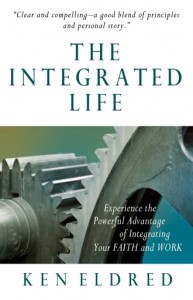
Eldred's The Integrated Life Two questions will serve us well as we consider greater significance.

First, will you deeply connect with God this season, with his heart and purposes for your life? No matter how discouraged you feel, you can cry out like George, “God help me. Get me back! I want to live again!” God cares and promises to supply you with his hope, purpose, and joy.

And second, will you intentionally adopt a Christ-focused purpose in your daily work, to serve others to the glory of God? Jesus said in John 10:10, “The thief comes only to steal and kill and destroy. I came that they may have life and have it abundantly.” Such abundance can overflow as we bring greater significance to our daily work. Serving Christ to the glory of God—such purpose imbues our daily work endeavors with greater significance, allowing us to truly live a more wonderful life!

For further exploration of these themes, check out Eldred’s exceptional book. And for a heartfelt, thoughtful story conveying this quest, grab and enjoy a copy of my book, Henry’s Glory: A Story for Discovering Lasting Significance in Your Daily Work (available at http://www.wipfandstock.com)


[1]Ken Eldred. The Integrated Life: Experience the Powerful Advantage of Integrating Your Faith and Work. Manna Ventures: Montrose, CO, 2010, pp. 44-45.

What Christ’s Finished Work Means for Our Life and Work

??????????????????????????????????????????????????????????????????????????????????????????????????????????????????????????????????????????

After five tedious hours of sanding and three coats of poly-finish, the vintage-1920’s, solid oak chair is restored. I lay my brush atop the can of urethane and step back to inspect. With a satisfied grin and a nod to the chair, I affirm: “This project is now finished.” It’s the culmination of both artful plans and hand-numbing toil. I smile. It’s now beautifully refinished!

On that bleak day at Golgotha, Christ cried out, “It is finished!” (John’s Gospel, 19:30) What did he mean? We might assume Christ was so profoundly exasperated that he was exclaiming, “It’s been agonizing, and now, it’s OVER!” Perhaps. But perhaps he meant even more. Throughout Christ’s time on earth, he worked. He worked hard. In Mark 6:3, people recognized him as the carpenter. A tekton engaged in hands-on work with wood and/or other sculpting and building materials. Prior to assuming his role as Rabbi-Miracle-Worker, Jesus plied the trade of his father, Joseph. With Christ’s baptism and inauguration of his kingdom initiatives, his Heavenly Father’s mission-business shifted into a next phase of implementation. Jesus taught crowds; he trained disciples; he touched the suffering; he transformed lives by his grace. In a real sense, his hands were still sculpting. Like most jobs, he had to work around the haters and cynics. On one such feisty occasion, he replied, “My Father is always at his work to this very day, and I too am working.” (John’s Gospel, 5:17)

????????????????????????????????????????????????????????????????????????????????

The language of Jesus’ cry from the cross was ripe with significance. Tetelestai. “It is now fully accomplished, totally completed. The plans have come to fruition. It’s paid in full. Redemption has fully arrived!”

How might Christ’s decisive cry, “It is finished!” impact our daily work?

We can affirm the value of long-term planning and implementation. Much of the Father’s work—and then his Son’s work—involved establishing and working out the ancient prophecies. Christ’s life work demonstrated marvelous fulfillment of those plans, culminating in extra-dynamic ways with the cross, resurrection, and ascension. Consider this: when we make strategic plans and work hard to implement them, we are more fully living out the image of God, matching his very character and transformative intentions for us.

We can infuse our daily work with his redemptive aims. Christ’s loud personal cry, tetelestai, declared the complete arrival of redemption. This should motivate us to make sure our own work keeps redemptive purposes in view. How does what I do today serve with humble sincerity, bless the mess, help reverse the curse, clear the confusion, and bring truly Good News to people who experience the bad news everyday? With both our daily actions and our daily words, we can share Christ’s hope-filled redemption.

We can work hard, relying on God’s grace. The Apostle Paul, after rehearsing the creed—Christ’s death, burial, and resurrection—insisted that he had worked harder than all the other apostles, “—yet not I, but the grace of God that was with me.” (1 Corinthians 15:10) In like fashion, it is the grace of God that confidently propels our own work today. We can fully trust him and praise him for such grace!

We can intentionally plan to finish strong. What does it take to finish strong in your life work? In their discussion of a strategy for entrepreneurs planning to finish well, Richard Goosen and R. Paul Stevens lend five insights: (1) Keep articulating your life goals, not just when you are young, but throughout life; (2) Constantly refresh your sense of calling; (3) Engage in an accountability group; (4) Practice thanksgiving day and night; and (5) plan on lifelong learning, blending study, work, and play all along the way.[1]

‘Ever wonder what Christ felt on certain days in the carpentry shop, especially when working on tough projects? How often did the skin on his hands get dry-cracked and calloused? What expression crossed his face when a splinter snagged him? And I wonder what words crossed his lips when he wrapped up an especially challenging piece? I have a hunch I know, and you probably do as well. After all, there was the day his hands held rough-hewn beams, and they felt the ugly work of nails. And on that day, Christ cried out, “It is finished!”

Take heart. His finished work and triumphant word supply all the grace we need to press on, work hard, and finish strong.

?????????????????????????????????????????????????????????????????????????????????????????

[1]Richard J. Goossen and R. Paul Stevens. Entrepreneurial Leadership: Finding Your Calling, Making a Difference. (Downers Grove: IVP Books, 2013) 176-179.

4 Reasons You Can Whistle @ Work

?????????????????????????????????????????????????????????????????????????????

I could not help but chuckle. My morning walk on the golf course cart path was proving to be gorgeous. Leaves revealed a hint of fallish tint. The mid-September sky was bright, and the air was crisp. Amid the rustling treetops, birds were chirping, but I was suddenly struck by another high tone, piercing the soundscape. Overtop the birdsong and gentle hum of a green machine at work, there danced a stunning, pronounced melody. The tune was distinct, recognizably classic in cadence, echoing off the arcade of trees and turf. I scanned in all directions, eventually to discover that the beautiful whistling was coming from the lips of the hard-working grounds keeper. It was a stunning, spot-on-pitch performance—and he was oblivious to having an audience. ‘Top of his lungs, he kept whistling, and I laughed aloud.

Immediately struck with amazement and query, I thought, “It’s very early morning; his work is tedious, mundane, for sure. It’s repetitive and ridiculously thankless for that matter.” Confession: I’ve never gone back to the clubhouse after a round of golf to deliberately compliment, tip, or otherwise praise the grounds crew. But here’s this early morning laborer, whistling as he works, with volume level at Max 10.

So what gives? ‘Something special in his 5 a.m. java? How can the rest of us find healthier joy in our daily work, whatever we do? Based on God’s view of work, I’ll suggest four reasons we can whistle in our work this week.

YOUR WORK TODAY MAKES GOD SMILE.

God originally made us in his image—his very likeness as creative coworkers—and he called us to work. In Genesis 2:15, we discover that a great big part of this imago Dei and our original call was for humans to work the garden. The Hebrew word for work carries the ideas of labor, service, and worship. Originally, this was all good, all positive. Yes, Genesis 3 records the curse in response to the Fall, but work was originally a part of God’s very good plans for humans. In response to the Curse’s ugly consequences, God’s story unfolds redemptive plans to renew all of creation, including work and its creative outcome (Rom. 8).[1] When we work, God smiles.

YOUR WORK TODAY IS THE OVERFLOW OF GRACE.

Our everyday work is part of our living out God’s saving grace. He planned for it! Ephesians 2:8-10 reminds us that we are saved by grace through faith; it’s not of our own good works. Yet, we discover with verse 10 that the overflow of God’s creativity, his remaking us, is that we now ACTIVELY live out creative good works. Faith is indeed about DOING something. He planned in advance for us to accomplish good works.

WHATEVER IT IS—YOUR WORK CAN SERVE CHRIST AND MAKE HIM FAMOUS!

For your own deeper inspiration and recalibration of perspective, explore these verses. Soak up fresh motivation for the soul of your work. See 1 Cor. 10:31 and Colossians 3:23-24.

YOUR WORK MATCHES JESUS’ HEART, ACTIONS, AND MISSION.

Jesus’ own example and his kingdom teachings are full of business and workplace implications. Mark 6:3 tells us that Jesus was a tekton, one who works with his hands. We often forget that Jesus was a carpenter and/or sculptor many more years than he was the traveling rabbi and miracle-worker. As a result, Jesus knew business and marketplace workers. Perhaps this sheds some light on why the majority of his parables are infused with business context and kingdom principles related to everyday work scenarios. Tom Nelson reminds us:

“Working with his hands day in and day out in a carpentry shop was not below Jesus. Jesus did not see his carpentry work as mundane or meaningless, for it was the work his Father had called him to do. I have a good hunch that Jesus was a top-notch carpenter and did top-notch work . . . I am sure there were many things that made the Father well pleased, but one important aspect of Jesus’ well-pleasing life that we must not overlook was his well-pleasing work as a carpenter.”[2]

So, as the golf course greens keeper continued whistling, I found myself grinning and saying, “Sign me up! I want what he’s having!” God’s smile, great big grace, his glory, and Jesus’ own work—four reasons you can rejoice with God in your work today. Let’s get whistling!

??????????????????????????????????????????????????????????????????????????????????????????????????????


[1]Darrell Cosden, The Heavenly Good of Earthly Work. (United Kingdom: Paternoster Press, 2006), 86-91.

[2]Tom Nelson, Work Matters: Connecting Sunday Worship to Monday Work. (Wheaton: Crossway, 2011), 90.