
Weed-Pulling @ Work

???????????????????????????????????????????????????????????????????????????????????????????????????????????????????

Mid-summer flowerbeds can be monstrously frightening. A few weeks back, dark mulch was rich and thick. Edges were crisp, and all was clean. That was late May. A mere six weeks later, ugly invaders have crept in. Early-fallen leaves, scorched by summer sun. Twisted twigs, dropped by thunderous episodes of the night. Scariest of all, prickly weeds, stray vines, and rogue tree-upstarts have taken over. What was previously pristine now appears dastardly devilish. However, last Friday morning, I overcame those foolish fears (including my sluggard tendencies). I mustered enough courage to machete my way into the sprawling plots to take on the insidious, wicked weeds. And I was triumphant! Now, the enemies have been vanquished; the beds have been beautified once again. Eden is restored (at least for this week).

I am struck with the primal necessity of tackling weeds. We were originally assigned the good work of the garden (Genesis 2:15), but such garden-work—all work for that matter—was cursed following the humans’ attempted coup d’état (Genesis 3). Thorns and thistles now spring up, yes literally—yet we dare not miss the metaphor such enemy invaders supply. The weeds and “sweat of the brow” take over what had previously been an uber-productive, marvelously creative, unencumbered workplace. All garden work—every workplace endeavor—is now a place characterized by more difficult, challenging, and even too often treacherous toil.

But greater news springs up! Because Christ’s redemption is far-reaching and will eventually transform Creation altogether (Romans 8:18-25), there is this important kingdom-work of weed-pulling. God’s grand story reveals the already-not-yet nature of Christ’s kingdom.[1] With Christ’s first coming and the inauguration of his kingdom, sin’s curse is indeed broken—AND then, there’s more to come! In all such interplay, we live with longing anticipation of all Christ will eventually fulfill, AND for now we work/serve by grace to impact all the God-glorifying, kingdom-advancement we can (Ephesians 2:10). In the here and now, we boldly work to pull weeds and make room for more creative, glorious beauty to spring up.
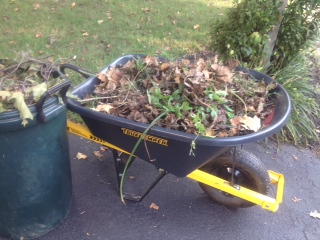
Wheel barrow of weeds

With such realization, there are numerous areas of daily work that might be labeled “pulling weeds.” Andy Crouch insists that “creation begins with cultivation—taking care of the good things that culture has already handed on to us.” Crouch asserts, “Cultivating also requires weeding—sorting out what does and does not belong, what will bear fruit and what will choke it out.”[2]

Allow me to suggest a poignant, mid-summer discipline for cultivating the soul and action of your daily work. Ask yourself two questions and make two answer lists.

First, what do I need to weed out of my own life and leadership habits, in order to make room for the greater work of God in me and through me? (Don’t skip this painful but highly important, personal cultivation step.) What needs yanked from your life to make room for fresh growth?

Second, what can and should be weeded from our workplace, business, or organization to make room for greater creativity and productivity? Two corollary, sub-questions: What should we stop doing in order to do the main thing of our mission more effectively? And what hard decision or proposed changes have we been putting off, but NOW is the time!?

Brilliant life-strategist Henry Cloud calls this pulling the tooth.[3] Too many of us put up with a nagging toothache for too long. Henry winsomely implores us to take action, now rather than later. Make the dentist appointment. Sit in the chair and get it pulled. Makes perfect sense for your mouth, so why not in your life and leadership at work?

Muster the courage to take action on attitudes, habits, negative people, and unfruitful team practices that really need to go. Pull the weeds, make room, and experience the joy of greater growth in your own life and your workplace this summer!

Mid-summer flower bed1


[1]Ben Witherington III supplies engaging discussion of such in his thoughtful work, Imminent Domain: The Story of the Kingdom of God and Its Celebration.

[2]Andy Crouch, Culture Making: Recovering Our Creative Calling. (IVP, 2008), 74-75.

[3]Henry Cloud, 9 Things You Simply Must Do to Succeed in Love and Life. (Integrity Publishers, Nashville), 43-67.


Raising Next Generation Workers

???????????????????????????????????????????????????????????????????

Our house was invaded last evening! My son, Jarod, turned sixteen this weekend, so a gaggle of his marching band cronies arrived for his party. There was uproarious laughter, scrumptious food, and spontaneous singing. Of course, this momentous event triggers additional milestones. In the next few days, he will go test for his driver’s permit. (Watch out. Consider yourself warned—go buy a helmet!) I am thrilled that in a couple weeks he will begin his first real, paying, part-time job at a local business. Yes, in case you cannot sense it, here is one “proud papa.” (Deep down, I’m even more thrilled that I might actually keep a little more cash in my pocket.)

In our previous post, I introduced the issue: How can parents ready a next generation of workers? How can we know with confidence that our kids are growing up truly ready to engage in a lifetime of God-honoring endeavors in all they do?

We are joined again by Dr. Christian Overman, the Director of Worldview Matters. http://www.biblicalworldview.com.

John: “Christian, in our first round, you shared the importance of a biblical worldview—gaining an accurate view of God, one’s life purpose, pursuits in the world—including one’s personal perspective on work. So I’m wondering, what seem to be the biggest present-day roadblocks to a healthy, God-pleasing worldview being cultivated in the next generation? Where do you see these blocks showing up and why?”

Christian: “The biggest challenge, as I see it, is that kids today live in a secularized society, and parents do little to counter this. Kids hear and see messages throughout the day that never make reference to God, or His Word. Not in math class at school, not in TV programs at home, and not in public shopping malls. This has the effect of convincing kids that ‘God things’ are ‘Sunday things,’ and reinforces the ‘Sacred-Secular Divide’ which keeps Christians thinking that some times are ‘God times’ such as times of personal devotion, church services, or saying grace at dinner, and everything else is ‘something other.’ But in reality, the biblical worldview makes no provision for ‘something other.’ The earth and all it contains is God’s. Jesus is Lord of all. Therefore, washing dishes is a ‘God time,’ mowing the lawn is a ‘God time,’ and doing homework is a ‘God time.’

John: “Wow! Perhaps I should try that as a motivator for getting my kids to actually DO their homework. Ha! Seriously though, it strikes me that getting over that barrier, this ‘great divide,’ is a humongous key to reshaping our framework and helping a next generation realize that they truly can be doing all for the glory of God (1 Cor. 10:31).

So one more question. Please share what you deem the ‘basic essentials’ parents need to emphasize for raising kids who are ready to work for God’s glory. What do you believe a parent needs to most cultivate in order to get a kid ready for a life of God-pleasing work?”

Christian: “Parents can emphasize that any kind of work that does not violate God’s will is work worth doing, has great value, and qualifies as ‘God’s work,’ whether it is done for pay or not. We don’t find meaning in our work. We bring meaning to our work. Parents can teach their kids to bring meaning to their daily work by doing it ‘heartily as unto the Lord.’ Work, at its best, is a practical way of loving God and loving people. The sooner kids view it this way, the better. We were created to work. That’s what God had in mind for us when He said, ‘Let us make man, and let them rule…over all the earth.’ This earth-ruling role requires all sorts of work, from farming to building airplanes. It is all a sacred task. We don’t have to be a pastor or a missionary to do ‘the work of God’ in the earth. Helping kids to ‘get’ this concept helps us all.”

John: “Those are profound essentials we need to make sure we are passing along if we want to effectively prepare the next generation for leading, creating, managing, and otherwise working on God’s earth. Great big thanks, Christian, for sharing with us in these posts!”

Want to know more? Intrigued to take this further with your kids and your own workplace perspectives? Grab empowering ideas from Christian’s book God’s Pleasure At Work: Bridging the Sacred-Secular Divide.

Order a copy at http://biblicalworldview.com/bookstore.html

God's Pleasure at Work


Busyness and a Missio Christmas

Christmas Cards

It was in my mailbox again this year—a marvelously mysterious Christmas card from a remarkable businessperson. “But why?” I wonder every year.

Most of us feel the strenuous stress, the tug and the tension of these days. This year is no different. You have extra product to push out the door, additional tasks to conquer, reconnections to make with long-term clients, and hopefully a pleasant handful of new relationships to foster. You also have a wish list a mile long, still to conquer, plus the wrapping, maybe a batch of baking, school concerts, the extra-special church services (queue the child-shepherds, clad in bathrobes), as well as the parties to attend (and possibly one or two to host!), and—well, you know, on and on, ad infinitum. As of this morning, there are just nine days ‘til Christmas—so sorry to scare you.

I am still shaking my head over the card. “Where does she find the time to send it?”

We all have a lot to cram into the upcoming hours, and this thought arrests my psyche this morning. If I do not make the time, in all the busyness of my business, I might miss the fuller significance, the blessed connections, and the real joy. I’m struck again: What was the origin, the purpose—the deeper significance, the real business of Christmas?

A dusty Latin phrase sums it up. Missio dei. The mission of God.[1] The babe of Christmas came and lived in light of his Father’s busy business. Whereas God certainly knows how to pause, to rest and reflect, he also seems very at-home with busyness. We first meet God in his story as an uber-creative, hard-working character (AKA, Creator, see Genesis, chapters 1-2). Across God’s story, he is constantly, intentionally planning and tangibly working out his redemptive plans. He’s busy. When he was a middle school kid, Jesus’ parents lost him in Jerusalem. (Yes, I know, how do you lose Jesus? A deep question to ask Mary and Joe, someday.) They finally found him, several days later, talking it up with the leaders in the Temple. Jesus’ response at his parents’ what were you thinking? is profound with intentionality. He replied, “Didn’t you know I would be busy with my Father’s business?” (my paraphrase; but see Luke 2:49, NKJV) When confronted about his Sabbath work, Jesus said, “My Father is always working, and so am I.” (John 5:17 NLT) Years later, one of Jesus’ followers, an early leader in the movement, Saint John, penned these words. “The Father has sent his Son to be the Savior of the world.” (1 John 4:14 NIV) These words capture the Father’s intentional planning, the busyness of his business, and the full push of the missio dei.

Our mystery card comes from Renae, a phenomenal realtor in Marion, Iowa. She sold our first house for us in 1999, when we were trying to move back to the east coast for a new endeavor. I chuckle now. Renae made a grand windfall of a few hundred dollars on the deal, and she treated us like we were million dollar clients. Every year, we receive the hand-written, personalized Christmas card, and I shake my head in amazement. Call it smart real estate business (you never know whom I might refer her way). Yes, AND we should call it smart mission. She has not forgotten that God’s business places precious, life-changing connections with people right at the forefront!

So, I am compelled to slow down, breathe deep, and remember the WHY behind all of the busyness. I am struck with fresh gratitude for people with whom I can connect, the energy for creativity to produce, and the joyous opportunities to join God in his mission this season and into the New Year.

I pray you make the time to pause and remember the why of this season—and have a very missio Christmas!


[1]C. Neal Johnson, Business As Mission: A Comprehensive Guide to Theory and Practice (Downers Grove: IVP Academic, 2009), 28 and 49.