How to Heal Our House Divided: Finding Hope in Lincoln’s Words and Jesus’ Way

By John Elton Pletcher

Sad irony abounds. Our United States stands at a critical juncture, mired in deep division and desperate political polarization. Heated elections are now the norm. We see loud town halls, gridlock on Capital Hill, and viral social media battles. Ideological chasms reach deeper and wider than ever, dividing families and whole communities. The fragmentation of American civic life appears both severe and personal. Today’s polarization is no longer born simply of policy differences, but increasingly stems from competing visions of truth, justice, and identity—both personal and tribal.

Our raucous season is not without precedent. America has faced frightening fault lines in our past. In fact, some of the most insightful guidance for our fractured age comes not from contemporary pundits but from two ancient sources: Abraham Lincoln’s Second Inaugural Address and the ethical teachings of Jesus of Nazareth.

Lincoln’s Moral Clarity Amid Civil War

Delivered on March 4, 1865, just weeks before the end of the Civil War and his assassination, Abraham Lincoln’s Second Inaugural Address is among the most profound speeches in American history. Rather than brag of the Union’s impending victory, Lincoln struck a tone of humility, sorrow, and reconciliation.

“With malice toward none, with charity for all, with firmness in the right as God gives us to see the right, let us strive on to finish the work we are in, to bind up the nation’s wounds…”
— Abraham Lincoln, Second Inaugural Address, 1865

Lincoln did not demonize the South. Instead, he acknowledged the nation’s shared complicity in the sin of slavery and framed the war as a divine reckoning. Both North and South shared guilt in the long-term evil of slavery. Amazingly, Lincoln resisted triumphalism and revenge. He called instead for compassion, moral introspection, and intentional work toward restortation.

This stands in stark contrast to today’s political climate, where victory often means vilifying the opposition and weaponizing past grievances. Too often, modern rhetoric doubles down on supposed ideological superiority and crowds out any shred of civic humility. Lincoln’s words model what mature political leadership can look like: compassionate, accountable, and future-oriented.

Jesus’ Divine Ethics: Radical Love and Reconciliation

Jesus of Nazareth, in his Sermon on the Mount (Matthew 5–7), taught a revolutionary moral framework. Remarkably divine, his ethic tipped conventional wisdom on its head. Perhaps, no teaching is more relevant—and more difficult—than this:

“Love your enemies and pray for those who persecute you, that you may be children of your Father in heaven.”
— Matthew 5:44–45, NIV

In a society divided by Rome’s imperial rule, ethnic tension, and sectarian violence, Jesus offered a truly radical, new way. Not violent resistance or passive acceptance, but active love. In our current political culture where opponents are frequently caricatured, even dehumanized, Jesus’ teaching seems almost impossible. But Jesus was not calling for naivete or a passive posture. Instead, he urged people to rise above vengeance and tribalism—to see others, even enemies, as bearers of divine image and worthy of great dignity. He called for mercy over judgment, reconciliation over retaliation, and humility over pride.

His teachings emphasize:

  • Peacemaking: “Blessed are the peacemakers…” (Matthew 5:9)
  • Self-examination: “First take the plank out of your own eye…” (Matthew 7:5)
  • Forgiveness: “Forgive, and you will be forgiven…” (Luke 6:37)

These principles challenge both our modern conservatism and pervasive progressivism, reminding us that moral authority does not come from power, but from love. In reality, Jesus’ teachings don’t align neatly with any present political ideology, but they do supply a higher standard for both public discourse and private conversations.

Comparison to the Current Political Climate

Today’s American politics often resembles a zero-sum game, where power must be won at all costs. When one side wins, the other must lose. Nuance is non-existent. Algorithms reward outrage. Tribal loyalty is prioritized over truth, and public discourse is poisoned by malice.

In such an environment, Lincoln’s and Jesus’ messages feel radical—even subversive. They offer a different kind of leadership—a devotedly virtuous one that does not avoid hard truth but pursues deeper reconciliation. Both call for:

  • Healing over scoring points
  • Humility over hubris
  • Service over self-interest
  • Unity over tribalism
  • Mercy over vengeance
  • Truth with grace

Whereas modern politics seeks victory, both Lincoln and Jesus sought healing. Both proclaimed a fundamental truth: genuine transformation starts in the human heart. Their approaches reflect a moral imagination that transcends opposing ideologies and predictable power plays. Political structures serve genuine purposes, but no amount of legislation can substitute for mercy, justice, and love enacted by ordinary people.

Pathways Forward: What Can Be Done?

While America’s polarization cannot be healed overnight, the combined moral vision of Lincoln and Jesus suggests a path forward.

1. Cultivate Humility

Like Lincoln, we must acknowledge our own blind spots and moral failings. As Jesus said, “Why do you look at the speck of sawdust in your brother’s eye…?” (Matthew 7:3). Loud proclamation of moral certainty, minus introspection, leads to arrogant self-righteousness and rarely real justice.

2. Pursue Reconciliation

Justice and reconciliation are not mutually exclusive. Lincoln didn’t ignore evil, but neither did he nurture hatred. Jesus’ command to “turn the other cheek” (Matthew 5:39) calls for dignity, not docility. Jesus’ call to love does not mean ignoring wrongdoing, but it does mean seeking resortation rather than malicious retribution.

3. Speak and Act with Charity

“Charity for all” includes listening—truly listening with empathy, assuming good intentions more often, and treating others with respect—even online. Let’s make “malice toward none” the national norm again. In both speech and policy, Americans must recover the lost art of charity—seeing political opponents not as enemies but as fellow citizens. After all, Lincoln’s examplary charity mirrors Jesus’ selfless, others-oriented, compassionate love. And lest we forget, true charity sent Christ all the way to the cross, giving his life graciously for the good of all.

4. Remember Our Shared Humanity

Even amidst disagreement, Lincoln reminded us of our shared national story. Jesus’ way reminds us of our shared divine image (Genesis 1:27) and our lasting call to love our neighbors (Matthew 22:34-40). Lincoln’s words and Jesus’ wise way supply tried and true concepts, ancient truths capable of tempering political hostility and catalyzing our unity once again. Most Americans, despite our differences, genuinely desire safety, opportunity, and dignity. If we focus on shared hopes instead of our division lines, we might rediscover our common, divinely-given purpose.

The question remains: Will we we dare to digest such hopeful truth and pursue hopeful healing?

Conclusion: A Hopeful Challenge

In this era of rife division, Americans are faced with a choice: continue down the road of resentment and polarization, or recover the moral vision that shaped some of the nation’s most enduring ideals.

Lincoln and Jesus do not offer easy answers. They offer something harder—and even better: the path of humility, charity, and sacrificial love.

It is not weakness to forgive. It is not naïve to seek peace. It is, as Lincoln said, the work of “binding up the nation’s wounds.” In that work, every citizen has a part to play in our healing together.

References

  1. Lincoln, A. (1865). Second Inaugural Address. The Avalon Project, Yale Law School. https://avalon.law.yale.edu/19th_century/lincoln2.asp
  2. The Holy Bible, New International Version. (2011). Zondervan.

About the Author

John Elton Pletcher writes and speaks about the dynamic intersection of faith, work, and culture. He is the author of Your Omni Year, Henry’s Glory, Henry’s Christmas, EmotiConversations, Joy & Thriving, and The Jesus You’re Searching For.

Two Lincoln Lessons this Presidents Day

From the impeachment trial in Washington to the scandal in New York State, we continue to struggle to find solid examples of upstanding, intentional leadership. These are desperate days. We need leaders marked by thoughtful integrity, thorough goodness, and hearts deliberately set on genuinely serving others.

With so much bad news lately, I have forced myself to reflect, to search and ponder some potential good news this Presidents Day. I find myself aiming to recall more positive lessons from past leaders.

Let’s revisit two lessons from Abraham Lincoln’s leadership, insights that emerge even amidst desperately negative circumstances.

Lincoln leveraged solid self-awareness of his own dark side.

His contemporaries—those people around him during early political days as well as those surrounding his presidency—all knew his capacity to convey a glum, weighted down demeanor. He would often retreat on his own with a furrowed brow in order to puzzle over problems or brood on dilemmas. He was known for projecting heaviness and a somber tone, so much that some historians have labeled Lincoln’s malaise as depression. However, Doris Kearns Goodwin has aptly deduced his outlook as melancholy instead.[1]

And here’s what’s remarkable: Lincoln knew this dismal personal penchant. He also knew how to leverage his melancholy for the greater good. Lincoln did two things in light of such self-awareness. First, he told stories, often humorous, witty ones. In such story crafting, he was typically successful at lifting his own spirit as well as the tone and overall outlook of those whom he was leading.

Second, he allowed his melancholy outlook to fuel deeper empathy. Historians recognize that much of Lincoln’s political success came via his uncanny ability to identify with the hurts and needs of his constituents. Having deeply pondered and felt their pain, he could then plan and plot a stronger platform of service.

Lincoln was also skillful at leveraging his melancholy in order to anticipate his political opponent’s next move. Sometimes he would do this well in advance of the other party’s action and the resulting public news. Such self-awareness and skillful ability to leverage his melancholy mood for the greater good proved marvelously helpful. Lincoln actually strengthened his leadership influence with intentional use of his known tendency.

Lincoln built his cabinet largely from a list of rivals.

So many present-day leaders are prone to assembling their teams and boards only from individuals with whom they fully agree. Leaders tend to gather those who are readily “yes people,” others who are not likely to give them push-back or express alternate views. It’s remarkable to realize, President-elect Lincoln very intentionally assembled his team out of those who had already expressed differences of opinion, run against him, and even some who had openly expressed opposition to his key platforms and agenda. Lincoln saw such diversity as essential, healthy, and empowering toward genuine progress and productive outcomes during those difficult days.

I am deeply grateful for these two Lincoln insights. I long to see them employed by more of our current leaders in Washington as well as influencers in vital business arenas. And I am also stirred and equally eager to utilize them myself in my own realms of church and community leadership in the days ahead.

Let’s learn from Lincoln! Happy Presidents Day!  


[1]Team of Rivals: The Political Genius of Abraham Lincoln. Simon & Schuster, 2005.  

What if we fail to make America great again?

I am deeply saddened for my three sons as they launch into adulthood. When I was their age, we still had numerous politicians—including presidential candidates—who engaged their tasks with a solid sense of genuine greatness. They were in no way perfect, but they sincerely viewed themselves as public servants. Theirs was greatness born of common grace goodness, including core character competencies essential to lead well. Alas today, I am increasingly vexed over the lack of such leaders. Too few possess those qualities necessary for a nation’s greater good and that nation’s ripple of good influence. I long for such leaders for my sons and future generations. Before you label me nostalgic or grumpy, please indulge my musing.

Disgrace of impeachment proceedings

Disturbing. Disgraceful. Discouraging. Amid blasts of mounting accusations and fuming vitriol from either side, I find myself using all three words to describe the current landscape of US politics and public sentiment. This past weekend, major rallies and policy-sharing events were held by both Republicans and Democrats. Those events revealed extremely troubling views, misguided agendas, and more all-out ugliness.

Gene Edward Veith urges us: “The Christian’s involvement with and responsibility to the culture in which God has placed him is part of his calling. Human societies also require governments, formal laws, and governing authorities. Filling these offices of earthly authority is indeed a worthy vocation for the Christian . . . ”[1] Now more than ever, we need people who genuinely show up, pray up, speak up, and step up. But how might we engage in a way that brings something different to the already disruptive equation?

Amidst today’s political turmoil, we all feel dissed. But there’s a much bigger brand of dis to blame. Pelosi and her peeps are guilty of it. Trump is egregiously guilty, including his evangelical leader cronies. In reality, we are all outrageously guilty of this particular ugly one.

It’s called dis-integration.

And it’s especially tricky. Here’s what happens when people say, “My faith is important, but I don’t need to mix that too much with political work. I can and should keep my church life and spirituality separate from my political views and actions.” Many people today bring this attitude: “It’s not spiritual; it’s just political.” Such outlook is a kissing cousin to “It’s not personal; it’s just business.”

Can integration really happen?

Overcoming dis-integration is not only a Red vs. Blue issue. It runs much deeper. At the core, it is about reclaiming the grace of serving fellow humans, both nearby and round the globe. Its roots are found in Genesis 2:15, where God purposed for humans to work in his Garden. In other places in Scripture, this ancient word for work is also translated as serve. God’s unfolding biblical story reveals a handful of characters who served in government in amazingly integrated, service-oriented ways. The likes of Joseph, Esther, and Daniel demonstrate how God’s people can be vibrantly involved in the work of politics and public service.[2]

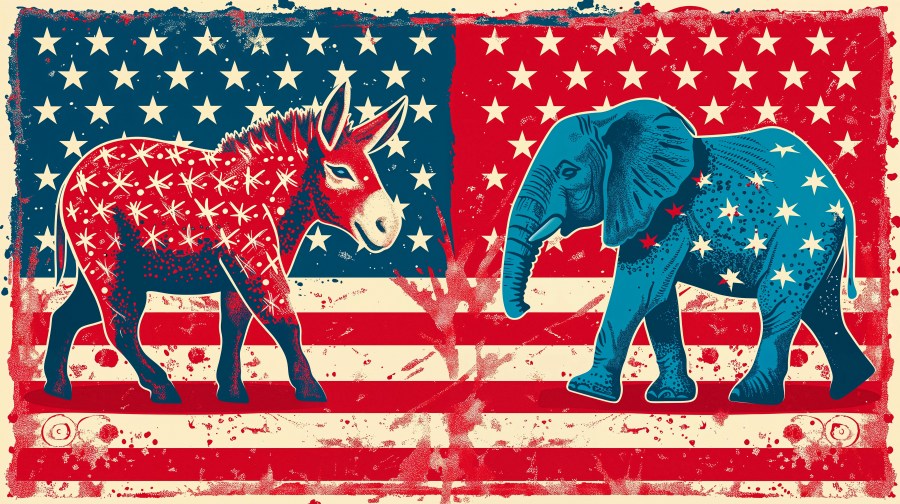
One party trumpets the MAGA slogan, but both the Elephant and the Donkey want to see America great again. They just seriously disagree about what the nuanced outcomes entail. Sadly, for both parties, greatness means some version of sassy rhetoric, fat-cat wealth, savvy power bases, and the firepower to successfully obliterate whomever they deem the enemy. Precise applications of such supposed greatness are what’s up for debate. This prescriptive understanding of greatness—both greatness of individual leaders and what greatness should look like for a collective people—is painfully flawed. It’s true on either side of the aisle. I feel sickened and saddened by such a despicable description of greatness.

Jesus supplied a deeply different understanding. He taught his disciples that true greatness means learning to humbly serve others (Mark 9:33-35) based on holistic, integrated love (Matthew 22:34-40). I know, this probably sounds like a pie-in-the-sky platitude, a hearkening back to Mayberry or Walton’s Mountain. But Jesus said it. Greatness is born of humble service. Will we believe him and work like that’s true in our own everyday vocations—including political and governmental responsibilities? In his book The Integrated Life, Ken Eldred argues for people to live all of life—especially their everyday work—fully informed and integrated with their faith. That means great leaders humbly serve others.[3]

Greater guiding questions

Aiming to pull out of my sadness, I try to envision what true greatness might look like for my sons and so many others for future years. True greatness would look like a fuller integration of our faith in the public sphere, an integration that impacts not just our nation but the globe. Such integration must involve once again the twin concepts of character and service. Too many good people are allowing their own hunger for political power and economic comfort to control their allegiances, their choices, and their votes.

Why do we continue to defend leaders whose words are persistently malicious, whose moral choices are corrupt, and whose practices are ripe with deception? How long will we ridiculously look the other way when leaders are obviously corrupt through and through? Why do we continue coddling all sorts of vices just because a candidate supports our own favorite view related to abortion, or race, or healthcare, or immigration, or some other singular, deeply held issue? Too many of us pledge our allegiance based on myopic tunnel vision.

Character matters. Good character means being trustworthy, full of integrity. Good character matters because telling the truth matters. Leaders must be willing to tell the truth, first to themselves about themselves. Truth be told, we are not always good leaders, both at our core and in our actions. During a political campaign early in his career, Abraham Lincoln noted:

Every man is said to have his peculiar ambition . . . I have no other so great as that of being truly esteemed of my fellow men, by rendering myself worthy of their esteem.[4]

Note Lincoln’s great ambition. He realized that in order to be truly esteemed by fellow men, he needed to render himself worthy of that esteem. There was no sense of entitlement. In Lincoln’s leadership framework, self-rendering was essential to a sincerely great ambition.

O that we had more leaders today willing to tell themselves the truth and “render” themselves. Lincoln was relentless in self-examination, working on personal change—even altering his viewpoints and platforms when necessary. Then he avidly pursued active, hands-on service to others. Being a deeply, truly kind leader truly matters. I long for such leaders in public service today.

I wonder what would happen if more of our politicians—and especially the ones aspiring to be President—would ask this two-part, formative question every day when they wake up:

What sort of person should I be—in light of King Jesus—and what actions should I take in order to actually bless the people I serve, to intentionally create greater flourishing?

I hope we fail. I hope we fail miserably at the current crazed attempts to make and keep America great again. And may that failure open the way for us to understand a truer, kinder, stronger greatness. O that such greatness would be born of good character and genuine service on behalf of others.


[1]Gene Edward Veith Jr. God at Work: Your Christian Vocation in All of Life, 101.

[2]For a winsome analysis of Joseph’s integration, see Albert M. Erisman’s book The Accidental Executive.

[3]Ken Eldred, The Integrated Life.

[4]Doris Kearns Goodwin. Leadership in Turbulent Times, 1-20.