
Your Must-Do Work in the Snowstorm

blizzard

Wintry weather pounded our classic two-story, antique-Iowan home during January 1998. Nancy and I did not yet have kids, but we had a houseful of “kids” that weekend. Our church regularly hosted worship team interns, all late-teen and early-twenty-something students. This crew of courageous collegians regularly traveled two hours from Ankeny to serve on weekends. Typical accommodations involved guys bunking at our place, and the girls staying at another leader’s house nearby.

In typical fashion, the car full of friends made their trek on Saturday morning. By Saturday afternoon, a surprise snowstorm was brewing. By evening, Old Man Winter was blasting our vintage house with all-out-blizzard gusto. Sunday church was cancelled as wind and whiteouts piled on a foot of fresh powder. The “kids”—including a gaggle of other local young adults from our church—ALL piled into our place for the long weekend.

Our house was abuzz for three days. We watched movies (Harrison Ford’s high-energy, action flick Air Force One had just come out. “GET OFF MY PLANE!”). We gobbled homemade pizza, toppings-piled-high nachos, and thick pans of lasagna. We laughed. We teased (two of our interns were in their early stages of flirtation and dating). Feeling some compulsion to add a dash of productivity, we held a worship arts planning meeting (well, sort of). We philosophized. We fought and made up. (After all, who doesn’t squabble after being cooped up that long with that many friends?) We sang outrageously goofy songs, made breakfast together both Sunday and Monday mornings, and otherwise created some of the most marvelous memories.

Eighteen years later, there is a snowpocalypse forecast for a large swath of the US east coast. Pictures of empty bread aisles and abandoned milk coolers are posted across social media. While I cannot recreate that one-of-a-kind, blizzard ’98 experience, I can envision a handful of must-dos we can each carry into the forthcoming labor of these snowy days.

First, there will be surprises. So, let’s roll with joy. Looking back, it would have been easy to tell those young adults a polite “no, you can’t stay,” or even “GET OFF MY PLANE.” I do recall that Nanc’ and I had already experienced a jam-packed week. No doubt it would have felt good to have our own space and breathing room. But we have never regretted those three hilarious days, and we are so glad we rolled with the opportunity.

Second, work will emerge, accompanied by opportunities to lovingly serve others. While we thoroughly enjoyed the cabin full of friends, it was some serious labor to host and navigate that flight. During this year’s blustering storm, will you find neighbors to assist with shoveling or nearby friends to serendipitously invite for a meal? While making bread, stacking wood, or washing dishes—tasks that certainly seem mundane—we must choose Christ’s joy and servant-hearts.

Finally, make the most of the space, the sweet grace of extra time. With that crew of young adults, we made delicious food, played hysterical practical jokes, planned for upcoming Sunday services, and unearthed a treasure trove of marvelous memories. Whatever you do during this storm, you must make something. If you have a woodworking shop, use the time to build that table or refinish an antique chair that’s been gathering dust. If you’re married, home alone, just the two of you, make the most of your time together. Wink-wink. (Need I really encourage this? All studies show there will be a significant spike in hospitals’ maternity traffic approximately nine months from this weekend.) So, why not make something? You get the idea.

Perhaps such gracious time carved out by snowstorms might, after all, be more like what God intends for our normal Sabbath rhythms (Genesis 2:1-3). I too often forget that intentional holy disruptions are commanded and encouraged, integral to practicing our workplace theology. We are too typically too busy. Snowstorms and accompanying Sabbath are indeed for our good. When Jesus and his disciples walked through the fields and plucked grain on the Sabbath, the Pharisees’ critique and Christ’s summative teaching proved unique and mildly puzzling (Mark 2:23-28). At least one of Christ’s intentions was to help us embrace the empowering tension of Sabbath. Yes, it’s commanded. Yes, we’re to be spontaneous. Yes, it’s God-like. And yes, it’s VERY good for us.

Every one of those characters who camped at our house for snowzilla ’98 is now all grown up, working hard, and serving strong in God’s kingdom. Nanc’ and I would never dream of taking credit for such marvelous adults—they had exceptional upbringings with brilliant parents. But we can relish the reality that we were privileged to play a brief role, including those seventy-two hours. And oh, what a fun plane ride it was!

Stephen Cottrell, describing more sensitive Sabbath principles, urges us: “So never speak of wasting time or spending time. Rather, say you are enjoying it or giving it away freely. Never say you have an hour to kill. Rather, say you have an hour to revive, to bring to life, to ravish.”[1]

Let’s ravish our way through the upcoming snowy hours, fully embracing both the joyous work and wonderful people God brings onto our planes.

[1]Stephen Cottrell. Do Nothing to Change Your Life: Discovering What Happens When You Stop. (New York: Seabury Books), 2008, p. 69.

Orange Explodes—how to exponentially increase your creativity

Orange Fall Leaves

Call me ridiculous, but I must confess childlike delight. On my morning run, I caught first glimpses of seasonal beauty breaking through on the landscape. It’s early October, so I should not be surprised, but I’m still a kid in serious awe each autumn. Slowly descending a hill, there I spied it. Just atop a cluster of trees, an explosion of burnt-orange leaves. Within the next ten hours, I began seeing similar deep hues dusting other tree lines, including a fresh blast of golden mums and pumpkins, now gracing ground level in flowerbeds everywhere. Harvest orange has arrived for the season, in all its amazing glory.

Most of us love fall colors and find ourselves in awe at the creativity that emerges with the season. And it’s not just the leaves and overall fall decor. We experience it via multiple sights, sounds, and flavors. (Did I mention pumpkin spice coffee and salted caramel mochas?)

With such applause for fall creativity, there are moments I wonder . . .

  • How could I personally be more creative in my approach to projects?
  • Are there ways to gather more and better ideas?
  • How do I inspire our team in order to increase our skills in creative thinking?
  • ‘Any chance we can move out of “stuck in a rut” and “bored stiff?”

Here’s an arena where I’m constantly aiming to stretch and grow. Throughout my leadership experiences, I’ve found these ideas are extremely useful in exponentially increasing creativity.

Make time for story time!

I had heard of this practice, but rarely ever actually practiced it. So this past year, I have started to more regularly storyboard. It’s proving to be simple, profound, fun, and amazingly productive. I gather oversized whiteboard paper and various colors of Sharpie markers. At the top of several sheets, I label the various sections, breakdowns, chapters, or pivotal movements. Then, I just start splashing thoughts—somewhat color-coded—and brush stroking ideas under each heading. Along the way, we constantly push the envelope by asking “what if” questions and otherwise challenging assumptions.

I LOVE to use the “what if” question. It opens new doors, breaks through stereotypes, keeps people dreaming, and stretches the boarders in extra-good ways for leaders. When I’m done, I usually have six to ten sheets hanging on a wall, full of fresh ideas from which to choose. Such an exercise can be done either on my own or with our team. This past year, we’ve used storyboarding to deliberately design big initiatives, a fresh series of talks, and other exciting projects.

Go play!

Richard Allen Farmer urges: “The person who would be authentically creative must not despise the power of play. In our fun we see parts of ourselves we do not normally see; we get a different perspective on an old problem. We grab hold of images to which we would otherwise not have access.”[1]

In the 1990’s, Nissan was attempting a fresh breakthrough in design for their popular Pathfinder SUV. Jerry Hirshberg, head of Nissan’s U.S. design studio at the time, sensed one afternoon that his team was bogging down in frustration and blocked conceptual creativity. His solution was nothing short of genius. He led the company’s entire staff, including the shop, secretaries, and maintenance crew in playing hooky to go to the movies for the afternoon. Hirshberg delightfully reported: “Upon returning from the film, there was much chatter among the staff about how delicious it had been to leave . . . knowing we had been ‘baad’ together. As everyone returned to their work . . . tension in the building began to dissipate. Within days the ideas again started flowing, knotty problem areas unraveled, and the design began to lead the designers, a sure sign that a strong concept was emerging.”[2]

Here’s a must-do on a regular basis with your team, especially when you sense you might be stuck in a deep rut, paralyzed by group-think, or otherwise experiencing a serious case of no-new-idea-itus.

????????????????????????????????????????????????????????????????????????????????????????

Take big cues from your Creator!

The opening pages of God’s story demonstrate the magnificent collages and cadence of creation (Genesis 1). We are wondrously treated to an encounter where God is the most creative design worker ever. With completion of his oh-so-deliberate, colorful accomplishments each day, he pauses to reflect and celebrate. “And it was good!”

At the culmination of Day Six, humans were created in God’s likeness, his very image. Consider this: the imago Dei included our commission to be “fruitful, multiply, and fill the earth”—to “rule and reign” over it all. ‘No doubt about it, we were called to be creative workers, just like our oh-so-creative God.

When our boys were young, we took them to the circus. One of my favorite features was watching the elephant tricks. The crowd roared in laughter and thunderous applause. You have to admit, an elephant is a sure sign that God possesses a sense of humor as well as one mighty creativity quotient. But then ponder how the humans tamed and trained, “ruled and reigned” over the massive creature, so as to wildly entertain a tent full of other humans!

We can draw abundant motivation by remembering God’s amazing original designs, and then get motivated by the realization: we each possess the imago Dei. His very image and his call have come to you and to me.

What might happen? What if we hear God urging us in fresh ways?

“Create with panache. Work with style. Rule your domain with generous imagination. Make things wonderful. Organize with flair. Be boldly intentional. Design beautiful things. Make life healthier, humorous, holistic, and holy. Above all, mimic me and be lavishly redemptive. And when in doubt, choose orange!”


[1]Richard Allen Farmer, It Won’t Fly If You Don’t Try OR How to Let Your Creative Genius Take Flight. (Portland, Multnomah) 1992, p. 68.

[2]Jerry Hirshberg, The Creative Priority: Driving Innovative Business in the Real World. (New York: Harper Business) 1998, p. 87-89.

Rolling Back to Work (how to greet your dreaded fall schedule with greater joy)

Rollercoaster in clouds

I LOVE riding roller coasters, and I love the fact that my boys sincerely enjoy jumping on to join me. This was not always the case. I found a picture from several years back. We were trying to convince one son that the biggest coaster at Hershey Park would be a joy to ride. He stood in line waiting, growing more anxious, dreading every inch of the track, and longing to bail out. We managed to keep him in line, got him to ride, and he finished with a big smile. (Yes, this is before and after.)

Hershey Joel and JarodHershey Joel and Jarod after

Contemplate the concept of coasters. We can’t help but conclude it’s a bit crazy. Think about it. You willingly place your body into this large contraption of metal, plastic, wood, bolts, and thousands of moving parts. The aim of this device is to hurtle you down the tracks, throw you into loops, then send you screaming until your voice is hoarse. It’s really rather awesome and requires a crazy amount of faith.

‘Truth is, how we roll back into fall’s work-school schedule requires similar trust and adventuresome perspective.

I could read it in many friends’ eyes and hear it in their voices this week. It seems we are all plunging down the tracks too fast, headed back toward normal workweeks and ferociously full schedules once again. Some of us feel dread, disappointment, and self-induced preliminary stress over soon-to-be early wake-ups, oh-too-predictable meeting schedules, and an overall return to the ridiculously full-throttle pace. Sarcastically, we say, “I just cannot wait to get back to my marvelous, wonderful, oh-so-fulfilling daily grind.”

How do we roll in healthier ways? Is it possible to discover a different perspective when we already feel overwhelmed? How will we roll into the tedious tasks, piles of projects, and fall’s spike in work expectations?

Consider this provocative point of wisdom from Proverbs 16:3. “Commit your work to the LORD, and your plans will be established.”

Proverb on Work-Commit

This lead off, ancient Hebrew word “commit” conveys a potent, picturesque concept. Among Scriptural incidents, the word was used of rolling a boulder over the door of a cave to incarcerate enemy kings (Joshua 10:18). This same word played a pivotal role in the covenant scene for the Israelites of Joshua’s day, as they intentionally and devotedly rolled back into practicing circumcision and experienced their guilty reproach being rolled away (Joshua 5:19).[1]

Proverbs 16:3 challenges us to COMMIT, to deliberately let our work concerns, plans, strategies, and worries roll toward God. We can commit to rolling our work issues, opportunities, and each endeavor in God’s direction, trusting Him to empower, infuse significance, and establish our plans. Rolling our trust His way can transform our attitudes from dread and gloom to adventure and productivity.

Consider three simple yet profound ideas for how to roll stronger as you head back to the normal full schedule for the work-school routine.

With start of fall, start a new habit. Commit your work to the Lord with start-of-the-day prayer. Too many mornings, we rush into our mad dash, forgetting to actually tap into our Lead Consultant’s great guidance. What might happen if we slow down at the start, to actually roll our concerns, challenges, and opportunities in His direction? Such transference of trust can lead to a deeply personal transformation, bringing greater peace and joy.

Commit to go God’s way—follow His directions—in all you do and say all day. As you trust Him and consult His Word, He will supply you with real-time wisdom, commands, principles and precepts that challenge the norm, set you on new paths, and call you into fresh opportunities for influence. Determine and say, “Lord, each step of my workday, I’ll roll your way!”

Roll into your fall work and full schedule with a fresh sense of adventure. Commit to greater productivity, creativity, and pursuing God’s mission. It’s wonderful to realize that God planned long ago for us to engage in purposeful, creative, difference-making work (Genesis 2:15, Ephesians 2:10, and Colossians 3:23-24).[2] When we truly sense how our daily work can bring God glory and reach others with his redemptive plans, even the seemingly mundane, thankless tasks and pressurized schedules can take on serious joy and significance.

With such deliberate prayer and a greater sense of adventure with God, we can be “on a roll” with fall’s work, bringing God glory with greater productivity—experiencing almost as much joy as riding roller coasters. Instead of dreading it, let’s revel in it. There is phenomenal opportunity for our fall endeavors to bring him greater glory!


[1]Harris, Archer, and Waltke, Theological Wordbook of the Old Testament, (Chicago: Moody Press), vol. 1, 162.

[2]Wayne Grudem, “How Business In Itself Can Glorify God,” On Kingdom Business: Transforming Missions Through Entrepreneurial Strategies (Wheaton: Crossway), 132-133.

Workplace Sex Trysts: A Strategy for Standing Strong

?????????????????????????????????????????

Diet Coke, circa mid-90’s, flaunted one very steamy TV ad. An office full of women suddenly begin whispering to each other, “It’s 11:30.” As the commercial commences, they scurry to the office windows to ogle. A male construction worker on ground level removes his sweat-soaked shirt and begins lusciously drinking a Diet Coke. Apparently, this has become a daily workplace ritual for these women. Though lusting should never be a laughing matter, the commercial’s format draws a chuckle twenty years later. The gawking women wear big-framed 80’s eye-wear and oh-so-poofy hair; the bare-chested eye candy is sporting a far-from-chiseled four-pack. And in retrospect, what real man sips Diet Coke anyway?

Workplace temptation runs rampant. Place people together for extended blocks of time, working close on endeavors of big consequence, and the affection temperature is bound to rise. Glances are exchanged and soon feelings are shared; flirtation seems innocent, but sparks begin to fly. Then all too quickly, something hotter kindles. So how can we develop a strategy for sexual integrity in our workplaces, a wholesomeness that matches Christ’s heart for business leaders and workers in every profession?

The young biblical hunk, Joseph, stands as a stunning example in overcoming workplace temptation. Genesis 39 records the racy scene. Promoted to second in command over a large estate in Egypt, Joseph soon caught the wandering eye of the owner’s wife. Mrs. Potiphar repeatedly made her temptress moves, “day after day,” the story records. Joseph repeatedly resisted, finally stating emphatically that such indulgence would be a serious violation of his relationship with God (Gen. 39:9). This young man’s conviction and stance, so far away from his father Jacob’s oversight, was astounding. Finally, Joseph employed the best strategy ever. In a moment of brilliant insight, he did the most courageous thing. He ran away! (explore more on such a strategy in 1 Corinthians 6:17-20) His reward? He was quickly framed by the scorned, pouting, plotting temptress. (I know, shocker!) And he was promptly tossed in the deep, dank confines of prison. (See the rest of the story in Genesis 40 through 50.) Tom Nelson elaborates: “When it comes to sexual temptation in the workplace, we don’t have to go out of our way to look for it; it often finds us. Joseph’s wise response to sexual temptation in the workplace is a model for us to emulate. Joseph didn’t cozy up to sexual temptation, he fled from it.”[1]

?????????????????????????????????????????????????????????????????????????????????????????????????????????

What’s the big deal? Our core struggle with lust is that we imagine how people can be used for our self-serving interests instead of genuinely loved. God’s style of selfless love aims at practically caring for others’ best interests, not using or abusing them. How do we develop a strategy, to stand strong against workplace temptation, or as in Joseph’s case, to decisively run away? In Taking Your Soul to Work, R. Paul Stevens and Alvin Ung urge these five strategy steps:

(1) Know that your heart’s desires are for God. Hunger and passion for God put all lesser desires into perspective. (2) Reduce exposure to erotic stimulation in your choice of movies, novels, and Internet sites. Put a plan in place that will help you avoid temptation on business trips. (3) Pray for a colleague, a customer, or a supervisor whom you find attractive. Choose God’s perspective on the person instead of treating her/him as “just a body” to be visually consumed. (4) Seek accountability partners. (5) Identify the early beginnings of lustful thoughts. Heightened vigilance in advance allows you to be more responsive to the Spirit’s guidance.[2]

Instead of being trapped in daily rituals of workplace lust and other sexual sins, we can stand strong. We can run away, stay pure, and truly honor Christ. We can honor others with more wholesome love at work.

[1]Tom Nelson. Work Matters: Connecting Sunday Worship to Monday Work. (Wheaton: Crossway, 2011), 173.

[2]R. Paul Stevens and Alvin Ung. Taking Your Soul to Work: Overcoming the Nine Deadly Sins of the Workplace. (Grand Rapids: Wm. B. Eerdmans Publishing, 2010), 26-31.

4 Reasons You Can Whistle @ Work

?????????????????????????????????????????????????????????????????????????????

I could not help but chuckle. My morning walk on the golf course cart path was proving to be gorgeous. Leaves revealed a hint of fallish tint. The mid-September sky was bright, and the air was crisp. Amid the rustling treetops, birds were chirping, but I was suddenly struck by another high tone, piercing the soundscape. Overtop the birdsong and gentle hum of a green machine at work, there danced a stunning, pronounced melody. The tune was distinct, recognizably classic in cadence, echoing off the arcade of trees and turf. I scanned in all directions, eventually to discover that the beautiful whistling was coming from the lips of the hard-working grounds keeper. It was a stunning, spot-on-pitch performance—and he was oblivious to having an audience. ‘Top of his lungs, he kept whistling, and I laughed aloud.

Immediately struck with amazement and query, I thought, “It’s very early morning; his work is tedious, mundane, for sure. It’s repetitive and ridiculously thankless for that matter.” Confession: I’ve never gone back to the clubhouse after a round of golf to deliberately compliment, tip, or otherwise praise the grounds crew. But here’s this early morning laborer, whistling as he works, with volume level at Max 10.

So what gives? ‘Something special in his 5 a.m. java? How can the rest of us find healthier joy in our daily work, whatever we do? Based on God’s view of work, I’ll suggest four reasons we can whistle in our work this week.

YOUR WORK TODAY MAKES GOD SMILE.

God originally made us in his image—his very likeness as creative coworkers—and he called us to work. In Genesis 2:15, we discover that a great big part of this imago Dei and our original call was for humans to work the garden. The Hebrew word for work carries the ideas of labor, service, and worship. Originally, this was all good, all positive. Yes, Genesis 3 records the curse in response to the Fall, but work was originally a part of God’s very good plans for humans. In response to the Curse’s ugly consequences, God’s story unfolds redemptive plans to renew all of creation, including work and its creative outcome (Rom. 8).[1] When we work, God smiles.

YOUR WORK TODAY IS THE OVERFLOW OF GRACE.

Our everyday work is part of our living out God’s saving grace. He planned for it! Ephesians 2:8-10 reminds us that we are saved by grace through faith; it’s not of our own good works. Yet, we discover with verse 10 that the overflow of God’s creativity, his remaking us, is that we now ACTIVELY live out creative good works. Faith is indeed about DOING something. He planned in advance for us to accomplish good works.

WHATEVER IT IS—YOUR WORK CAN SERVE CHRIST AND MAKE HIM FAMOUS!

For your own deeper inspiration and recalibration of perspective, explore these verses. Soak up fresh motivation for the soul of your work. See 1 Cor. 10:31 and Colossians 3:23-24.

YOUR WORK MATCHES JESUS’ HEART, ACTIONS, AND MISSION.

Jesus’ own example and his kingdom teachings are full of business and workplace implications. Mark 6:3 tells us that Jesus was a tekton, one who works with his hands. We often forget that Jesus was a carpenter and/or sculptor many more years than he was the traveling rabbi and miracle-worker. As a result, Jesus knew business and marketplace workers. Perhaps this sheds some light on why the majority of his parables are infused with business context and kingdom principles related to everyday work scenarios. Tom Nelson reminds us:

“Working with his hands day in and day out in a carpentry shop was not below Jesus. Jesus did not see his carpentry work as mundane or meaningless, for it was the work his Father had called him to do. I have a good hunch that Jesus was a top-notch carpenter and did top-notch work . . . I am sure there were many things that made the Father well pleased, but one important aspect of Jesus’ well-pleasing life that we must not overlook was his well-pleasing work as a carpenter.”[2]

So, as the golf course greens keeper continued whistling, I found myself grinning and saying, “Sign me up! I want what he’s having!” God’s smile, great big grace, his glory, and Jesus’ own work—four reasons you can rejoice with God in your work today. Let’s get whistling!

??????????????????????????????????????????????????????????????????????????????????????????????????????


[1]Darrell Cosden, The Heavenly Good of Earthly Work. (United Kingdom: Paternoster Press, 2006), 86-91.

[2]Tom Nelson, Work Matters: Connecting Sunday Worship to Monday Work. (Wheaton: Crossway, 2011), 90.

Weed-Pulling @ Work

???????????????????????????????????????????????????????????????????????????????????????????????????????????????????

Mid-summer flowerbeds can be monstrously frightening. A few weeks back, dark mulch was rich and thick. Edges were crisp, and all was clean. That was late May. A mere six weeks later, ugly invaders have crept in. Early-fallen leaves, scorched by summer sun. Twisted twigs, dropped by thunderous episodes of the night. Scariest of all, prickly weeds, stray vines, and rogue tree-upstarts have taken over. What was previously pristine now appears dastardly devilish. However, last Friday morning, I overcame those foolish fears (including my sluggard tendencies). I mustered enough courage to machete my way into the sprawling plots to take on the insidious, wicked weeds. And I was triumphant! Now, the enemies have been vanquished; the beds have been beautified once again. Eden is restored (at least for this week).

I am struck with the primal necessity of tackling weeds. We were originally assigned the good work of the garden (Genesis 2:15), but such garden-work—all work for that matter—was cursed following the humans’ attempted coup d’état (Genesis 3). Thorns and thistles now spring up, yes literally—yet we dare not miss the metaphor such enemy invaders supply. The weeds and “sweat of the brow” take over what had previously been an uber-productive, marvelously creative, unencumbered workplace. All garden work—every workplace endeavor—is now a place characterized by more difficult, challenging, and even too often treacherous toil.

But greater news springs up! Because Christ’s redemption is far-reaching and will eventually transform Creation altogether (Romans 8:18-25), there is this important kingdom-work of weed-pulling. God’s grand story reveals the already-not-yet nature of Christ’s kingdom.[1] With Christ’s first coming and the inauguration of his kingdom, sin’s curse is indeed broken—AND then, there’s more to come! In all such interplay, we live with longing anticipation of all Christ will eventually fulfill, AND for now we work/serve by grace to impact all the God-glorifying, kingdom-advancement we can (Ephesians 2:10). In the here and now, we boldly work to pull weeds and make room for more creative, glorious beauty to spring up.

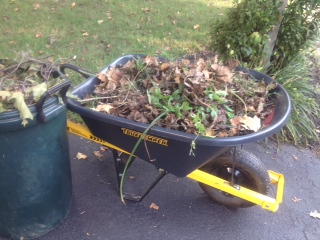
Wheel barrow of weeds

With such realization, there are numerous areas of daily work that might be labeled “pulling weeds.” Andy Crouch insists that “creation begins with cultivation—taking care of the good things that culture has already handed on to us.” Crouch asserts, “Cultivating also requires weeding—sorting out what does and does not belong, what will bear fruit and what will choke it out.”[2]

Allow me to suggest a poignant, mid-summer discipline for cultivating the soul and action of your daily work. Ask yourself two questions and make two answer lists.

First, what do I need to weed out of my own life and leadership habits, in order to make room for the greater work of God in me and through me? (Don’t skip this painful but highly important, personal cultivation step.) What needs yanked from your life to make room for fresh growth?

Second, what can and should be weeded from our workplace, business, or organization to make room for greater creativity and productivity? Two corollary, sub-questions: What should we stop doing in order to do the main thing of our mission more effectively? And what hard decision or proposed changes have we been putting off, but NOW is the time!?

Brilliant life-strategist Henry Cloud calls this pulling the tooth.[3] Too many of us put up with a nagging toothache for too long. Henry winsomely implores us to take action, now rather than later. Make the dentist appointment. Sit in the chair and get it pulled. Makes perfect sense for your mouth, so why not in your life and leadership at work?

Muster the courage to take action on attitudes, habits, negative people, and unfruitful team practices that really need to go. Pull the weeds, make room, and experience the joy of greater growth in your own life and your workplace this summer!

Mid-summer flower bed1


[1]Ben Witherington III supplies engaging discussion of such in his thoughtful work, Imminent Domain: The Story of the Kingdom of God and Its Celebration.

[2]Andy Crouch, Culture Making: Recovering Our Creative Calling. (IVP, 2008), 74-75.

[3]Henry Cloud, 9 Things You Simply Must Do to Succeed in Love and Life. (Integrity Publishers, Nashville), 43-67.

Joy @ Work—even the P.O.

Post Office—Rustic


Non-stop, the press reports that the US Postal Service has fallen on hard times, so it really wasn’t a stretch for my expectations to be low. I stood waiting at a local Post Office, a tiny, drafty storefront with just one customer station. I’m amazed they keep such Podunk places open; but then ironically, I still appreciate such convenience. The clerk was working to help the lone customer in front of me, but she was plodding, slow as molasses in January. I was annoyed by the worker’s sluggish pace and oh-so-obvious gift of gab. Certainly, she could move faster and cut with all the superfluous chatter. Some of us have places to go and tasks to accomplish today. Her every move seemed SO slow, and yet accompanied by joy-filled gibberish about everything—from the freezing temp’s to her mild jealousy over a coworker’s trip to Florida. All the while, she was ridiculously focused on serving this woman’s every postal need. Finally, when it appeared all was finished and it would be my turn, I heard, “Oh, now, do you need any stamps? The rate hike happens next week.” “Why, yes, I do,” replied the patron. “Thanks so much!” While maintaining a cool exterior, I grit my teeth. I was about to lose it in exasperation. When will it be MY turn?!

Upon further review, three simple, but powerfully important perspectives are present in this little scene.

First, my methodical clerk believed she was to serve the person right in front of her. I can’t help but recognize, intrinsically woven into this clerk’s work purpose is serving others, aiming to add real value. (And why did I find this so irritating? —a sure sign of my own rank selfishness. Despicable ME!)

Second, she placed cultivating relationships first, over the robotic, just get-‘er-done approach that runs rampant. In retrospect, kudos to post office lady for talking it up and putting a passionate priority on the person right in front of you! Kudos to the USPS for encouraging such relational focus in your team members!

Third, my uber-conversationalist clerk has obviously learned to enjoy her work while serving others. Can this really be? Is this actually legal? Dennis Bakke has written a rich resource, extolling the practice of joy at work.[1] Many of us were taught, our upbringing implied, or perhaps we mistakenly inferred, that work was a wicked result of the curse of sin, a rascally consequence of the biblical Fall (Genesis 3). In reality, work was part of God’s wonderful, original framework. He personally accomplished amazingly good work with the Creation in Genesis 1. Humans were created “in his image” (Gen. 1:26-27). Since we first encounter God as the ultimate worker, we must conclude he planned for us to be productive, creative workers as well. Genesis 1 makes it clear that at the wrap-up of each day, he found great joy, as he repeatedly labeled his work “good” and “very good.” He assigned the humans to “work” the Garden (Gen. 2:15). Certainly, the consequences delineated in Genesis 3 include work becoming more sweaty and arduous. However, in light of God’s original intentions, we dare not conclude that God intended our perspective on work to be perpetually horrific, a kill-joy outlook. Consider this: a part of Christ’s redemption includes our attitude in our work. Just last week, Pope Francis tweeted: “If we live the faith in our daily life, then our work too becomes a chance to spread the joy of being a Christian.”[2] There’s a wave of fresh realization—our perspective can become more like my exemplary postal worker.

Finally, it was my turn at the P.0. My package was quickly stamped. I paid. She smiled and talked. “I’ve worked for the Post office for 37 years. I really enjoy my job!” I grinned and replied, “It’s obvious; you exude joy! Thanks so much.” She beamed a big smile, and so did I. I was extra-glad that a few moments before, I didn’t go postal.


[1]Dennis Bakke, Joy at Work: A Revolutionary Approach to Fun on the Job, (PVG, 2010).

[2]@Pontifex, Jan 21