
What Might Tolkien Teach Us About Christmastime Stress?

Are you frazzled and flustered by the season? For fast-paced workers and business leaders, this most wonderful time of the year is also our busiest. Add to your plate the shopping, umpteen school programs, as well as extra baking, wrapping, and all sorts of crafting. Later nights plus earlier mornings often equal less sleep, which too readily leads to rascally illness and flat-out exhaustion.

We wonder at times, “Is all of this holiday stress a recent-days phenomenon?” And in our most reflective moments, we might ask, “Is there any way to find some deeper joy?”

I discovered an intriguing letter by J.R.R. Tolkien from December of 1937, the same year The Hobbit was first released. Written to his publisher, Sir Stanley Unwin, the opening excerpt is tremendously insightful:

16 December 1937                                                                            20 Nonhmoor Road, Oxford

Dear Mr Unwin,

I have been ill and am still rather tottery, and have had others of the common human troubles, so that time has slipped out of my hands: I have accomplished next to nothing of any kind since I saw you. Father Christmas’ 1937 letter is unwritten yet. …. My chief joy comes from learning that the Silmarillion is not rejected with scorn. (The Letters of J.R.R. Tolkien, edited by Humphrey Carpenter and Christopher Tolkien, 2000)

‘Fascinating to consider. We might mistakenly assume that Tolkien would have been having a most magical Christmas in light of his book’s successful debut. Instead, this letter reveals one worn out, stressed out, time-crunched, regretful author. He’s even feeling very tardy about his annual tradition of writing the Father Christmas letter for his children.

I find some sense of comfort in the reality that even a highly successful individual such as Tolkien was battered by Christmastime stress. Perhaps it’s not exactly the new-to-our-generation development for which we are too readily prone to accept heaping doses of blame.

But I’m also stirred by the realization that in the midst of his exhaustion, seasonal trouble, and time pressures, he was intentional to discover some glimmer of joy. The Silmarillion was Tolkien’s collection of writings, material totally foundational to The Legendarium. This robust body of work supplied stunning backstory, crucial keys for a fuller understanding of Middle-earth. In 1937, The Lord of the Rings was not yet even a twinkle in Tolkien’s eye or a wispy puff from his pipe. But The Silmarillion, well those tales of the early ages already danced as quite elaborate smoke rings. They were Tolkien’s driving passion and delight. He had recently pitched the collection to his publisher. With this letter, he was simply finding joy in the fact that Unwin and company had not resoundingly rejected it.

Throughout years to come, they would stall Tolkien off again and again on his quest to have his magnum opus placed in print. In fact, The Silmarillion would not be published until after Tolkien’s death forty years later, and only then through the earnest of his son, Christopher. Of course, Tolkien went on to craft and see the Rings trilogy successfully published as well as other masterpieces. But each of these works had their grand basis in Tolkien’s pride and joy. How fitting that in this dusty old letter from 1937, our beloved professor discovered some joy related to his masterpiece, a joy that buoys his otherwise flustered spirit.

I am moved in the midst of my own hustle and bustle of the season with these two rich realities.

First, there is something life-giving and rejuvenating about slowing down enough to celebrate simple goodness in projects you are accomplishing—yes, even the potential good that others might see. Such reflection on The Silmarillion brought Tolkien delight amidst his hectic Christmas of 1937. And I am reminded that similar reflection brought the original Creator great delight at the wrap up of each day of his creating (Genesis 1).

What have you been creating this year? Amidst all of the challenges and setbacks, what has proven productive? What product line is making some progress? Is there a group of leaders or students in whom you are seeing real growth? What project have you been bringing to life, perhaps one you sense is starting to take shape? Amid the Holiday rush, take intentional time to pause, celebrate, see the good, and rejoice!

Second, I am encouraged to realize I am not alone in the rush and push. Neither are you. Tolkien was acquainted with feeling overwhelmed at Christmastime. And don’t forget, so was that holy family over two millennia ago as they wearily entered the gates of Bethlehem. Winsomely, Mary found time to ponder and treasure all these things in her heart (Luke 2:19).

I am stirred to intentionally make time in the midst of the stress and exhaustion, time to reflect and encounter greater joy. May we all!




If You Dare, A Labor Day Prayer

Throughout the years, I’ve noticed a mischievous thing about Labor Day weekend. If I’m not careful, I miss it. I can get so caught up in the sensational hoopla of picnics, yard work, or a last-hurrah-of-summer getaway that I mindlessly skip over this holiday’s true significance.

Might we dare to think, stir, and move a step or two deeper this year on the meaning and opportunity of Labor Day weekend?

Originally, Labor Day was so much more than a calendar marker for wrap-up of summer, the pool’s closing, and launch of all things flavored pumpkin spice. Call for such a day was the creation of the labor movement and dedicated to recognize the social and economic achievements of American workers. It constitutes a yearly national tribute to the contributions workers have made to the strength, prosperity, and well being of our country. The first state bill for Labor Day was introduced into the New York legislature, but the first to become law was passed by Oregon on February 21, 1887. During that year four more states—Colorado, Massachusetts, New Jersey, and New York—created the Labor Day holiday by legislative enactment. By the end of the decade Connecticut, Nebraska, and Pennsylvania had followed suit. By 1894, 23 other states had adopted the holiday in honor of workers, and on June 28 of that year, Congress passed an act making the first Monday in September of each year a legal holiday in DC and the territories.

I’m afraid we too often forget just how meaningful and significant our daily work is in the scope of God’s original call to humans (Genesis 1-2) and his ongoing redemptive plans (Ephesians 2:8-10). For disciples of Jesus who are seeking to actively grow in holistic faith, there’s a thought-provoking, responsive prayer, originally penned by Jim Cotter and Paul Payton.[1] If we dare to pray this prayer, it might just refocus our outlook and help guide us into an even more robust, holistic perspective on the vital role our work plays in God’s great work in this world. It goes like this:

Leader: Let the sowers of seed bless you, great God, the gardeners and farmers sing your praise.

Everyone: May the fishers and foresters bless you, Beloved, praise your name and glorify you forever.

Leader: Let the bread from grain bless you, great God, the wine from the grape sing your praise.

Everyone: May the transformations from cooks bless you, Beloved, praise your name and glorify you forever.

Leader: Let the spinners and weavers bless you, great God, the designers of clothes sing your praise.

Everyone: May the salesmen and retailers bless you, Beloved, praise your name and glorify you forever.

Leader: Let the sounds and silences of music bless you, great God, the great composers sing your praise.

Everyone: May the improvisers of jazz bless you, Beloved, praise your name and glorify you forever.

Leader: Let the software and civil engineers bless you, great God, the architects sing your praise.

Everyone: May the pastors and clergy bless you, Beloved, praise your name and glorify you forever.

Leader: Let the marketers and advertisers bless you, great God, the entrepreneurs sing your praise.

Everyone: May the attorneys and judges bless you, Beloved, praise your name and glorify you forever.

Leader: Let the educators bless you, great God, the academics and authors sing your praise.

Everyone: May the doctors and nurses bless you, Beloved, praise your name and glorify you forever.

Leader: Let the sculptor and scientists bless you, great God, the business owners and janitors sing your praise.

Everyone: May the artists and baristas bless you, Beloved, praise your name and glorify you forever.

Amen.

We’ve prayed this congregational, responsive prayer in our church’s worship services. Might you dare to pray it personally, share it with friends, and even potentially share it in your congregation?

[1]Jim Cotter and Paul Payton. Out of the Silence . . . Prayer’s Daily Round (with changes by Mark Mohrlang and adapted here for congregational responsive prayer).

The Messy Middle—when you’re not flourishing

My three sons are now enjoying the zenith of their youth. With thick hair on their heads, they readily revel in highlighting their dad’s graying, thinning, Friar Tuck up top and his less-than bulging biceps. I remind them that I can still take them any day in a wrestling match. They grin and sport a “We wouldn’t want to hurt you; we still need your paycheck” look.

This summer alone, my two oldest are adventuring for work and mission in Los Angeles, Port-Au-Prince, Moscow, and D.C. If he’s lucky, their father might trip off to New Jersey some evening if there’s a little gas remaining in a vehicle. Sure signs of my own middle age on Middle-earth.

That’s all tongue-in-cheek. Really. I’m seriously thrilled my boys are flourishing. And there’s our beloved buzzword. It’s everywhere these days, zooming about in the titles, texts, subtitles, and subtexts of the latest, greatest, brightest, and mightiest of current thinking on the good work and Good News for our desperate world.

“God wants humans to flourish.”

That’s true. I concur that from the earliest pages of the Gospel story to the final shout of Revelation’s victory, God is working for his humans and all creation to experience redeemed flourishing—all for his glory.

But my heart is aching these days for the messy middle where most of us spend so much of life. What about the hard-working entrepreneur whose best-made strategies seem to produce zilch in profits five years in a row? What about the uber-creative, aspiring artist who can’t land an agent or garner more than fifty followers on Twitter? What about my beautiful friend from high school who’s passionately checking off her bucket list as she battles cancer? And there’s my friend serving in that stifling hot, undisclosed location on the other side of the globe, laboring to learn a new language, to make new friends with Muslims and somehow make ends meet—all for the good of Jesus’ kingdom work.

I’ve been reminded lately that this messy middle—the graying, not-so-flourishing places where most of us live most of life—can actually be a very good place. Dusty words from the old prophet Habakkuk supply some beautiful ugly perspective:

“Although the fig tree shall not blossom, neither shall fruit be in the vines; the labour of the olive shall fail, and the fields shall yield no meat; the flock shall be cut off from the fold, and there shall be no herd in the stalls:

Yet I will rejoice in the Lord, I will joy in the God of my salvation.

The Lord God is my strength, and he will make my feet like hinds’ feet, and he will make me to walk upon mine high places.” —Habakkuk 3:17-19 (KJV)

Such vivid description of NOT flourishing! But right there, Habakkuk made the choice to rejoice and find his strength in the LORD God.

How do we become such joy curators & joy carriers, especially when it feels like we are not flourishing? Here are 7 ideas you might find empowering in the messy middle:

Create more holidays! Recall that holidays were originally HOLY days, like Sabbath and festivals. Why such intentional plans? God himself celebrates, delights, and gushes joy, even at the end of each day of Creation (see Genesis 1-2)!

Celebrate thanksgiving daily, not just in November. Deliberately make lists of situations, people, and provisions for which you are grateful. It’s tough to stay stuck in doom and gloom, pessimism and skepticism, when you are reflecting thanks.

Laugh on wholesome humor. If you need a kick-starter, go watch a couple clips from Michael Jr. or Tim Hawkins on YouTube. Get ready to laugh.

Hang out with joyful people. They are contagious!

Break from your devices. Sometimes, we think we’re not flourishing because we’re stuck playing comparison games with everyone else’s stunningly beautiful lives as portrayed on Fakebook and Instacram. Admit it; you might need a break.

Bless and serve others! There is something SO uplifting, therapeutic, Jesus-like, and joy-producing about deliberately focusing on other people’s needs, interests, and opportunities.

Start now. Choose joy in the present! Psalm 118:24-25 motivates us: “The Lord has done it this very day; let us rejoice today and be glad. Lord, save us! Lord, grant us success!” (NIV)

Even in such messy middle, those seasons when it seems like our work and overall life is not flourishing, we can make our bigger discovery—this choice to rejoice. We can find fresh strength in Christ. Maybe, just maybe, we’ll discover there’s actually something new beginning to flourish in our souls!


How Cheesy is Your Job?

I love cheese! In our kitchen, cheese is often employed at all three meals of the day (Yes, even at breakfast on my bagel with an egg and pepperoni). Cheese makes everything taste better! Apparently unbeknown to many of us, we have been sprinkling our spaghetti and meatballs with a bit more than the green and red canisters claim.

Stunning news broke last October. The president of Castle Cheese in Slippery Rock, PA was sentenced to two hundred hours of community service, a five thousand dollar fine, and three years probation. The offense? Her company was caught selling Parmesan cheese that was not fully cheese.

Both the U.S. FDA and IRS raided Castle Cheese’s facility in early 2013 and discovered their products included substitute ingredients such as cellulose, an additive produced from wood pulp. The problem of adulterated cheese is not limited to Castle’s plant. A Bloomberg News report in February 2016 cited broad-based, nationwide test results of various companies claiming to sell 100 percent grated Parmesan. An independent lab found cellulose levels as high as 8.8 percent.[1]

What’s the big deal, besides my gag reflex at the thought of digesting wood chips with my pasta? Why such public outcry and legal proceedings? Two correlating issues are in play, issues that actually hold big personal implications for our own jobs every day.

First, integrity in business is at stake. What do we expect to be produced by a cheese company? Well, um, cheese please. (And though some cellulose supposedly serves as a non-clumping agent, our collective conscience demands that what they say on their label will truly be what they are really selling.) Before we get too high and mighty, judging the cheese makers’ false blend, let’s take stock of our own work products and services. Our customers and clients expect nothing less of our ingenuity, time investments, and relational focus.

Will we step up as leaders, to design and deliver our most creative, thoughtful, and empowering goods and services? We are amazingly created in God’s image (Genesis 1:26-28) and whatever our daily tasks, we are called to serve the Lord Christ (Colossians 3:23-24). With such divine identity motivating us, there can be an ever-growing uptick in the quality and integrity with which we work.

Second, there’s a crucial link between such authentic excellence and our witness for Christ. Tom Nelson urges us: “The excellence of our work often gives us the credibility to speak of the excellence of our Lord Jesus and to share the good news of the gospel with our coworkers.”[2] We want to be sure that with both our words and our goods, we are serving up beautiful, deliciously genuine helpings of the gospel!

Bottom line: No wood filler in our work.

Let’s make certain our jobs are very cheesy!


[1]https://www.bloomberg.com/news/articles/2016-10-11/cheese-executive-gets-probation-fine-for-fake-parmesan

[2]Tom Nelson. Work Matters: Connecting Sunday Worship to Monday Work. (Wheaton: Crossway, 2011), 96.

Paperwork OR Peoplework? You’re probably PARALYZING your productivity!

I was first asked the insidious question many years ago as a student in a leadership workshop: “Which are you?” I naively assumed it was a valid question, a thoughtful call for leadership categorization.

HGTV’s hit show insists their contestants “Love it OR List it.”

People are commonly either “dog people OR cat people.”

As a passionate coffee lover, I often encounter folks who are either “coffee lovers OR tea lovers.” I rarely meet someone who claims allegiance to both beverages. (And anyway, how could a tea lover also appreciate coffee? I say you’re either strong OR wimpy.)

So which are you? Tasks and details-oriented OR people-oriented and more contemplative?

Either-or thinking flows naturally in so many arenas of life. BUT when it comes to work life, I believe our productivity often suffers from such either-or attitudes and actions. We say things like:

“I thrive on relationships and time well-spent with others. C’mon, pour more coffee. Let’s chat, build trust, and bask in the process. But please, I don’t do the administrative stuff.” The result? There’s usually great talk with others, but little if anything actually gets produced.

Another coworker might declare, “Bring on the tasks, strategies, and lists. Divide and conquer! But please, oh please, don’t make me work with other people!” Such go-getter leaders insist: “I push, drive, and accomplish. I’m HIGH D, baby! That’s me. So cut the relational crap. Let’s just get ‘er done!” And what’s the outcome? Great accomplishments abound, but there’s usually a serious body count in the process. (Even if it’s not right away, the carnage happens over time.)

“Tasks and deets” OR “people and contemplation?” Workplace assessments, personality profiles, and job satisfaction surveys often force people into such categorical buckets.

What if God’s view is much more integrated? When we analyze three of Holy Scripture’s hallmark work scenes, we make a unique discovery.

Work Scene 1: In the biblical book of Genesis, chapters 1 and 2, we find a detailed, poetic, methodical list of day-by-day accomplishments. There is no doubt about it—God is orderly and very strategic in sequence. AND in this same report, humans and our subsequent relationships—both with God and one another—prove to be the apex of the Creation encounter (Gen 1:26-2:3). God’s work cannot be tightly filed into either-or folders. God does BOTH.

Work Scene 2: When instructions are given for the building of the Hebrew Tabernacle during the Israelites’ wilderness wandering (Exodus, chapters 25-30), the Lord supplied a serious task list. (Admit it, many of us have lost it right here, our best Bible read-thru momentum has gone up in flames. ZZZZZZ.) We dare not miss the beautiful reality that God’s tedious tabernacle details culminate with a passionate focus on the skilled craftsmen named Bezalel and Oholiab. It was God’s oh-so-personal impartation of his Spirit that empowered them to accomplish their tasks. God’s work cannot be tightly filed into either-or folders. God does BOTH.

Work Scene 3: The Gospel accounts reveal God’s Son, Jesus, working with similar modus operandi. Christ remarkably blended accomplishment of tasks, his focus on details with his priority for people and relational/contemplative cultivation (See Mark’s Gospel, chapter 6, verses 30-44 for Jesus’ both-and blend in this story. Five thousand+ people enjoy an amazing picnic!). The God-Man did both.

If you’re more of a task-oriented person, marvelous! Bridges would collapse without the engineers and code enforcers. Cars and trucks would not make it down the road one mile if we lacked auto designers and mechanics. You rock! Local and global economies would crash without the pencil pushers and number crunchers. God’s work in this world needs you. We need you and your penchant for spreadsheets and schematics. We applaud you!

And there are those of you who are all about the conversations, extended times of deeper contemplation, and fostering dynamic connections. You lunch meeting experts and relational gurus, thank you! You keep us caring, encouraging, feeling, healing, networking, learning, and growing. God’s work in this world needs you. We need you and your bent toward conversing and flourishing with others.

But over the years, I’ve observed: Most of the most effective leaders deliberately develop a skillful blend. They’ve learned to do the dance between details and people. They resist the bog-down and paralysis that often comes with either-or thinking. How can we do that in our own businesses and workplace leadership?

  • Push back against your own either-or thinking. You’re seriously limiting your own potential and the productivity of your business when you willingly decide it has to be either-or. Instead, embrace attitudes and daily patterns that involve both strategic tasks AND loving conversations with people. Dare to embrace this bolder, image-of-God reality. You CAN do both!
  • Don’t aim for perfect balance in this crucial leadership choice. Balance is a ridiculous pursuit. Instead, shoot for a God-like blend, skillfully choosing between people and tasks as opportunities emerge. Since the Lord is our ultimate example of a creative leader and flourishing worker, let’s dare to cultivate such a tasks-people blend in our workplace approaches.
  • If you’re more task-oriented, deliberately schedule more people time. Hans Finzel warns us about “putting paperwork before peoplework.” (The Top Ten Mistakes Leaders Make, chapter 2) When you create greater margin for relational cultivation and reflective contemplation, you’ll likely see an exponential increase in your quality of connectedness with others and subsequent productivity in teamwork.
  • People sometimes ask me how I get so much done while being strongly relational in my approach. I smile and tell them my secret weapon. I make aggressive task lists. Now because I personally bristle at the thought of being too task-oriented, I label my uber-full weekly list as “OPPORTUNITIES this Week.” (You’re probably chuckling and calling me out: “Okay, Pletch is crazy—just playing a semantics game.” But hey, it works for me. Really!) And the silver bullet is this: My “OPPORTUNITIES” list always includes more people with whom I’m aiming to connect, equip, and cultivate.

What have you found best helps you push back the either-or approach and more fully live out God’s beautiful blend of details and people?  

Make Something

Wind and the wintry mix were pounding our roof as I awoke. (‘Must confess, the little kid deep inside me said, “Ah, the storm did indeed arrive.”) After a foray outside with Brody, our golden retriever, I began the joyous task of carefully stripping newspaper, strategically clumping kindling, and then lighting the flame. Within moments, my boys were gathered around, basking in the glow.

I’m struck with the integral connection between holy interruptions in our regular schedules—these God-appointed disturbances, like snowstorms—and the opportunity to make something. We learn of the God who oh-so-creatively makes things in Genesis 1. Many years later, Jesus reminded his critics that his Father is always working (John 5:16-18). So I’m challenged today with the opportunity.

I can make the most of the space, the sweet grace of extra time. I sense the Lord’s promptings today. “John, whatever you do during this storm, you must make something.” Just perhaps, we might each hear his whisper carried on the winds and driving flakes of snow. Build the fire and keep it burning all day. If you have a woodworking shop, use the time to build that table or refinish an antique chair that’s been gathering dust. Make french toast—and bacon, and eggs, and waffles. Go all out. Throw on your warmest snow clothes and go make memories—even just thirty minutes worth—with your kids. If you’re married, home alone, just the two of you, make the most of your time together. Wink-wink. (Need I really encourage this? All studies show there will be a significant spike in hospitals’ maternity traffic approximately nine months from this wintry blast.)

So, why not make something? You get the idea.

Perhaps such gracious time carved out by snowstorms might, after all, be more like what God intends for our normal Sabbath rhythms (Genesis 2:1-3). I too often forget that intentional holy disruptions are commanded and encouraged, integral to practicing God’s intentions for our workplace theology. We are too typically too busy. Snowstorms and accompanying Sabbath are made by our all-wise Father, for our good. When Jesus and his disciples walked through the fields and plucked grain on the Sabbath, the Pharisees’ critique and Christ’s summative teaching proved unique and mildly puzzling (check out Mark 2:23-28). At least one of Christ’s intentions was to help us embrace the empowering tension of Sabbath. Yes, it’s commanded. Yes, we’re to be spontaneous. Yes, it’s God-like. And yes, it’s VERY good for us.

Stephen Cottrell, describing more sensitive Sabbath principles, urges us: “So never speak of wasting time or spending time. Rather, say you are enjoying it or giving it away freely. Never say you have an hour to kill. Rather, say you have an hour to revive, to bring to life, to ravish.”[1]

Let’s ravish our way through the upcoming snowy hours. Now go make something!

[1]Stephen Cottrell. Do Nothing to Change Your Life: Discovering What Happens When You Stop. (New York: Seabury Books), 2008, p. 69.

Brave and Beautiful Work with Words

Sara Bareilles’ hit song “Brave” boldly proclaims: “You can be amazing, you can turn a phrase into a weapon or a drug . . . Say what you wanna say, and let the words fall out. Honestly, I wanna see you be brave.”

Sara’s lyrics provocatively remind us of the power of our words to accomplish some things rather wonderful. This should not surprise us when we consider that our Creator, the first and foremost worker, originally labored with skillful words. Genesis 1 paints a masterful picture of God’s extraordinary, skillful design of the world and humans. Marvelous to remember, his primary modus operandi was his word.

“And God said . . .” is the leading phrase. And at the culmination, on the sixth day, he created humans to reflect his very image.

My own hermeneutical training encourages me to understand this section of Sacred Writ as a blend of literal, historical account conveyed with beautiful, poetic utterance. Hence, God’s own work with words joins with the subsequent work of human writing, producing a powerful picture of words at work!

As an author and speaker in the twenty-first century, I am terrifyingly tasked with trafficking in words. Consequently, I can deeply resonate with Bareilles’ sentiments. There are times my words may be a weapon; other times, a drug. And many days, they fall out as just sloppy and floppy, rather harmless, hopeless, and ho-hum.

I am oh-so-grateful for the supportive, endorsing words of five different friends, oh-so-kindly supplying a thumbs-up for my recent book Henry’s Christmas: A Story for Discovering God’s Joyous Work at Advent.

 henryschristmaslargefront

I’ll be featuring their comments in several upcoming posts, but I’ll share Chris Horst’s right now to get us started:

“The bookcases of most leaders are full of books on faith, work, and charity. But few of these books are as fun to read as Henry’s Christmas. In this festive tale, John Pletcher explores life’s most important questions—and our deepest longings—through the lens of a story. This spirited book is a fresh and engaging guide to the Advent season.”

—Chris Horst Vice President of Development, HOPE International, author of Mission Drift, and founder of dadcraft

chris-horstGreat thanks, Chris, for such a hearty endorsement! Reminiscing, I recall eight words, written atop a term paper’s final page during my senior year of college. The prof simply penned: “This is good writing! God can use you!” The day I read those words, they sank deep and did something very solid in my soul, spurring me to be brave, to dare to traffic in words.

Personal app: How will your words accomplish very good work today? How will you encourage someone, express gratitude, or verbally share something beautiful, bold, and brave?


If You’re Dreading Going Back to Work . . .

worker at old typewriter

I grew up dreading work. My father was a loving dad, but like many parents, he was set on cultivating a monster work ethic in his son. This included bailing hay in scorching August heat. (Can you sympathize with a scrawny middle school kid, drenched in sweat with scratched up arms?) Dad also tossed me underneath vehicles and had me turning wrenches when I was very young. (Apparently, he had no appreciation for child labor laws.) I got bloody knuckles, along with crumbling rust and dripping grease on my face. When Dad discovered I was not mechanically inclined, I was handed a broom and assigned cleanup duty in his shop. Yes, I grew up dreading such manual labor. And I learned at an early age to dread going back to work, especially after a few days off.

Perhaps you have similar sentiments following this long holiday weekend. We readily think certain jobs are more glorious, while we deem other lines of labor to be of little importance. We categorize—there’s the “ordinary” and the “extraordinary.” There’s the “mundane” and then the “marvelous!”

If you’re in a season where you feel like your current job falls in the ordinary or mundane category, you probably need some fresh motivation to go back tomorrow. Consider these back-to-work motivators, straight from God’s grand story in the Bible (I’ve included pertinent biblical reference addresses so you can explore on your own.)

You’re actually being VERY God-like when you work!

When we first encounter God, He’s working; he made humans in his image to rule and to reign (yes, it’s royal lingo)—to lead strong in labor. Genesis 2:15 shares that God placed the man in the Garden of Eden to work it. It’s a rich word meaning “intentional service with an attitude of worship.”

As you head back to work, let this thought motivate you: “My daily work in whatever garden God has placed me is a seriously good way to live out God’s image, to serve others, and to worship my Creator!”

Our daily labors—our efforts, feelings, and overall outcomes—took a big tumble. (See Genesis 3:17-19) Our struggles arrived when work went topsy-turvy and fell along with all of the original Creation. The Curse entered the scene because of sin. Now, we encounter thorns, thistles, and sweat. Just knowing this certainly doesn’t make everything feel better, but it does lend us greater understanding regarding WHY work often feels so miserable. As you head back to work, let this motivate you:

God started working to redeem all of Creation—and this includes our work efforts and outcomes.

He extended grace to humans, and he chose Abraham. He called him to go and be a blessing! God said that all humans, every nation would be blessed through Abraham. (See Genesis 12:1-3) Let this motivate you as you return to work: God is working to reverse the curse, to bring us blessing, and that includes blessing for our daily labors!

God did not abandon his plans for human leadership in daily work. (See Psalm 8)

The psalmist emphasizes that we still “rule and reign” over God’s creative work. Whatever you do—whether scrubbing toilets, leading a sales team, flipping burgers, or mentoring kids during retirement—every task still matters to God!

Jesus was and is an amazing worker! 

We often forget, long before He was the miracle-working rabbi, Jesus was originally a carpenter, probably taking over Joseph’s business. When confronted by critics, he said, “My Father is always working, and I myself am working.” (See Mark 6:2-3 and John 5:16-18.)

Don’t miss this motivator for tomorrow’s labor:

Your daily work can be infused with greater meaning—real significance—as you focus on pleasing Christ.

Recently, people shared with me on Facebook & LinkedIn their favorite thing and their most frustrating thing about their daily labor. A guy working for the water company told me his favorite work feature is “working outside,” and his most frustrating is “working outside.” Another person said her favorite is “working with the public,” and her most frustrating is “working with the public.”

Randy Kilgore encourages us: “Who we work with and who is impacted by our work are not merely economic considerations; these issues are part of our spiritual service. Work is not merely a means to an end or a place to put in time or raise funds. Our workplace can be holy ground . . . faithful service to the Father.”[1]

MadetoMatter

Paul’s words in Colossians 3:23-24 supply rich motivation:

“Whatever you do, work at it with all your heart, as working for the Lord, not for human masters, since you know that you will receive an inheritance from the Lord as a reward. It is the Lord Christ you are serving.”

One final motivator: The future is bright with God’s plans for human work.

In God’s grand story, Eden will be restored as the culmination of Christ’s work, and work will be fully redeemed. Houses will be built; crops will be planted; children will be raised. We will indeed still work, and it will be work like we have never worked before! (See Revelation 22:2-5 and Isaiah 65:17, 19, 21-23)

Let’s head back to work with “all our hearts,” remembering that our daily work marvelously matters to God!

motivated worker

[1]Randy Kilgore. Made to Matter: Devotions for Working Christians. P. 92.

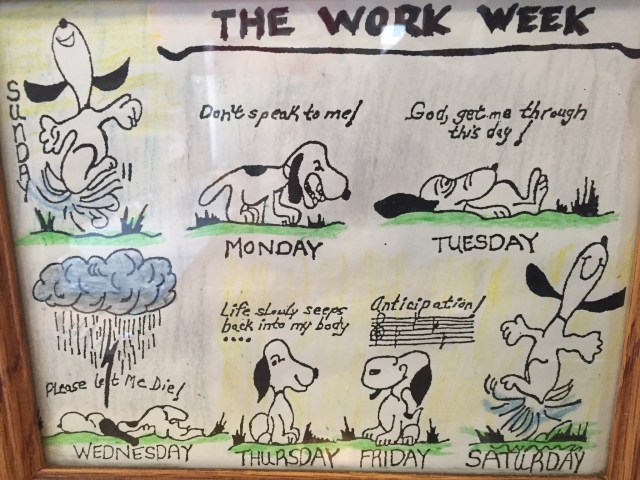
How Do You REALLY Feel About Your Workweek?

Workweekcartoon

The cartoon hangs in one of my favorite pizza shops. As I pay for my pizza or hoagies, I can’t help but chuckle. Each week, we ride a wild roller coaster of emotions related to our workplaces. And honestly, who among us doesn’t live for the weekend?

But WHAT IF that could be different? Consider these possibilities:

  • What if you gained a renewed attitude and learned to bring meaning to your tasks and appointments, instead of striving to find meaning in your daily work?[1]
  • What if this renewed outlook, bringing meaning to your work, could be found in the wondrous reality that we each reflect God’s image? After all, we are God’s co-creators and coworkers, vital leaders and culture makers in the rhythm of our daily tasks (Genesis 1:27-31). (I too quickly forget this, making everything seem way too mundane!)
  • What if we could discover fresh passion, deeply entrusting the work of our hands to God’s blessings and favor, doing our very best for his glory, and ultimately trusting him for productive outcomes (Psalm 90:16-17 & John 15:4-5)?
  • What if your work-time outlook was infused with the fresh realization that you are daily serving Christ in whatever you do? As a result, you can work at it heartily (Colossians 3:23-24).
  • What if you discover a renewed joy in your calling and gifting? In his winsome book, Loving Monday, John D. Beckett asserts:

“We can be called to the arts, to athletics, to government service or to business. If it is God’s call, it is a legitimate and high calling. In other words, you can be an ‘ordained’ plumber! People called to business have many opportunities for service unavailable to those who are specifically focused on ministry vocations.”[2]

What if we were to uncover the start of renewed passion and childlike joy? We might just start loving the opportunities we encounter every Monday through Friday!

For further exploration of how you can better navigate your own emotions about your workweek, check out my new book, co-authored with my mother, Holly Hall-Pletcher. EmotiConversations: Working through Our Deepest Places. It’s available at wipfandstock.com, amazon.com, and other favorite booksellers.

Print

[1]Bonnie Wurzbacher, as quoted by Christian Overman in God’s Pleasure at Work: Bridging the Sacred-Secular Divide, p. 16.

[2]John D. Beckett. Loving Monday: Succeeding in Business Without Selling Your Soul, p. 96.

How Can Earthquakes and “Zombies” Motivate Our Daily Work?

resurrectionlight

It’s a plaguing question that haunts us all.

Does my daily work actually have any lasting, eternal value? (Let’s keep it real. We all ask this from time to time.)

And let me complicate the issue with one further annoying question: Might the Easter season hold clues or help us in any way answer this question of our daily work’s meaning and motivation?

First, let’s be clear. We are including the everyday, down-to-earth stuff like landscaping, making cereal, spreading manure, and running repetitive, tedious lab tests. Yes, the messy, sometimes bloody, dirty stuff. Most of us are quick to assign some greater, lasting value to arenas like teaching children, caring for patients, preaching sermons, creating works of art, or leading a not-for-profit. But what about changing diapers, changing oil at the garage, changing hair color in the salon, or changing light bulbs in a warehouse? ‘Just want to be clear. The question is pertinent for every task, especially and including this often mind-numbing, mundane stuff.

Next, it’s important to grasp work’s original ideal. Work was originally portrayed in God’s grand story as very earthy, dirty, creative, tactile, and marvelously full of worship. Genesis 1 presents God as the original earth-worker. The first man was formed from the dust of the ground (Gen 2:7). The LORD called and commissioned humans to “rule and reign” in his image (Gen 1:26-28). In Genesis 2:15, he assigned Adam “to work” and “take care” of the garden. This same word for work, when surveyed across the broader scope of Scripture, conveys rich ideas of working in various fields, serving in a full mix of arenas, and even worshiping.

Thus, work and work’s outcomes were blessed and beautiful. However, humanity’s rebellion and the resulting curse sent everything topsy-turvy, horrifically including human work (Gen 3:17-19). Here is at least part of why we now find work tedious, exhausting and sweaty, extra-conflicted by relational stress, and all-too-often perplexing. Yes, we readily encounter daily work as unfulfilling.

SO, what in the world does Easter have to do with our quest for greater motivation and meaning? Tucked in Matthew’s account are two potentially puzzling, curious events. Matthew 27:51b-53 recounts

“The earth shook, rocks split apart, and tombs opened. The bodies of many godly men and women who had died were raised from the dead. They left the cemetery after Jesus’ resurrection, went into the holy city of Jerusalem, and appeared to many people.”

earthquake-cracks?????????????????????????????????????????????????????????????????????????????

Why do earthquakes and zombie-like people appear as Jesus is dying? Consider this. Jesus’ gruesome, glorious death evokes an immediate response for the previously cursed creation. Earth quakes. Rocks split. Tombs break open as dusty bodies with brittle bones rejoin (compare Ezekiel 37). New spirit enters long-dead heroes of the Hebrew faith. Eventually, once Christ is raised, these holy “walking dead” come into the holy city, Jerusalem, and appear to many people. This had to feel stunningly apocalyptic.

If your head is spinning with curiosity, ponder the potentially divine reason. God was seriously showing off, displaying a preview, early signs of what is yet to come. Dodson and Watson explain: “Tied to the bodily resurrection is also the idea that the world will be renewed and restored to its state of wholeness as a garden paradise . . . it involves the renewal of what has been destroyed—cities, the land, and all of creation (Isaiah 60; Ezekiel 36) . . . The end of the world would bring about a resurrected creation.”[1] What breaks open at Christ’s death and resurrection is like a movie preview supplying glimpses into scenes that will fully flood the screen at the culmination of history in Christ’s final victory (1 Corinthians 15).

Darrell Cosden posits: “That this salvation of the natural world includes our work follows logically. Work, which has further shaped nature, is now just as much a part of nature as what God made originally . . . we must conclude from this biblical material that our work experiences salvation along with us.”[2] Thus, Cosden links such consummation of Christ’s resurrection, our human resurrections, and the subsequent redemption of Creation (Romans 8) with eventual redemption of our work and work’s outcomes.

As present-day workers, we can find far-reaching hope! Even our most mundane, treacherous tasks—like plowing endless expanses of field, making the umpteenth sales call, or engaging in one more boring board meeting—might actually hold eternal value. When done to serve the Lord Christ, for the good of others, such rough and tumble, everyday, earthy jobs can actually bring him great glory and end up emerging as work that’s included in the shocking, death-defying, restored New Creation at Christ’s triumphant return. No wonder the Apostle Paul closed 1 Corinthians 15 by saying: “So, my dear brothers and sisters, be strong and immovable. Always work enthusiastically for the Lord, for you know that nothing you do for the Lord is ever useless.”

With such earthshaking potential for holy renewal, let’s get motivated in today’s work—with greater enthusiasm—and all for his glory!

[1]Jonathan K. Dodson and Brad Watson. Raised? Finding Jesus by Doubting the Resurrection. Grand Rapids: Zondervan, 2014, p. 24.

[2]Darrell Cosden, The Heavenly Good of Earthly Work. UK: Paternoster, 2006, p. 71.