One Extremely Trendy, Very Dangerous Thing We Do at Work

judgingothers

We were stunned. No one would help us. My wife, Nancy, and I stood in the men’s department of a fine store, looking at new suits. In my mid-20s and having just completed my master’s degree, I was about to start a new job. I had received a very generous graduation gift, so we allocated it toward new dress clothes. I donned a navy pinstripe blazer and stared into the mirror, contemplating how seriously good I looked. Sales clerks were busy, apparently too busy laughing and chatting. After some awkward moments of no assistance, Nanc’ walked over to the sales counter and asked a question, anticipating that her inquiry might shake out some attention. Met with a curt answer, the associate’s nonverbal responses screamed, “I’d really rather not be pestered.” He quickly returned to his animated conversation with work cronies. They glanced my way and chuckled.

After several more minutes of being ignored, we looked at each other and shook our heads. We knew exactly what was taking place. They had sized me up, performed a snap judgment, and decided that I was not worthy of their time. “Too young. Not nearly professional enough in his current garb.” Apparently, I did not fit the profile of the typical big spenders who frequented their department. Why bother with me?

Snarky judgment and snide comments are extremely trendy, all-too-much the norm in our daily workplaces. Stephen Graves wisely urges leaders: “An organization that values people will demonstrate care by . . . how it communicates with people . . . It will treat them with kindness, fairness, dignity, justice, and compassion . . . intentional about treating people decently.”[1]

Jesus made a very pointed prohibition in Matthew 7:1. “Do not judge . . .” And he proceeded to explain the rationale for his caution. Judging other people makes us very vulnerable in return. Jesus knew that judging others often has a boomerang effect. How do judgmental attitudes show up with our coworkers, employees, and clients? We think and say things like,

  • “That had to be one of the most ludicrous presentations I’ve ever seen!”
  • “Can you believe she only turned in those measly numbers last quarter?”
  • “He is certainly not the sharpest crayon in the box. Can you believe he . . . ?”
  • “I know before I even open this doc, their proposal is going to be a real joke.”
  • “Whatever you do, don’t invite her to go to the conference. She always . . .”

Jesus probed: “Why do you look at the speck of sawdust in your brother’s eye and pay no attention to the plank in your own eye? How can you say to your brother, ‘Let me take the speck out of your eye,’ when all the time there is a plank in your own eye? You hypocrite, first take the plank out of your own eye, and then you will see clearly to remove the speck from your brother’s eye” (Matt. 7:3-5). Extra-stunning to realize—Jesus was employing a comical picture, most likely straight out of his own experiences with woodworking in his family’s carpentry business (Mark 6:3). Jesus was no stranger to flying sawdust and boards.

judgenot—plankeye

Judging others at work is extremely dangerous. Christ calls us to work humble and helpful, not judgmental and hurtful. First, I must make certain I have addressed my own integrity issues before I jump to scold or correct others. First, I need to truly bring my A-game to the team before I label others as inadequate for the job. When I do believe I have genuinely discerned that something should improve or someone has room to grow, I must employ kind, empowering methods of addressing what/who needs changed (Gal 6:1-2). Work humble and helpful, not judgmental and hurtful.

A wise practice is to pause regularly for self-evaluation. Good doses of personalized judgment are healthy for our workplace interaction and influence. Two questions can assist you:

  • With which coworkers or clients do you need to stop being judgy, and instead, start being more humble and helpful?
  • Any wooden planks you need to first remove from your own eye, before you help someone remove their sawdust?

Nanc’ and I moved on to another store to make my professional clothing purchases. There is serious irony in the salespeople’s jump-to-judgment about me that day. What they did not know was that I had more than enough money in my pocket, a stash of cash thick enough to purchase not one, but two very fine suits. Though they never knew it, their judgmental outlook cost them some serious commission. Judging others at work can prove very dangerous. To this day, we chuckle over how they judged me, and all the more over their self-incurred loss in the process.

[1]Stephen R. Graves. The Gospel Goes to Work: God’s Big Canvas of Calling and Renewal. (Fayetteville, AR: KJK Inc. Publishing) 2015, p. 125.



George Bailey’s Wisdom for Workplace Significance

GeorgeBailey

It’s a long-standing tradition for many of us. At least once each Christmas season, I have to watch the classic, It’s A Wonderful Life. In recent years, what I had previously viewed as simply a feel-good Christmas flick has now seriously morphed in my thinking. I have begun to realize that George Bailey’s desperate personal struggle conveys much more than a warmhearted, life-turnaround story. With deeper reflection, we encounter great wisdom for discovering personal significance in our daily work. Consider it.

In spite of the movie’s title, George’s life seems anything but wonderful. As the story opens, we learn that George is thinking about taking his own life. Plagued by one setback after another, this “every man” character has struggled for years with feeling unhappy, discontent, and purposeless. George Bailey’s struggle points out this extremely inconvenient reality, all-too-common to our plight:

Working hard to serve others never guarantees immediate “success.” In fact, such posture often leaves us feeling frazzled and forgotten, beleaguered and belittled.

George and the entire Bailey Building and Loan enterprise endlessly wrestled with doing what was right—selflessly serving others—and yet never getting ahead. George Bailey does consistently make right choices, but again and again, he’s filled with regret and seethes inside with raucous feelings of pointlessness and emptiness—even jealousy and anger—over others who seem to succeed and have easier lives. For George, intentionally working to do the right thing feels difficult, lonely, and fails to land him in first place.

Even as we focus at Christmastime on Jesus’ coming and his service-oriented mindset (Phil. 2:4-5), we can easily feel conflicted. We are busy and pushed with extra demands and distractions. We feel the crunch of end-of-year expenses and deadlines. We encounter the relational strain of coworkers and family who are frazzled and grumpy. We even wrestle with déjà vu, easily recalling the “ghosts” of Christmases past, those years that were less than snow-globe-like.

George Bailey knew these feelings all throughout his life. His story becomes more than ironic and harsh. Consider these famous scenes:

  • He courageously saved his brother’s life, but he lost his hearing in his ear as a result.
  • His big dreams of traveling & making a million—they’re always just out of reach!
  • He stayed stuck in Bedford Falls, tediously tending to the oh-so-slow, seems-to-never-really-grow, Bailey Building and Loan.
  • The Bailey family stood in stark contrast to grumbly old Mr. Potter, the mean, fat-cat tycoon who seemed to own everything else in the town.
  • While embarking on his honeymoon with Mary—just like George’s dumb luck—the stock market crashed. There was a run on the bank, and the newlyweds ended up using their honeymoon money to hold people over.
  • They settled in Bedford Falls and started renovating the old Grandville House. As years passed and kids came along, George found himself more and more disillusioned, constantly embroiled in business conflict with Potter. Life felt cold and desperate instead of wonderful and fulfilling.
  • When World War II began, George couldn’t even be drafted and travel the world on account of his injured ear. His kid brother, Harry, went off to war, and of course, he ended up a hero!
  • Christmas Eve, Uncle Billy misplaced $8000 of the Building and Loan’s money, actually mistakenly placing it in Potter’s hands. Unaccounted for, such missing money would mean financial disgrace and scandal for the Bailey Building and Loan and George’s whole family.

If we pause to reflect, we discover that George Bailey’s story shows us a handful of rich insights for finding greater significance in our daily work. For starters, George’s condition proves . . .

God uses ordinary, struggling, disturbed, fearful, down-on-their-luck people to change the world. It was true in God’s personnel plans for bringing Jesus to earth. (Just look at the lineup in the family tree, the genealogy of Matthew 1.) It’s powerful to realize that Jesus came to bring us hope and joy, and God still uses everyday, ordinary people like us in his process of redemption and transformation.

Consider the fictitious angel in George’s story—Clarence, the funny little guy who needed to earn his wings. “Earning wings” is a fanciful add-on in this movie (not biblically-based). Nevertheless, there’s no mistaking the connection with God’s angelic messengers who play a huge role in the original Christmas story. And we gain this second insight for discovering greater significance in our daily work.

God cares. God communicates. And we can connect with him.

Whether it’s the angelic messengers in the biblical accounts, God’s often-stunning orchestration of events in our lives today, or his precious written Word—readily available for us—this much is certain. Christmas reminds us that God communicates so we can connect with him. Take a few moments to explore these examples of God communicating, so we can be blessed for greater redemptive connections: Gen. 12:3; Isaiah 9:6-7; Micah 5:2-5; and Hebrews 1:1-3. Christ brings us such hope!

Clarence went on to show George what life would have looked like if he’d never been born. Bedford Falls was now Pottersville, a dismal place. No one recognized him. No one. George and Mary’s grand old house was nothing but an old shell in shambles. He ran through the house, shouting for Mary and the kids. No one answers. When he goes to his mother’s house, she answers the door. She’s rough and haggard, and she does not know him. No one in town recognizes him. George stumbles upon a graveyard and finds his brother, Harry’s gravestone. Clarence shows up and tells him Harry drowned. George shouts a flamboyant denial, “I pulled Harry from the icy water that day. Harry’s alive! He’s a hero. He rescued all the men on that transport!” “No,” Clarence retorts, “You were never born, George. Every man on that transport died. You see, you weren’t there to save Harry.”

Through these spectacular realizations, George ends up back on the bridge, praying and pleading, “Please, oh, God, let me live again. Please, I want to live again.” And at that moment, he is restored. With great jubilation, he heads home and discovers that Mary has rallied the townspeople, who all bring money to bail George and the Bailey Building and Loan out of trouble. The house is jam-packed with friends, and in the closing scene, George’s hero-brother, Harry, arrives and makes a toast, “To my big brother, George, the richest man in town!”

We’re stirred because we can SO relate to George’s feelings, but there’s more. Here’s the final takeaway:

Christ gives our daily work real significance as we serve others—to his glory. A life of serving others is wonderfully abundant and leaves a HUGE impact!

Ken Eldred has winsomely declared the real goal of business: serve others to the glory of God. Eldred thoughtfully expands our understanding of service with three clarifications:

  • Business that effectively serves others will generate value and expand the total pie. Profit is indeed a sign that others are being served.
  • Business cannot neglect efficiency and profitability or it will cease being able to serve others.
  • Serving investors means that we’ll generate a return on their investment (Matt 25:14-30).[1]

Eldred's The Integrated Life Two questions will serve us well as we consider greater significance.

First, will you deeply connect with God this season, with his heart and purposes for your life? No matter how discouraged you feel, you can cry out like George, “God help me. Get me back! I want to live again!” God cares and promises to supply you with his hope, purpose, and joy.

And second, will you intentionally adopt a Christ-focused purpose in your daily work, to serve others to the glory of God? Jesus said in John 10:10, “The thief comes only to steal and kill and destroy. I came that they may have life and have it abundantly.” Such abundance can overflow as we bring greater significance to our daily work. Serving Christ to the glory of God—such purpose imbues our daily work endeavors with greater significance, allowing us to truly live a more wonderful life!

For further exploration of these themes, check out Eldred’s exceptional book. And for a heartfelt, thoughtful story conveying this quest, grab and enjoy a copy of my book, Henry’s Glory: A Story for Discovering Lasting Significance in Your Daily Work (available at http://www.wipfandstock.com)


[1]Ken Eldred. The Integrated Life: Experience the Powerful Advantage of Integrating Your Faith and Work. Manna Ventures: Montrose, CO, 2010, pp. 44-45.

Gobbling Leaves and the Work of Gratitude

Thanksgiving—Leaves

Our Golden Retriever, Brody, does the goofiest dance while outside walking on blustery fall days. Gusts of wind toss leaves up the road, and my crazy canine chases them—as if they are squirrels—snapping at them, as if to eat them up. Brody is a leaf gobbler. He has munched leaves since he was a puppy. People told us he would grow out of it. He’s now six years old, and he still chases and chomps on fall foliage. When not gobbling, Brody loves to leap in large leaf piles that line our street. (Did I mention he also chases and chews on his own tail? Yes, we’ve affectionately dubbed him the dingbat dog.) Whether it’s gobbling or leaf pile jumping, Brody delights in the leaves.

While the dog is totally thrilled with the leaves, it’s a different story for the humans. The neighborhood is abuzz these days with a cacophony of blowers, rakes, and mowers. We’re handling the leaves with backbreaking labor, often necessitating a hearty dose of Advil at evening’s end.

Honestly, if I’m not careful, all of the fall cleanup can easily leave me grumpy, leaning way more in the direction of a grumbling heart instead of a grateful-as-a-Golden, joy-filled soul. Under the burden of such tedious tasks, I can allow my attitude to downward-spiral into disgust, discontent, and overall disgruntled feelings. Instead of glowing with Brody-like delight and gratitude, I can wallow in deplorable grumbling.

Deep down inside, you probably realize it. These attitudinal issues are not unique to the fall season’s yard work. They creep into our everyday workplaces, meetings, and projects. Our offices, corporate road trips, and bustling stock rooms can become the breeding grounds of sour moods, discontent, whining, and griping. We can slide into self-talk that is utterly dismal:

“So much to do, so little time.”

“Why do I have to work with these Debbie Downers?—what a negative environment!”

“If only I had a better team . . .”

“If only I made a bigger paycheck . . .”

“Why can’t I work different hours?”

“If only I could land my dream job . . .”

“If only the boss really knew how much I’m worth . . .”

“If only I received a surprise inheritance or won the lottery . . .”

We seldom set out to deliberately adopt such pervasive and debilitating outlooks, but they soak into our psyches, take deep-reaching root, and end up holding a pervasive sway that keeps us from flourishing in attitudes and actions.

‘Top of this decade, Charles Shelton of Regis University wrote The Gratitude Factor[1], winsomely encouraging people to give thanks for their work, recreation, relationships, and other everyday experiences—recognizing that all our daily events actually flow from God’s grace. Shelton encourages a disciplined exercise of thankfulness, including a “daily gratitude inventory.” Great progress can be made in our perspective when we orient our thankfulness toward others, their gifts, and their unique contributions within our community.

“Gratitude is the antidote to the ‘grumpies’, the ‘gimmes’, and the ‘gotta-haves’!”

What might happen if we each more strategically applied the gratitude factor in our daily work? What if we chose to say, “Immense thanks, Lord, for this current job. Right now, it’s very challenging, but I’m trusting you to grow my tenacity and character.” Or if we honestly reflect, “I’m often easily frustrated, Lord, by my quirky coworkers and ferociously feisty clients, but upon further reflection, my life might be rather boring without them. Seriously, I am choosing to thank you for them! AND I thank you for opportunities to bless them and help them encounter your grace.” Or perhaps you’d say, “Father, I’ll admit, I wish I made more money, but there are thousands of people ‘round the globe who would love to earn what I do. I am so grateful I have work and an income!”

The Apostle Paul urges us: “Be joyful always . . . give thanks in all circumstances, for this is God’s will for you in Christ Jesus” (1 Thessalonians 5:17).

So, this evening as I’m raking, I’m going to intentionally switch it up. I’ll aim to be invigorated in the gusts of wind and to joyfully dive into my leafy labors. As I do, I’ll be joining God’s will—what he so deeply wants—my more intentional movement toward a grateful heart!

With a Brody-like outlook, gratitude can work greater joy and more confident faith in each of us. Let’s go gobble and dance in the leaves!
Brody and Leaves

[1]Charles Shelton, The Gratitude Factor: Enhancing Your Life through Grateful Living. Mahwah, NJ: Paulist Press, 2010.

Orange Explodes—how to exponentially increase your creativity

Orange Fall Leaves

Call me ridiculous, but I must confess childlike delight. On my morning run, I caught first glimpses of seasonal beauty breaking through on the landscape. It’s early October, so I should not be surprised, but I’m still a kid in serious awe each autumn. Slowly descending a hill, there I spied it. Just atop a cluster of trees, an explosion of burnt-orange leaves. Within the next ten hours, I began seeing similar deep hues dusting other tree lines, including a fresh blast of golden mums and pumpkins, now gracing ground level in flowerbeds everywhere. Harvest orange has arrived for the season, in all its amazing glory.

Most of us love fall colors and find ourselves in awe at the creativity that emerges with the season. And it’s not just the leaves and overall fall decor. We experience it via multiple sights, sounds, and flavors. (Did I mention pumpkin spice coffee and salted caramel mochas?)

With such applause for fall creativity, there are moments I wonder . . .

  • How could I personally be more creative in my approach to projects?
  • Are there ways to gather more and better ideas?
  • How do I inspire our team in order to increase our skills in creative thinking?
  • ‘Any chance we can move out of “stuck in a rut” and “bored stiff?”

Here’s an arena where I’m constantly aiming to stretch and grow. Throughout my leadership experiences, I’ve found these ideas are extremely useful in exponentially increasing creativity.

Make time for story time!

I had heard of this practice, but rarely ever actually practiced it. So this past year, I have started to more regularly storyboard. It’s proving to be simple, profound, fun, and amazingly productive. I gather oversized whiteboard paper and various colors of Sharpie markers. At the top of several sheets, I label the various sections, breakdowns, chapters, or pivotal movements. Then, I just start splashing thoughts—somewhat color-coded—and brush stroking ideas under each heading. Along the way, we constantly push the envelope by asking “what if” questions and otherwise challenging assumptions.

I LOVE to use the “what if” question. It opens new doors, breaks through stereotypes, keeps people dreaming, and stretches the boarders in extra-good ways for leaders. When I’m done, I usually have six to ten sheets hanging on a wall, full of fresh ideas from which to choose. Such an exercise can be done either on my own or with our team. This past year, we’ve used storyboarding to deliberately design big initiatives, a fresh series of talks, and other exciting projects.

Go play!

Richard Allen Farmer urges: “The person who would be authentically creative must not despise the power of play. In our fun we see parts of ourselves we do not normally see; we get a different perspective on an old problem. We grab hold of images to which we would otherwise not have access.”[1]

In the 1990’s, Nissan was attempting a fresh breakthrough in design for their popular Pathfinder SUV. Jerry Hirshberg, head of Nissan’s U.S. design studio at the time, sensed one afternoon that his team was bogging down in frustration and blocked conceptual creativity. His solution was nothing short of genius. He led the company’s entire staff, including the shop, secretaries, and maintenance crew in playing hooky to go to the movies for the afternoon. Hirshberg delightfully reported: “Upon returning from the film, there was much chatter among the staff about how delicious it had been to leave . . . knowing we had been ‘baad’ together. As everyone returned to their work . . . tension in the building began to dissipate. Within days the ideas again started flowing, knotty problem areas unraveled, and the design began to lead the designers, a sure sign that a strong concept was emerging.”[2]

Here’s a must-do on a regular basis with your team, especially when you sense you might be stuck in a deep rut, paralyzed by group-think, or otherwise experiencing a serious case of no-new-idea-itus.

????????????????????????????????????????????????????????????????????????????????????????

Take big cues from your Creator!

The opening pages of God’s story demonstrate the magnificent collages and cadence of creation (Genesis 1). We are wondrously treated to an encounter where God is the most creative design worker ever. With completion of his oh-so-deliberate, colorful accomplishments each day, he pauses to reflect and celebrate. “And it was good!”

At the culmination of Day Six, humans were created in God’s likeness, his very image. Consider this: the imago Dei included our commission to be “fruitful, multiply, and fill the earth”—to “rule and reign” over it all. ‘No doubt about it, we were called to be creative workers, just like our oh-so-creative God.

When our boys were young, we took them to the circus. One of my favorite features was watching the elephant tricks. The crowd roared in laughter and thunderous applause. You have to admit, an elephant is a sure sign that God possesses a sense of humor as well as one mighty creativity quotient. But then ponder how the humans tamed and trained, “ruled and reigned” over the massive creature, so as to wildly entertain a tent full of other humans!

We can draw abundant motivation by remembering God’s amazing original designs, and then get motivated by the realization: we each possess the imago Dei. His very image and his call have come to you and to me.

What might happen? What if we hear God urging us in fresh ways?

“Create with panache. Work with style. Rule your domain with generous imagination. Make things wonderful. Organize with flair. Be boldly intentional. Design beautiful things. Make life healthier, humorous, holistic, and holy. Above all, mimic me and be lavishly redemptive. And when in doubt, choose orange!”


[1]Richard Allen Farmer, It Won’t Fly If You Don’t Try OR How to Let Your Creative Genius Take Flight. (Portland, Multnomah) 1992, p. 68.

[2]Jerry Hirshberg, The Creative Priority: Driving Innovative Business in the Real World. (New York: Harper Business) 1998, p. 87-89.

Working with Dad

Dad & Dumptruck

I heard Dad say it often. “I love to work!” He seldom camped on a single profession. Some dubbed him “scattered, shot-gun-like, a jack of all trades.” Reality—he was skillfully gifted in a variety of arenas. His sundry mix of roles included commercial coach bus driver, car salesperson, pastor-teacher, camp director, entrepreneurial auto repairman, truck driver, and avid church ministry volunteer.

I often wondered: Did some of Dad’s work matter more or less than those jobs that were churchy, distinctly ministry-oriented? Randy Kilgore lends holistic insight: “God is at work in every corner of creation, not just the church. He is present in the stock market and the supermarket . . . in the assembly line and the picket line. When we become one with Christ, we join Him where He is already at work.”[1]

MadetoMatter

Ironically, many of my best father-son memories involve working with Dad. I usually grumbled under my breath and held such labor in low regard. Little did I know that these sweaty experiences would supply formative personal building blocks for my own outlook on work’s significance.

I mowed grass for the first time when I was seven. Dad walked immediately behind me, his hands giving the push right next to mine. My chin barely touched the lawnmower’s top bar; toes were mere centimeters from the blade. (I’m fairly certain there is a statute of limitation on child endangerment.) I was thrilled at such a big opportunity, failing to fathom the agonizing years of mowing yet to come.

While living in rural MI, our family worked a small hobby farm of animals and crops. I rose at 6 a.m. each morning—bright sun or blowing snow—to perform a vast list of smelly, grimy chores. Gather eggs, slop hogs, milk goats, and clean stalls. The same monotonous routine took place around 5:30 p.m. each evening. “’Builds character, Son. ‘Builds character.”

Dad owned a ’61 GMC pickup. The summer I was twelve, we worked tediously at replacing the motor and refinishing the body. I assisted by handing Dad grimy tools, crawling in and out from under the truck, holding greasy parts in place, sanding fenders, guzzling iced tea, and pretending to help Dad solve what seemed like endless setbacks. I was big stuff.

Saturday mornings during high school, I would drag my lazy bones out of bed to join Dad for breakfast and the big job of visitation. Our church had a bus ministry that transported children to church on Sunday mornings. In order to prime the pump, reach out to families (and hopefully boost Sunday attendance), we would visit each child’s family. Every Saturday was a new people adventure, an all-out foray into a foreign land. Houses were jungles filled with rambunctious breakfasts, blaring cartoons, and stinky furniture—plenty of drama and trauma, the likes of which I had never beheld.

Dad also taught me how to run a chainsaw, chop logs, build a fire, bale hay, change a tire, and quickly prepare to deliver an encouraging faith talk for a ministry team.

Thirty years later, I realize I also learned big building blocks that proved formative to my own work perspective. These include:

  • Every job has tedious, mundane tasks. Don’t gripe. Just do them; then you can ride bike, play Atari, build the tree fort, or read a book.
  • Worst first. This is now one of my own favorite axioms, and my children groan. Set out early to conquer the least fun jobs. Then you can do the tasks you actually enjoy.
  • Hard work can be fun. Your attitude makes all the difference.
  • God is crazy about people. He especially loves the ones with smelly couches who yell at their kids while burning waffles on Saturday mornings.
  • Creativity is good and God-like (Genesis 1-2). Dad repainted the GMC truck multiple times. It started out banana yellow, shifted to classic black with an orange tiger stripe, and finished as candy apple red with a metallic fleck (my personal favorite, because I was a part of that final paint job). Creativity is a joy-filled tool to be employed in virtually any job, a genuine gateway to ingenuity.

Greg Forster declares a vibrant connection between our Heavenly Father’s work and our work: “We can be fruitful because we are made in the image of a Father who creates . . . we do work within the universe he produced to produce blessings within it.”[2]

Joyfortheworldwrench

Call it rose-colored glasses, but I now realize that working with Dad was truly good. And I find great encouragement in realizing I am in good company. Christ held a very near-and-dear perspective regarding his Father and his Father’s work. When accused of desecrating the Sabbath, he taunted the Pharisees with his own Father’s monster work ethic. “My father is always working . . .” (John 5:16-17) And Christ went on to explain that for insight, direction, and agenda, he takes his cues from his Father. “. . . the Son can do nothing by himself; he can do only what he sees the Father doing . . . the Father loves the Son and shows him all he does. Yes, and he will show him even greater works than these, so that you will be amazed.” (John 5:19-20)

When I reflect on the works accomplished by both of my Fathers, I am indeed amazed and inspired anew to follow their lead.

[1]Randy Kilgore. Made to Matter: Devotions for Working Christians. Grand Rapids: Discovery House, 2008, p. 130.

[2]Greg Forster. Joy for the World: How Christianity Lost Its Cultural Influence & Can Begin Rebuilding It. Wheaton: Crossway, 2014, p. 221.

Finding God’s Work in William Faris

faithworkpuzzle

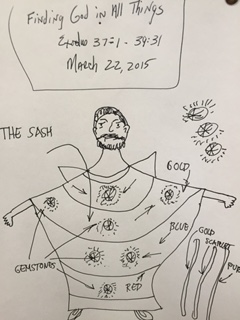
I was stunned, quickly swept up in such brilliant insight. We were in staff prayer time; I was standing by the bulletin board. A section of this board holds William’s drawings of various Bible stories. Lifting my eyes while listening to others pray, this particular composition’s title grabbed my attention. Carefully scribed on the page is a combination of both thought-provoking words and detailed sketch. His picture’s simple, crisp lines drew me to further consider the implications—both deeply theological and practically down-to-earth.

Our church has been on a faith @ work adventure over the past two years, deliberately seeking to engage with God’s view of our daily work. We are aiming to see more clearly how we join his mission in our daily tasks. We’ve been learning to break up the sacred-secular divide, to view and do our ordinary tasks as kingdom initiatives, and to appreciate our everyday workplaces as our primary mission fields. By his grace, we are beginning to see God in all things, even in the dusty and seemingly mundane.

Just last Sunday, we enjoyed hearing Dr. William Peel, the Executive Director of the Center for Faith & Work at LeTourneau University and co-author of Workplace Grace: Becoming a Spiritual Influence at Work.[1] During an extended interview, Peel shared one of his favorite practices for faith integration. “Ask the WIGD question each morning and throughout your day. What Is God Doing? What is God doing in and through my business today? What is God doing in this client or coworker’s life? What is God doing through these opportunities, and how might I join him?”

WorkplaceGraceCover

It should not have surprised me that William Faris’ artwork expresses kindred theoretical sentiments. He listens carefully in church services and his weekly Life Group study. His hands then skillfully join his mind, both working together to express what he sees. This particular drawing is simple yet poignantly intriguing. A bearded stick figure is draped in a strange-shaped gown, with unique décor embellishing the garb. William supplies a top-of-page biblical passage as the source of his inspiration: Exodus 37:1—39:31.

William Faris sketch

My suddenly curious yet cursory review of this Scripture validated my dusty recollection. Here is a description of the work performed by the ancient artisans of Hebrew sacred relics. Bezalel, Oholiab, and a team of craftsmen created the Ark of the Covenant, tabernacle furniture, and the priestly garments. Chapter 36 sets the stage: “the LORD has given skill and ability to know how to carry out all the work of constructing the sanctuary . . . to do the work just as the LORD has commanded.” I am deeply moved by this realization: such scriptural setting supplied inspiration for William’s own artwork, now thousands of years later.

I must confess the reason I am so stunned. William Faris faces a great personal challenge; he lives with a profound cognitive disability. Now in his fifties, William lives in Faith Friendship Villa, a couple miles from Manor Church. He faithfully attends worship services each weekend along with other residents. Willam and friends are vibrantly involved in their Life Group, led by people who are lovingly committed to working with individuals and families affected by disabilities. With such passionate work, this group regularly chooses to see God in all things.

William Faris

So, I am personally stirred by William’s artistic expression. Not only does he reflect theological savvy in his sketch; his own work remarkably reflects the image of his creative God and the extraordinary capabilities God has granted.

Drawn in by his work—both the sketch and the link to the biblical account—I am stirred afresh by the fact that it is God who gives skills and abilities to workers. William captures with loving stroke of pen on paper the old, old story. And he embodies with vibrant Spirit the very essence of such gifting. As William Peel reminded our crowd, we can see God at work daily in all things. WIGD? We see God at work through William Faris and his art.

And I am further captivated, swept up in this oh-so personal, yes, even convicting question: Am I personally integrating each day with such skillful sophistication—daring to see God at work in the “all things” of my own life—both in the old, old story, and in the current story of our lives?

[1]Bill Peel and Walt Larimore. Workplace Grace: Becoming a Spiritual Influence at Work. (Longview, TX: LeTourneau Press) 2014.

What Christ’s Finished Work Means for Our Life and Work

??????????????????????????????????????????????????????????????????????????????????????????????????????????????????????????????????????????

After five tedious hours of sanding and three coats of poly-finish, the vintage-1920’s, solid oak chair is restored. I lay my brush atop the can of urethane and step back to inspect. With a satisfied grin and a nod to the chair, I affirm: “This project is now finished.” It’s the culmination of both artful plans and hand-numbing toil. I smile. It’s now beautifully refinished!

On that bleak day at Golgotha, Christ cried out, “It is finished!” (John’s Gospel, 19:30) What did he mean? We might assume Christ was so profoundly exasperated that he was exclaiming, “It’s been agonizing, and now, it’s OVER!” Perhaps. But perhaps he meant even more. Throughout Christ’s time on earth, he worked. He worked hard. In Mark 6:3, people recognized him as the carpenter. A tekton engaged in hands-on work with wood and/or other sculpting and building materials. Prior to assuming his role as Rabbi-Miracle-Worker, Jesus plied the trade of his father, Joseph. With Christ’s baptism and inauguration of his kingdom initiatives, his Heavenly Father’s mission-business shifted into a next phase of implementation. Jesus taught crowds; he trained disciples; he touched the suffering; he transformed lives by his grace. In a real sense, his hands were still sculpting. Like most jobs, he had to work around the haters and cynics. On one such feisty occasion, he replied, “My Father is always at his work to this very day, and I too am working.” (John’s Gospel, 5:17)

????????????????????????????????????????????????????????????????????????????????

The language of Jesus’ cry from the cross was ripe with significance. Tetelestai. “It is now fully accomplished, totally completed. The plans have come to fruition. It’s paid in full. Redemption has fully arrived!”

How might Christ’s decisive cry, “It is finished!” impact our daily work?

We can affirm the value of long-term planning and implementation. Much of the Father’s work—and then his Son’s work—involved establishing and working out the ancient prophecies. Christ’s life work demonstrated marvelous fulfillment of those plans, culminating in extra-dynamic ways with the cross, resurrection, and ascension. Consider this: when we make strategic plans and work hard to implement them, we are more fully living out the image of God, matching his very character and transformative intentions for us.

We can infuse our daily work with his redemptive aims. Christ’s loud personal cry, tetelestai, declared the complete arrival of redemption. This should motivate us to make sure our own work keeps redemptive purposes in view. How does what I do today serve with humble sincerity, bless the mess, help reverse the curse, clear the confusion, and bring truly Good News to people who experience the bad news everyday? With both our daily actions and our daily words, we can share Christ’s hope-filled redemption.

We can work hard, relying on God’s grace. The Apostle Paul, after rehearsing the creed—Christ’s death, burial, and resurrection—insisted that he had worked harder than all the other apostles, “—yet not I, but the grace of God that was with me.” (1 Corinthians 15:10) In like fashion, it is the grace of God that confidently propels our own work today. We can fully trust him and praise him for such grace!

We can intentionally plan to finish strong. What does it take to finish strong in your life work? In their discussion of a strategy for entrepreneurs planning to finish well, Richard Goosen and R. Paul Stevens lend five insights: (1) Keep articulating your life goals, not just when you are young, but throughout life; (2) Constantly refresh your sense of calling; (3) Engage in an accountability group; (4) Practice thanksgiving day and night; and (5) plan on lifelong learning, blending study, work, and play all along the way.[1]

‘Ever wonder what Christ felt on certain days in the carpentry shop, especially when working on tough projects? How often did the skin on his hands get dry-cracked and calloused? What expression crossed his face when a splinter snagged him? And I wonder what words crossed his lips when he wrapped up an especially challenging piece? I have a hunch I know, and you probably do as well. After all, there was the day his hands held rough-hewn beams, and they felt the ugly work of nails. And on that day, Christ cried out, “It is finished!”

Take heart. His finished work and triumphant word supply all the grace we need to press on, work hard, and finish strong.

?????????????????????????????????????????????????????????????????????????????????????????

[1]Richard J. Goossen and R. Paul Stevens. Entrepreneurial Leadership: Finding Your Calling, Making a Difference. (Downers Grove: IVP Books, 2013) 176-179.

See Your Work through Better Lenses

?????????????????????????????????????????????????????????????????????????????

What do you see? Is your vision blurry?

Michelle gets up each morning to teach math at Donegal High School. Plenty of days, it could seem like exponential drudgery. Amid tedious numbers and grading ad nauseam, what might infuse her daily work with real joy and significance?

Andy works on broken-down automobiles every day, rain or shine. His tasks are greasy, grimy, and often knuckle-numbing. He’s a FORD guy at heart, but willingly turns wrenches on anything with wheels. In the past two years, he has curiously discovered fresh purpose and greater sense of personal mission.

Charlie designs and installs high-end video/audio in primarily commercial applications. In recent months, he’s been overheard saying: “We used to have a good business; now we have a seriously GREAT business.” Why such advancement?

Abigail is in her 20’s, a brilliant art student, passionately discovering how her crazy creativity and design flair might actually evoke God’s smile and express Christ’s own passion for recreating and redeeming.

Each of these hard-working leaders has very intentionally engaged in a next-level adventure during the past twelve to twenty-four months. They have embarked on the audacious quest to more fully integrate their faith and calling in Christ with their daily tasks.

They are each seeing and developing life vision with bolder clarity, utilizing some better lenses for discovery.

First, they are developing a bolder perspective that includes a serious theology of work. They’ve started to see God as the first creative Worker and each of us, made in his image, as coworkers, co-rulers and co-leaders over his creation. They are seeing a bigger vision of God’s redemptive plans to reclaim humans and all of creation—including our everyday work—as marvelously instrumental in His redemption story.

Each of these workers is also seeing more clearly with a second lens, a greater commitment to personal integration. Instead of viewing their daily life as split-up, compartmentalized between secular life and sacred life, they are learning to see life as WHOLE, gaining a more holistic integration of faith and work. With the opportunity to love God and neighbor with all they have, every action, decision, and conversation in ones’ workday can be and should be all to the glory of God. They’re finding they can truly BE the church Monday through Saturday, not just on Sundays. It’s WHY Christine was so instrumental in helping one of her clients, Robert, come to a renewed faith in Christ this Christmas season. It was such a joy to see him baptized in early February. Christine was taking her faith to work everyday and impacting Robert, and then bringing him along with other friends to church on Sundays. Robert was responsive to Christ, and Christine stood with him helping him as he publicly declared his faith in Christ at his baptism.

And that’s the third lens. It’s not only a theological lens and an integrated lens, but it’s an intentionally relational, missional lens. For people like Christine, as well as my friends, Kevin, Greg, Chuck, Barb—and others who are passionate about connecting—there is this growing perspective that their workplace is their primary mission field. With such clarity of vision, leaders say, “Yes, I am there each day to glorify God with extraordinarily excellent work, including superb products and services. AND I am there to build life-changing connections that can potentially change people’s eternal destinies.”

Michelle, my friend who teaches math, says this about her own vision now:

“I never realized that my workplace could be my mission field. I always felt that my work had meaning. I just did not realize the potential for mission that was surrounding me every day. Throughout this experience, I felt an amazing shift in my spirit. I started to see that I could be a positive role model for other professionals. I realized that my mood, attitude, and actions could influence others. I now look for ways that I can make a positive contribution to the world through my work—from the simple act of redirecting a negative conversation to discussing the Bible with a colleague. I feel more comfortable sharing my faith and being a positive example for others in my workplace.”

How about your vision at work? What do you see?

Vision—eye


Meet THE Business Game-Changer in Haiti

Savings Group—Meemos

Meemoos is a remarkable young woman, full of joy and creativity. She lives in Haiti, approximately two and a half hours southwest of Port-Au-Prince, and owns a Coca-Cola business. (Think classic, tall glass bottles in short wooden crates. ‘Thirsty yet?) Coke sales are common at roadside provision stands in Haiti, but Meemoos’ business is extra-unique. Hers is actually a small warehouse that serves as a wholesale distributorship, resourcing many of those roadside businesses.

Our team encountered Meemoos in a schoolyard in Cadiac. Each morning, she teaches a room full of grade school students. (Perhaps you are sensing—she is extremely energetic and hardworking.) As we interacted, we learned the game-changing key to the start of her Coca-Cola business. Yes, she gained funds through her teaching job, but normally, those resources would be ravenously gobbled up by the hungry Haitian economy. (78% of the population lives on less than $2 per day; there’s a 41% unemployment rate.) Meemoos told us that several years ago, she joined a savings group at her local church. That experience has been revolutionary.

Savings groups are a brilliant missional method of gathering people, both already-church-attenders and people from the community who do not yet know Christ. Groups are composed of 20-25 people who come together for Christ-centered teaching, with a focus on the gracious good news of discipleship, including biblical principles of finance. Each group meeting includes worship, teaching from God’s Word, and the actual WORK of the group as they save together. Such saving helps resource members with eventual loans that might be used for their children’s schooling, a motorcycle to ride to work, or supplies to build a house. For many individuals, the savings group can be THE game-changer in their ability to start their own business.

H3 hopehelphaiti pic

Along the way, such savings groups and business creation serve as a remarkable component in God’s mission. This is what Michael R. Baer dubs kingdom business. Baer clarifies: “In other words, it is directly involved in making disciples of all nations—beginning at home but with international involvement too. . . . To be a kingdom business there must be intentional connection to God’s eternal purposes in the world, a connection that will ultimately lead in some way to involvement in world missions.”[1]

Our church, Manor Church in Lancaster, PA, has the immense privilege of launching a brand new partnership with HOPE International in Haiti. Across 2015 through 2017, it is our prayerful aim that we might learn, grow, give, and ultimately partner in greater ways with God’s work in Haiti. For more info on the H3 adventure, a link to Sunday’s H3 message, and details on how you can engage, check out www.manorchurch.org.

One more amazing thing about Meemoos. Not only does she teach school and lead her Coca-Cola business. She is now the president of her local savings group, which meets weekly at her school. She is living out the core of her discipleship (Mark 1:14-20), focused on Jesus’ “fishing business,” and blessing more people. Meemoos personally experienced Christ’s hope, and now she’s expressing that hope to others.

Will you go buy a Coke today, pray deeply for Meemoos’ work, and also pray: “Lord, stretch me and use me, for your glory!”?

Coke bottle

[1]Michael R. Baer. Business as Mission: The Power of Business in the Kingdom of God. (Seattle: YWAM Publishing, 2006), 14.

>GREATER Things @ Work in ‘15!

?????????????????????????????????????????????????????????????????????????????????????????????????????????????????????????????????????????????????????????????????

Back to the daily grind—our first work days of January. Holiday euphoria has dimmed. Why do early December’s dazzling decorations seem so treasure-like, but the same items become pesky junk by early January? It’s SO hard to find the motivation; the boxes taunt us to be packed back in the attic. And there’s a strong probability that any intentions you had of crafting fresh resolutions or objectives have now drifted. Like so many people, you could just settle into a repeat of ’14’s same old, same old. Same outlook, attitudes, and modus operandi in your workplace. It’s easy to say, “Just hit REPLAY.”

How about discovering deeper and lasting motivation, prompting you to aspire to greater things in 2015? What might make the difference in your aspirations for 2015? Three methods can lift your intentions and lead you away from settling, to instead aspire to greater things:

First, seriously contemplate: How deep does this run? How much do I desire this and believe in this? Wisdom from habit-change gurus Prochaska, Norcross, and Diclemente is also applicable for new aspirations. They describe the necessary steps: contemplation, preparation, and then action. “In the contemplation stage, people acknowledge that they have a problem and begin to think seriously about solving it. . . . Most people in the preparation stage are planning to take action within the very next month . . . Action is the most obviously busy period, and the one that requires the greatest commitment of time and energy.”[1] Here is stand-out methodology, essential for achieving greater aspirations. Such preparation and action only come after serious personal contemplation. Ask yourself, “Am I passionate, deeply and desperately serious about embracing new attitudes and actions?”

Second, search your confidence source: Where is my confidence placed—whom am I trusting to pull this off? If you’re counting only on your own UMPH and sweat to achieve those new business goals, you might as well add them to the dusty pile of yesteryear’s best intentions, never achieved. The writer of the New Testament book of Hebrews proclaims Christ Jesus to be greater than any other life focus, philosophical ideology, supposed power source, or past religious paths. In fact, Jesus is the one who is “sustaining all things by his powerful word.” (Hebrews 1, verse 3) If we believe Christ is truly leading, overseeing and empowering in such great ways—and if we believe “all things” include our workplaces—we must aspire to greater things in the New Year! Why would we hold back, dream small dreams, or expect less?

Greater logo

Still wondering what your greater aspirations might include in the New Year? Try some of these ideas:

  • What will you aspire to read, to strengthen your heart and skills?
  • Whom or what group might you aim to serve?
  • Whom will you aspire to mentor?
  • Can you identify a new “garden” to plant, aiming for longer-term results?
  • How can you develop healthier habits in both body and soul?
  • How about a fresh creative dream to pursue? Can you dare to “color with brighter crayons?”
  • Will you dare to do something you know will be very difficult, because you know it’s worth the price?

Third, prayerfully plan: Make a sketch of your strategy for greatness. The old axiom still rings true: If you fail to plan, you plan to fail. Like most people, I’ve been a quitter on a stack of resolutions. But there have been several aspirations—praise God—that I have actually achieved. Each of my own “Yea, God!” success stories were indeed infused with deep passion, confidence in Christ’s power, but also a deliberate action-bias. Try these strategic approaches with each of your aspirations.

  • Keep your list of aspirations concise, ambitious yet achievable. Focus your energy on one, no more than three, new endeavors.
  • With each aim, identify at least three doable action steps you will take during January through March. Write down the action steps and give yourself a date for completion.
  • Prayerfully commit your plans to Christ each day. Ask him to guide, empower, and change your course where needed (that’s why it’s a sketch). And constantly pray that Jesus will be glorified in your new endeavor.
  • With each new aspiration, name and invite three to five other people to help you make this endeavor become a reality. Committing to others for encouragement and accountability is vitally important.
  • By mid-March, revisit your action steps and the list of people who make up your dream team. Revise your sketch strategy as needed.

Get ready. By January 15th, enthusiasm will be waning as you struggle with feelings of inefficiency. You may feel less-than-productive or even totally incompetent, still lacking the necessary knowledge, skill or ability to achieve those greater endeavors. Ed Silvoso winsomely reminds us: “If your job is your ministry, then God, who appointed you as a minister, has a supernatural empowerment for you to be able to do it His way.” By February 1st, you will consider scrapping your greater aspiration(s) altogether. Here’s why placing your confidence in Christ makes the deeper difference.

Silvoso challenges us: “Officially welcome the Lord Jesus into your workplace for His perfect efficiency to replace your own deficiency or insufficiency. Literally go to the front door, open it and say, ‘Welcome, Lord Jesus. Come in. I need you.”[2]

Remember, Christ is greater. He will sustain and empower you to aspire and achieve those greater things! Now gather your courage, and go put away those miserable Christmas decorations.

[1]James O. Prochaska, John C. Norcross, and Carlo C. Diclemente. Changing for Good: A Revolutionary Six-Stage Program for Overcoming Bad Habits and Moving You Life Positively Forward. (Collins: New York) 2006, pp. 41-44.

[2]Ed Silvoso. Anointed for Business: How to Use Your Influence in the Marketplace to Change the World. (Regal: Ventura) 2002, pp. 152-160.