
Featured

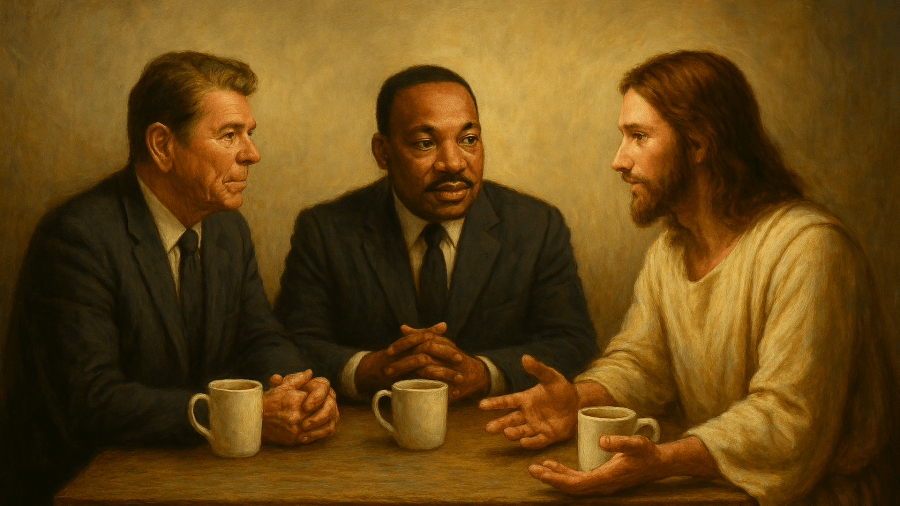
What if MLK, Reagan, and Jesus Conversed over Coffee?

By John Elton Pletcher

Explanation: This article was crafted using my imagination, wordsmithing, and discerning use of both ChapGPT and Copilot tools.

One evening, they sat round a simple wooden table, its surface worn smooth by years of use. No news media or audience of constituents—only a quiet room, mugs, and three men whose words had already traveled farther than their feet ever could.

Martin Luther King Jr. leaned forward, his hands folded, his voice carrying the familiar cadence of the pulpit. Ronald Reagan sat back, attentive, genial, a storyteller’s smile waiting at the corners of his mouth. Jesus of Nazareth, calm and unhurried, looked at them both as though he had all the time in the world. After all, wooden tables, careful words, and coffee beans had been Christ’s original inventions eons ago.

Theirs was a conversation crafted not of new declarations, but of old echoes—concepts drawn from sermons, speeches, parables, and letters that had shaped centuries.

On Power and Moral Law

King was first to break the silence.

“Power,” he said, “is not evil in itself. It becomes dangerous when it is divorced from love and justice.” It was a thought he had returned to often in his sermons: power at its best is love implementing the demands and opportunities of justice.

Reagan nodded. “I’ve always believed government should be strong enough to protect freedom, but humble enough to remember it exists because of the people,” he replied. The President was echoing his frequent warnings against centralized power and his faith in the moral capacity of individuals. “When power forgets its limits, it forgets its purpose.”

Jesus listened, then spoke softly. “You both speak of power as something to be restrained and directed,” he reflected. “I have said that the greatest among you must be a servant. Power that does not serve well—grounded in genuine love—always seeks to selfishly rule others.”

The room settled into that idea. King saw in it the backbone of nonviolent resistance. Reagan heard a reminder that authority without virtue corrodes from within.

On Freedom

Reagan took his turn. “Freedom is fragile. It’s never more than one generation away from extinction. It has to be defended—not just with strength, but with conviction.”

King answered without hesitation. “And freedom,” he said, “is not simply the absence of chains. It is the presence of dignity. A man is not free if he is humiliated by law or custom, even if no one is holding him down.”

Jesus traced a finger along the grain of the table. “You speak of freedom in the world,” he said. “And I speak of freedom of the heart. Human hearts need forgiveness. People may live under empire and yet be free; another may rule kingdoms and still be enslaved—to fear, to wealth, to hatred.”

Reagan smiled faintly. “That sounds like a warning against what happens when prosperity becomes the only measure.”

Jesus met his eyes. “It is a warning against forgetting what prosperity is intended to accomplish.”

On Love, Conflict, and Enemies

King’s voice grew more intense, though never harsh. “We cannot drive out darkness with darkness,” he said, drawing from the core of his philosophy. “Hate cannot defeat hate. Only love can do that. But love is not passive. It resists evil without becoming evil.”

Reagan considered this. “I spent a lifetime opposing systems I believed were wrong,” He was recalling his Cold War speeches about tyranny and freedom. “But I also believed people on the other side were still people. That’s why words matter. If you call your enemy a monster long enough, you forget they’re human.”

Jesus nodded. “Love your enemies,” he said simply, repeating a command that had confounded listeners for two millennia. “Not because they are right, but because love changes the one who gives it—and sometimes, the one who receives it.”

King smiled at that. “That’s the heart of nonviolence,” he said. “It seeks not to defeat or humiliate, but to awaken.”

On Hope and the Future

For a moment, the conversation turned quiet. Reagan took another sip of coffee, then spoke again, his tone lighter but no less serious.

“I’ve always been an optimist,” he said. Both King and Christ gave a knowing chuckle. “I believe tomorrow can be better than today, not because history guarantees it, but because people can choose it.”

King responded with familiar confidence. “The arc of the moral universe is long,” he said, “but it bends toward justice—because people bend it. Progress doesn’t roll in on the wheels of inevitability. It comes through sacrifice.”

Jesus smiled at them both. There was no urgency in his voice. “Hope,” he said, “is faith made visible in action. You plant seeds whose shade you may never sit under. That is enough.”

Leaving the Table

When they finally rose, nothing had been formally resolved. No manifesto was signed. No single philosophy had conquered the others.

But something had happened.

King carried with him a renewed assurance that love could confront power without surrendering to it. Reagan left with deeper conviction that freedom and forgiveness require moral grounding and bold courage.

And Jesus—unchanged yet ever present—left behind the reminder that words, when joined to humility and service, can outlive empires.

The table and mugs remained, empty now but not silent. Both were still echoing with ideas—about justice that loves, freedom that serves, and hope that acts.

How to Heal Our House Divided: Finding Hope in Lincoln’s Words and Jesus’ Way

By John Elton Pletcher

Sad irony abounds. Our United States stands at a critical juncture, mired in deep division and desperate political polarization. Heated elections are now the norm. We see loud town halls, gridlock on Capital Hill, and viral social media battles. Ideological chasms reach deeper and wider than ever, dividing families and whole communities. The fragmentation of American civic life appears both severe and personal. Today’s polarization is no longer born simply of policy differences, but increasingly stems from competing visions of truth, justice, and identity—both personal and tribal.

Our raucous season is not without precedent. America has faced frightening fault lines in our past. In fact, some of the most insightful guidance for our fractured age comes not from contemporary pundits but from two ancient sources: Abraham Lincoln’s Second Inaugural Address and the ethical teachings of Jesus of Nazareth.

Lincoln’s Moral Clarity Amid Civil War

Delivered on March 4, 1865, just weeks before the end of the Civil War and his assassination, Abraham Lincoln’s Second Inaugural Address is among the most profound speeches in American history. Rather than brag of the Union’s impending victory, Lincoln struck a tone of humility, sorrow, and reconciliation.

“With malice toward none, with charity for all, with firmness in the right as God gives us to see the right, let us strive on to finish the work we are in, to bind up the nation’s wounds…”
— Abraham Lincoln, Second Inaugural Address, 1865

Lincoln did not demonize the South. Instead, he acknowledged the nation’s shared complicity in the sin of slavery and framed the war as a divine reckoning. Both North and South shared guilt in the long-term evil of slavery. Amazingly, Lincoln resisted triumphalism and revenge. He called instead for compassion, moral introspection, and intentional work toward restortation.

This stands in stark contrast to today’s political climate, where victory often means vilifying the opposition and weaponizing past grievances. Too often, modern rhetoric doubles down on supposed ideological superiority and crowds out any shred of civic humility. Lincoln’s words model what mature political leadership can look like: compassionate, accountable, and future-oriented.

Jesus’ Divine Ethics: Radical Love and Reconciliation

Jesus of Nazareth, in his Sermon on the Mount (Matthew 5–7), taught a revolutionary moral framework. Remarkably divine, his ethic tipped conventional wisdom on its head. Perhaps, no teaching is more relevant—and more difficult—than this:

“Love your enemies and pray for those who persecute you, that you may be children of your Father in heaven.”
— Matthew 5:44–45, NIV

In a society divided by Rome’s imperial rule, ethnic tension, and sectarian violence, Jesus offered a truly radical, new way. Not violent resistance or passive acceptance, but active love. In our current political culture where opponents are frequently caricatured, even dehumanized, Jesus’ teaching seems almost impossible. But Jesus was not calling for naivete or a passive posture. Instead, he urged people to rise above vengeance and tribalism—to see others, even enemies, as bearers of divine image and worthy of great dignity. He called for mercy over judgment, reconciliation over retaliation, and humility over pride.

His teachings emphasize:

  • Peacemaking: “Blessed are the peacemakers…” (Matthew 5:9)
  • Self-examination: “First take the plank out of your own eye…” (Matthew 7:5)
  • Forgiveness: “Forgive, and you will be forgiven…” (Luke 6:37)

These principles challenge both our modern conservatism and pervasive progressivism, reminding us that moral authority does not come from power, but from love. In reality, Jesus’ teachings don’t align neatly with any present political ideology, but they do supply a higher standard for both public discourse and private conversations.

Comparison to the Current Political Climate

Today’s American politics often resembles a zero-sum game, where power must be won at all costs. When one side wins, the other must lose. Nuance is non-existent. Algorithms reward outrage. Tribal loyalty is prioritized over truth, and public discourse is poisoned by malice.

In such an environment, Lincoln’s and Jesus’ messages feel radical—even subversive. They offer a different kind of leadership—a devotedly virtuous one that does not avoid hard truth but pursues deeper reconciliation. Both call for:

  • Healing over scoring points
  • Humility over hubris
  • Service over self-interest
  • Unity over tribalism
  • Mercy over vengeance
  • Truth with grace

Whereas modern politics seeks victory, both Lincoln and Jesus sought healing. Both proclaimed a fundamental truth: genuine transformation starts in the human heart. Their approaches reflect a moral imagination that transcends opposing ideologies and predictable power plays. Political structures serve genuine purposes, but no amount of legislation can substitute for mercy, justice, and love enacted by ordinary people.

Pathways Forward: What Can Be Done?

While America’s polarization cannot be healed overnight, the combined moral vision of Lincoln and Jesus suggests a path forward.

1. Cultivate Humility

Like Lincoln, we must acknowledge our own blind spots and moral failings. As Jesus said, “Why do you look at the speck of sawdust in your brother’s eye…?” (Matthew 7:3). Loud proclamation of moral certainty, minus introspection, leads to arrogant self-righteousness and rarely real justice.

2. Pursue Reconciliation

Justice and reconciliation are not mutually exclusive. Lincoln didn’t ignore evil, but neither did he nurture hatred. Jesus’ command to “turn the other cheek” (Matthew 5:39) calls for dignity, not docility. Jesus’ call to love does not mean ignoring wrongdoing, but it does mean seeking resortation rather than malicious retribution.

3. Speak and Act with Charity

“Charity for all” includes listening—truly listening with empathy, assuming good intentions more often, and treating others with respect—even online. Let’s make “malice toward none” the national norm again. In both speech and policy, Americans must recover the lost art of charity—seeing political opponents not as enemies but as fellow citizens. After all, Lincoln’s examplary charity mirrors Jesus’ selfless, others-oriented, compassionate love. And lest we forget, true charity sent Christ all the way to the cross, giving his life graciously for the good of all.

4. Remember Our Shared Humanity

Even amidst disagreement, Lincoln reminded us of our shared national story. Jesus’ way reminds us of our shared divine image (Genesis 1:27) and our lasting call to love our neighbors (Matthew 22:34-40). Lincoln’s words and Jesus’ wise way supply tried and true concepts, ancient truths capable of tempering political hostility and catalyzing our unity once again. Most Americans, despite our differences, genuinely desire safety, opportunity, and dignity. If we focus on shared hopes instead of our division lines, we might rediscover our common, divinely-given purpose.

The question remains: Will we we dare to digest such hopeful truth and pursue hopeful healing?

Conclusion: A Hopeful Challenge

In this era of rife division, Americans are faced with a choice: continue down the road of resentment and polarization, or recover the moral vision that shaped some of the nation’s most enduring ideals.

Lincoln and Jesus do not offer easy answers. They offer something harder—and even better: the path of humility, charity, and sacrificial love.

It is not weakness to forgive. It is not naïve to seek peace. It is, as Lincoln said, the work of “binding up the nation’s wounds.” In that work, every citizen has a part to play in our healing together.

References

  1. Lincoln, A. (1865). Second Inaugural Address. The Avalon Project, Yale Law School. https://avalon.law.yale.edu/19th_century/lincoln2.asp
  2. The Holy Bible, New International Version. (2011). Zondervan.

About the Author

John Elton Pletcher writes and speaks about the dynamic intersection of faith, work, and culture. He is the author of Your Omni Year, Henry’s Glory, Henry’s Christmas, EmotiConversations, Joy & Thriving, and The Jesus You’re Searching For.

Featured

5 Ways to Pray this Easter Weekend

As we roll into the weekend, there is so much to anticipate!

Gatherings with friends and family (bring on the ham!). 

Scrambling to hunt eggs. 

Reflecting during a Good Friday service. 

And of course celebrating on Resurrection Sunday morning!

As you’re aiming to live in the flow of Jesus’ heart and loving mission, I bet you’re eager to focus your prayers. But how? How do we truly align our prayers with God’s heart on such a wondrous weekend?

I’ll suggest five sure-fire ways to engage in Jesus-like, others-oriented praying:

Pray for happiness.

People everywhere are saturated in grump and gloom. Let’s ask the Lord to supply from his deep well of joy this weekend. After all, we always say, “Merry Christmas!” And we say “Happy Easter!” Let’s give that kind sentiment some extra significance by praying with extra passion and purpose. We can ask Christ, who is the source of true happiness, to supply his abiding joy in lavish doses as we gather with others. Happiness is a wondrous common (or uncommon) grace, too oft in short supply. But it’s a grace Jesus will delight to gush our way from his overflow of joy. Let’s pray it’s truly a Happy Easter!

Pray for hope.

We can readily feel engulfed in negativity and cynicism. Circumstances dump regular doses of hopeless, death-like living. In big contrast, our King Jesus deals out serious hope. And so do we as his faithful followers. Call out for fresh perspective! Pray that we’ll fix our eyes with fresh vision—and for dozens of others to see and sense his transformative hope this Easter! Cry out for souls to be flooded with confident expectation of Jesus’ gracious good coming their way. The renewal of all things really is coming—because of his glorious resurrection. Really! 

Pray for healing.

Our neighbors, coworkers, family, (each and every one of us, if we’re honest) are banged up, scarred, bruised, and broken. We feel broken in our frail bodies; our minds get riddled with anxious thoughts; people everywhere feel overwhelmed. God’s sacred text reminds us in both testaments that the Messiah’s torturous wounds bring genuine healing in all the ways we so desperately need healed (Isaiah 53:5 and 1 Peter 2:24). Pray for healing!

Pray for help.

Too many precious people feel desperately lonely. There’s something extremely empowering when you learn someone’s truly in your corner, got your back, and standing with you in helpful solidarity. All that and more come people’s way when they trust the Risen King—and his helpful followers like you and me. The Holy Spirit, our Holy Helper, can rush in with his immense help. Let’s be praying that folks really sense they have such access to divine help!

Pray for hearts. Jesus’ Gospel is truly good news, through and through, true as true can be. After all, as Resurrected King, he is our wondrous hope, our help incarnate, and our deepest source of lasting happiness.

Let’s pray for hearts that are VERY receptive to the life-transforming good news. Boldly ask the Lord to stir hearts to say YES to Jesus’ merciful forgiveness, his gracious goodness, and his ultimate joy for now and all eternity!

Let’s pray! Let’s rejoice. And have a very Happy Easter!