By John Elton Pletcher
Explanation: This article was crafted using my imagination, wordsmithing, and discerning use of both ChapGPT and Copilot tools.
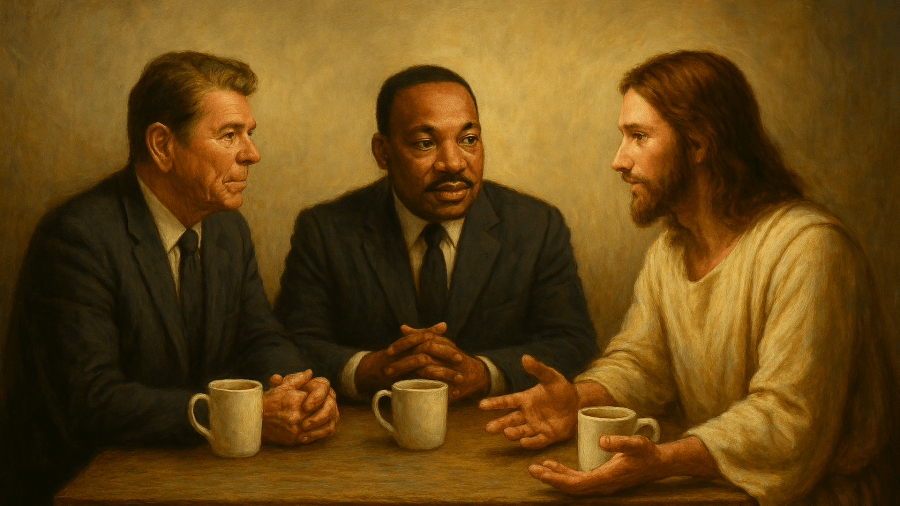
One evening, they sat round a simple wooden table, its surface worn smooth by years of use. No news media or audience of constituents—only a quiet room, mugs, and three men whose words had already traveled farther than their feet ever could.
Martin Luther King Jr. leaned forward, his hands folded, his voice carrying the familiar cadence of the pulpit. Ronald Reagan sat back, attentive, genial, a storyteller’s smile waiting at the corners of his mouth. Jesus of Nazareth, calm and unhurried, looked at them both as though he had all the time in the world. After all, wooden tables, careful words, and coffee beans had been Christ’s original inventions eons ago.
Theirs was a conversation crafted not of new declarations, but of old echoes—concepts drawn from sermons, speeches, parables, and letters that had shaped centuries.
On Power and Moral Law
King was first to break the silence.
“Power,” he said, “is not evil in itself. It becomes dangerous when it is divorced from love and justice.” It was a thought he had returned to often in his sermons: power at its best is love implementing the demands and opportunities of justice.
Reagan nodded. “I’ve always believed government should be strong enough to protect freedom, but humble enough to remember it exists because of the people,” he replied. The President was echoing his frequent warnings against centralized power and his faith in the moral capacity of individuals. “When power forgets its limits, it forgets its purpose.”
Jesus listened, then spoke softly. “You both speak of power as something to be restrained and directed,” he reflected. “I have said that the greatest among you must be a servant. Power that does not serve well—grounded in genuine love—always seeks to selfishly rule others.”
The room settled into that idea. King saw in it the backbone of nonviolent resistance. Reagan heard a reminder that authority without virtue corrodes from within.
On Freedom
Reagan took his turn. “Freedom is fragile. It’s never more than one generation away from extinction. It has to be defended—not just with strength, but with conviction.”
King answered without hesitation. “And freedom,” he said, “is not simply the absence of chains. It is the presence of dignity. A man is not free if he is humiliated by law or custom, even if no one is holding him down.”
Jesus traced a finger along the grain of the table. “You speak of freedom in the world,” he said. “And I speak of freedom of the heart. Human hearts need forgiveness. People may live under empire and yet be free; another may rule kingdoms and still be enslaved—to fear, to wealth, to hatred.”
Reagan smiled faintly. “That sounds like a warning against what happens when prosperity becomes the only measure.”
Jesus met his eyes. “It is a warning against forgetting what prosperity is intended to accomplish.”
On Love, Conflict, and Enemies
King’s voice grew more intense, though never harsh. “We cannot drive out darkness with darkness,” he said, drawing from the core of his philosophy. “Hate cannot defeat hate. Only love can do that. But love is not passive. It resists evil without becoming evil.”
Reagan considered this. “I spent a lifetime opposing systems I believed were wrong,” He was recalling his Cold War speeches about tyranny and freedom. “But I also believed people on the other side were still people. That’s why words matter. If you call your enemy a monster long enough, you forget they’re human.”
Jesus nodded. “Love your enemies,” he said simply, repeating a command that had confounded listeners for two millennia. “Not because they are right, but because love changes the one who gives it—and sometimes, the one who receives it.”
King smiled at that. “That’s the heart of nonviolence,” he said. “It seeks not to defeat or humiliate, but to awaken.”
On Hope and the Future
For a moment, the conversation turned quiet. Reagan took another sip of coffee, then spoke again, his tone lighter but no less serious.
“I’ve always been an optimist,” he said. Both King and Christ gave a knowing chuckle. “I believe tomorrow can be better than today, not because history guarantees it, but because people can choose it.”
King responded with familiar confidence. “The arc of the moral universe is long,” he said, “but it bends toward justice—because people bend it. Progress doesn’t roll in on the wheels of inevitability. It comes through sacrifice.”
Jesus smiled at them both. There was no urgency in his voice. “Hope,” he said, “is faith made visible in action. You plant seeds whose shade you may never sit under. That is enough.”
Leaving the Table
When they finally rose, nothing had been formally resolved. No manifesto was signed. No single philosophy had conquered the others.
But something had happened.
King carried with him a renewed assurance that love could confront power without surrendering to it. Reagan left with deeper conviction that freedom and forgiveness require moral grounding and bold courage.
And Jesus—unchanged yet ever present—left behind the reminder that words, when joined to humility and service, can outlive empires.
The table and mugs remained, empty now but not silent. Both were still echoing with ideas—about justice that loves, freedom that serves, and hope that acts.
 johneltonpletcher